Seiten

Sunday, 22 July 2012

Fiddler


An item posted on various networks on the world-wide-web shocked many people this week; Kenneth Dunlap had died.

The internet has changed – and goes on changing – our lives; creating realities unimaginable for our grandparents. One of the most enriching changes it has made for me is the boundless possibilities it offers for making contact and developing friendships with all kinds of fascinating people worldwide. In my case, this has had an emphasis on people interested in meeting for the purpose of presenting, developing, discussing and exchanging ideas; people engaged in what might best be called “the life of the mind.” It has been, and continues to be a rich and fascinating adventure – one in which I have made many contacts, more than a few of which have developed into genuine friendships.

Given my interests, it is therefore not surprising that – long before things like Facebook and Google+ – one of the first places I started to make real contacts was on a Google Group known as Minds Eye. A couple of years ago, a new contributor exploded into the group, posting extensively and intensely on all sorts of subjects, someone with an online/group identity known as Fiddler.

Minds Eye has always been a group of very diverse free spirits, with different views about everything under the sun, views which are staunchly presented and defended and, as such, achieving a consensus among those active there has always made the challenge of herding cats look like a piece of cake. But – unusually among the thousands of forums which evolved out of the old talk-rooms and Usenet groups – Minds Eye was characterised by an predominant atmosphere of … civility, coupled with an exceptionally high standard of erudition and discussion on all sorts of subjects; philosophical, theological, anthropological, political, cultural, etc.

Fiddler irritated, irritated massively. He had very definitive opinions on all the subjects about which he posted and he did not suffer fools gladly – and his definition of a fool would have encompassed anyone who took up an opinion contrary to his own. His passion for the positions he held often made it difficult for him to distinguish between the ideas of those he saw as his opponents and their persons, so that his argumentation often became seriously personal and ad hominem. It was on Minds Eye that I first encountered one of his favourite words for describing someone with whom he did not agree and whom he consequently regarded as being seriously deficient in reason; “fucktard.”

Some of those involved in the group regarded him simply as a troll and a few even suggested banning him. But many more of us sensed that there was real sincerity here, combined with intelligence and education, but also with anger and a tendency to flame. I, for one, tried to engage with Fiddler, attempting to point out that, for example, there were many sane, intelligent, rational people who sincerely believed in God and who could not all be simply dismissed as “fucktards.” Moreover, there were more (and usually better) ways to win a debate than to try to bludgeon your opponents into submission, using your arguments as a cudgel.

In the course of that discussion, Fiddler – or Ken, for that was his real name – revealed something more of himself; he had Asperger Syndrome. It explained a lot, particularly about his difficulties in relating “normally” with other people. He was well aware of this, though not particularly apologetic about it – in common with many other “Aspies,” he did not regard his condition as an affliction or illness, but rather as a different way of being; one which made his social relationships more complicated but which also had compensations in other areas. He described being able to “taste” numbers, for example, something which made mathematics a real source of joy for him.

In the end, Fiddler/Ken quit Minds Eye. It was a reaction he made, I believe, in something of a huff, as he had received some sharp rebukes for the way in which he had been addressing others and there had been renewed calls for his banning. But we soon met again, at various other online hangouts, like Gravity (which kind of went and died) and obnoxi.us (which is sadly also currently moribund) and we hooked up on Facebook and Google+. Ken joined that increasing network of virtual friends my burgeoning on-line life was producing, friends with whom you (just like in “real” life) sometimes have more, sometimes less interaction, but with whom you always keep up some kind of loose contact.

In the course of the last couple of years I learned quite a bit about him. He had lived, and continued to live, a chequered life, full of drama, conflicts and discontinuities. He grew up in an abusive family and had a sister who was murdered as a teenager. He had six children, from two different marriages. He had spent much of his youth in a religious fundamentalist setting but had abjured this in favour of a pretty muscular type of atheism. He had struggled with poverty for most of his life, but never let this stop him doing anything. He was a student, and passionate about learning – though his major area of study was geology, he was interested in almost everything.

For somebody with such innate difficulties in social relationships, there was something about him which seemed to fascinate people. I can only imagine how it must have been in real life, but over three and a half thousand people had him in their circles on Google+, a social network which he (inevitably) much preferred to Facebook. It was perhaps easier to be a friend to him on-line than it was in real life, for I have no doubt that Ken could be very strenuous. Even on-line he could be strenuous, but a computer you can always switch off.

I suspect that it was very hard to switch Ken off in real life. He was one of those people whose transmissions have one gear, full steam ahead, and whose brakes only work intermittently. But all that power, that energy, that rage which drove him, he channelled into a struggle for the rights of others, for the weak, the oppressed, any group or minority he perceived as being put down or persecuted by the forces of illiberality, intolerance, ignorance or small-mindedness. It got him practically involved in actions to free women in the Middle East who suffered under misogynistic forms of Islamic practice. And it frequently put him at loggerheads with the practices and values of Middle America.

Ken had a vision of what a free, pluralistic, caring and tolerant society could be like and it made him furiously, relentlessly rant against the present complex of hypocritical religious fundamentalism, heartless, profit-driven, corporate capitalism and anti-intellectual, petit-bourgouis jingoism he described – with his typical, savage wit – as Teathuglicanism. Though he was disappointed in Obama, he regarded the prospect of a President Romney with genuine horror, and his ascerbic, cutting commentary will be sadly missed in the coming months.

De mortuis nihil nisi bonum [Speak of the dead naught but good], they say, but Fiddler would have been contemptuous of this, also in respect of himself. De mortuis nihil nisi veritas [truth], I am certain, would have been much more to his liking. Truth, in that scientific, open, testing, questioning sense, was for him synonymous with the good and it was the lodestone of his life.

I can only speak of those truths about Ken which I know; his engagement for tolerance and liberalism (in its best, original sense), his championing of the rights of the weaker and those discriminated against, his campaigning for more social justice and a more caring society. The many other truths of his life – those which I sense or suspect, like the centrality of his love for his children in his whole being, are for others to tell, perhaps even today (July 22) when a service in celebration of his life will be held in Ferndale, Washington State.

Ken’s death was a shock to everyone. He had been seriously unwell in the past months and had found it hard to get adequate medical treatment, an indictment of the current American health system and something which is very difficult for a West European like myself, with our unquestioned systems of socialised medicine, to understand. But he also seemed down recently, feeling the weight of the seemingly constant struggle which was his life. Of course he carried his own, not insignificant share of responsibility for the many misfortunes to which he was prone, but he was also – at least in part – a victim of the callous, unfeeling harshness of the society in which he lived and, I feel, he deserved to live in that better world, the establishment of which he spent so much of his fury and energy for.

For those of us who knew him –  if only in the attenuated virtual world – he was a figure somehow larger than life, his struggles heroic, his difficulties epic. Thinking of him in the past few days, since hearing of his death, it strikes me that his character and story offers the stuff for a marvellous film, with Sean Penn, at best (for they share many characteristics), in the title role. But, for now, Fiddler is finally at peace. I will miss him, him and his outraged, idealistic fury. But I also feel honoured and lucky to have known him, even if only from a digital distance. Goodbye, my friend. Rage on.


The photos in this post are all from Ken's Google+ profile page

Friday, 6 July 2012

Travelling ...


The thunderstorms which swept through during the night had wakened me briefly, but they had left the summer morning air with a wonderful cleanly-washed feeling. The sun was shining and the pleasant fresh warmth promised to become close and muggy later but that didn’t worry me. By the time that later came, I’d be gone, flying nearly a thousand kilometres westward to Ireland.

The first stage of the journey was by rail; from my home town Remscheid to Düsseldorf, with a change of train in Solingen. The highlight of this is the crossing of the Müngsten Bridge, the highest steel railway bridge in Germany. Remscheid and Solingen are both built on hills, and you can see one town from the other, but they are divided by the deep valley of the river Wupper. You look 350 feet down from the train at the river, winding its way through a densely wooded canyon. A magnificent sight on this fine morning, with wisps of water vapour lazily writhing above the water. The bridge itself has a something of a sinister reputation locally as a popular attraction for desperate people, planning to end their own lives.

I change trains in the Solingen suburb of Ohligs. Like both the other two cities in the so-called Bergisch-Metropolitan-Triangle, Wuppertal and Remscheid, it is an amalgamation of various pre-existing smaller towns. Solingen is known as the “City of Blades” and has a tradition of steel and cutlery making going back for many hundreds of years, with an historical reputation comparable only with Sheffield and Toledo. Ohligs itself is on the border between the old Duchy of Berg and the Rhineland and has, if the truth be told, more a Rheinisch than a Bergisch character. Historically, the Rhinelanders have a reputation for being relaxed, laid-back and fun-loving, while the inhabitants of Berg are more frequently described as being dour, taciturn and serious. It is, perhaps, not entirely coincidental that the Reformation made a lot of ground in Berg, while the Rhineland remained largely (if generally unfervently) Catholic.

The journey from Remscheid to Dublin is one I’ve been doing three or four times annually for the past years, ever since my parents moved to Dublin. As the train moves smoothly towards Düsseldorf, I find myself thinking about how routine it’s become for me. I was twenty one years old before I flew for the first time; now it’s just part of my life. But the world has changed in the past thirty years.

The most basic defining fact about Ireland is that it is an island. This has always made it harder to get to or leave than countries with land borders. In my youth, the most common way to and from the country was the “boat” across the Irish Sea to Liverpool or Holyhead. I’ve taken the boat too, often enough in my youth, crossing England to take yet another boat to finally reach the continent, where the way generally continued by train.

I realise that it has been quite a few years since I took a long train journey. There’s something lost there, for I find rail travel more comfortable and relaxed than flying. You have more room, you can look out the window and watch the ever-changing variety of towns and countryside, you can get up and walk around. You’re more inclined to get into conversation with your fellow travellers – or perhaps I’ve just become older and more taciturn. But that loss of relaxation is what you exchange for that most highly rated modern commodity, time. To get from Remscheid to Dublin by train and boat would take a couple of days; the way I do it now, I travel from door to door (including all the waiting at airports) in less than six hours.

Though, even in terms of relaxation, I have nothing to complain about. I do this journey so often that I have long since personally optimised every phase of it and, from the moment I arrive at the first railway station, I have moved into a personal, time out mode. I know where to get tickets, which platforms to go to, where to check in, etc., and all this stuff runs semi-automatically. So I have the inner space to just enjoy the feeling of being on the move, without pressure.

My flight is from Düsseldorf International Airport, the third biggest in Germany after Frankfurt and Munich (though it will probably be relegated to fourth after the new single Berlin airport finally gets up and running next year). Düsseldorf, with a population of just under 600,000 isn’t one of Germany’s biggest cities, but it’s one of the most successful. There are various reasons for this, one of the most important being the decision by the western allies after the Second World War to make it the capital of Germany’s largest (by population) province of North Rhine-Westphalia.

Düsseldorf has an intensively competitive relationship with Cologne, just a few miles farther up the Rhine. Cologne is bigger and over a millennium older, having been founded by Agrippa, the faithful adjutant of the Emperor Augustus, while Düsseldorf isn’t mentioned historically until the Middle Ages. Cologners tend to regard Düsseldorfers as parvenu and claim that the insecurity resulting from this is the reason why the residents of their rival city are so concerned with status, fashion, and being “in.” Certainly, the Königsallee (popularly known as the “Kö”), the premier shopping street in Düsseldorf, would claim to compete with New York’s Fifth Avenue, or the Via Condotti in Rome, and you might be forgiven for a feeling of taking the tone of the place down if you find yourself driving down the in a car which isn’t a Porsche, a Mercedes, or a BMW.

Düsseldorf and Cologne both have their own varieties of beer. In Düsseldorf it’s a dark ale known as Alt, while in Cologne they brew a light, lager-type beer known as Kölsch. It’s more than your life is worth to try to order an Alt in Cologne, while the Düsseldorfers generally say that Kölsch is a liquid which passes unchanged – apart from the temperature – through the human body.

With its finely-tuned consciousness of chic, Düsseldorf is, inevitably, a major centre of culture, although here there is also a keen rivalry with Cologne. One of the city’s most successful cultural exports in the past thirty years is the cult band, Die Toten Hosen (literally “Dead Trousers,” the phrase being a slang expression meaning “nothing going on,” or “boring.”), who play a good-humoured form of punk rock, often with a healthy dollop of social criticism thrown in.

The airport is, thankfully, easily reached by rail. Thankfully, I say, because, in common with nearly all others, it costs an arm and a leg to leave your car there for anything more than an hour or two. The last stage of the journey involves a short trip on the Sky Train, a hanging monorail which takes you from the station right into the terminal building. This is large and airy, the result of a comprehensive rebuilding programme after a major fire there sixteen years ago, thus providing enough room to handle 20 million passengers a year.

Air travel, as I’ve already mentioned, has changed considerably in Europe in the past couple of decades. The key phrase is “low-cost flying.” Whereas thirty years ago flying still had a cachet of being a bit exclusive, it has now become affordable travel for the masses. Part of the philosophy behind this is the optimisation of every element of every element of the process and the reduction of the fundamental fact to its minimum, the flying from A to B. The basic flight price – on a route where the size of the planes and the frequency of flights have been carefully analysed to ensure that the vehicles are always well occupied – is kept as low as possible. Everything else costs extra; luggage, meals and drinks on the plane, choice of seats, often even personal checking-in. One of the most successful of the low-cost carriers is the Irish firm Ryanair, with its spectacular in-your-face Managing Director, Michael O’Leary (if you’re interested, you can watch him outlining the company’s philosophy here). Fortunately, I don’t have to travel with O’Leary’s firm, who are pretty ingenious at thinking up new methods to make you pay extra (they don’t fly from Düsseldorf, claiming that the landing charges there are too expensive) – as the pressure of competition with them has forced to Irish national carrier, Aer Lingus, to go low-cost too, so that I can generally get a return flight from Düsseldorf to Dublin for less than US $ 150.

“I used to think Genitalia was an airline until I discovered Aer Lingus,” some comedian once commented. Personally, I’d prefer sex to flying any time. To be truthful, I find flying both boring and frequently annoying, uselessly annoying. It starts with the security check. Even today, years after the ridiculous measure has been introduced, there still seem to be passengers who haven’t realised that you’re not allowed to carry liquids onto the plane. It doesn’t matter which queue I choose, I always seem to finish up behind the lady who wants to bring her shampoo, face-cleaning fluid and Chanel No. 5 in her hand-luggage and engages some bored, underpaid security worker, who only speaks broken German, in an interminable and increasingly bad-tempered discussion. Forget it lady, ditch your Chanel or get another flight!

But even in the world of proposed extra charges for using the aircraft toilets, Aer Lingus still retains some of its old charm. The flight attendants are always very friendly and helpful, and they still offer a warm traditional Irish breakfast, with sausages and rashers, black and white pudding, fried tomato, potato cake, brown bread and butter with orange juice, coffee or tea. It’s not free of course – though, on reflection, it never really was, after all, it was all part of the princely price you paid for your ticket – but at € 7.50 it’s still a bargain. As I usually take the morning flight, and only drink a cup (or two) of coffee before leaving home, it has become another ritual of mine whenever I take this flight.

An hour and a half after taking off, we land. And now, another aspect of low-cost flying really comes into its own for me. All the cheap carriers make you pay extra for checked-in luggage. I have become expert at travelling light, carrying everything I really need in my hand-baggage. And so, only ten minutes after the plane as stopped, I saunter past the people standing hypnotised at the baggage carousel, waiting seemingly forever for their bags to be spewed up out of the innards of the airport, down the green customs line and out of the airport. A little more than five hours after leaving home, I’ve arrived. Now there’s just the short bus and car trip to my parents’ place.

It would have taken me just as long to drive from home to Berlin or Munich – and would have cost me just as much. Funny old world, isn’t it?

This little piece from the Toten Hosen is a love song from an extremely jealous lover, who first offers to kill himself to prove his love ... and finally decides to kill both himself and his girlfriend.


Pictures retrieved from:

Wednesday, 27 June 2012

Schland: Football and National Identity


In the course of the current European football championship, the exclamation, “Schland, o Schland!” can be heard and read frequently here in Germany – most commonly as an exclamation of joy by generally younger people on Facebook – after the German team has scored or won a game.

The word Schland was invented six years ago by the German TV comedian and personality, Stefan Raab. Raab is a difficult phenomenon to explain to non-Germans. He’s like a cross between Jon Stewart (though without Stewart’s absolutely biting political side) and Conan O’Brien, and is immensely popular, particularly with people between fifteen and thirty five. From his beginnings as a clown with an MTV-clone in the early nineties, he has become involved in all kinds of media projects, including a number of attempts at the Eurovision Song Contest, which his protégée, Lena Meyer-Landrut, won with the song “Satellite” in 2010.

In the course of the World Cup in Germany in 2006, Raab coined Schland as an abbreviation for Deutschland, as spoken by a drunk. When Meyer-Landrut won the Eurovision four years later, a student group from Münster, who called themselves Uwu Lena, covered her song in a spoof version as a statement of national pride in the German team playing at that year’s World Cup in South Africa. They replaced Lena’s lyrics “Love, o Love,” with “Schland, o Schland,” and landed a surprise hit.

All right, so now I’ve presented you with a load of trivia about German pop culture and you’re starting to wonder about where I’m going with all this. Actually, I see it as exemplary for the development of a new kind of national identity in Germany – an identity of a new generation which has finally managed to liberate itself both from the abomination of megalomanic Nazi racism and the cringing, ashamed self-doubt of the post-war generations.

I’ve lived in Germany for over a quarter of a century now. In many respects I feel completely at home here, yet there is a part of me which clings to my essential Irishness, that part which refuses to apply for German citizenship (though I would be entitled to do so), that part which still chooses to see myself as an outsider, an observer of the culture in which I today probably feel more comfortable, if I am to be completely honest, than in the Ireland I left in my mid-twenties. It is a Germany which – in common with most Western European countries – is becoming ever more multi-racial and multi-cultural, even if this process is (also in common with most Western European countries) accompanied by persistent teething troubles. Certainly there are nationalities and cultures which contain significant proportions who have major problems with integration into modern western societies (particularly those with an Islamic component), but the statistics now claim that nearly a third of all those living in Germany today have a migrant background of some kind, and in many areas the majority of children being born have migrant roots. If you look at the German national football team currently competing in the European Championship, five of the eleven players at the beginning of each game up to now have had a migrant background of some kind.

I’m back to football again. And this is no accident, for – in a very strange way – football has been one of the major catalysts for the formation of this new German identity.

By football I mean, of course, soccer – in common with most of the world. Sport seems to be an area in which the USA travels a different road. America may cling to that strange ritual involving quarterbacks, line-outs, touchdowns and other incomprehensible terms surrounding what seems to be some arcane form of rugby; most of the rest of the globe regards it as a weird eccentricity. And as for baseball … well, there’s no accounting for tastes, I suppose.

For Germans, at any rate, football (soccer) is very definitely a part of the national soul, and an important one at that. It is a generally accepted fact that the Football God moves in mysterious ways which cannot be divined by his countless millions of worshippers worldwide, but, in the case of Germany, football has played a significant role in the history of a country trying to redefine its national identity in the wake of the indescribable catastrophe of Nazism.

In 1954, the German Federal Republic (then in its initial West German iteration) was in its infancy, and very much under probation. The decision to grant a generous peace, to allow a rebuilding of Germany was controversial; while the American line, championed above all by Secretary of State George Marshall, prevailed, there were many among the allies (especially in France) who would have preferred to see Germany permanently politically and economically annihilated. And most Germans themselves were deeply traumatised; after having followed the ghastly Nazi chimera for over twelve years, they were profoundly defeated, dazed with guilt, uncertain as to their capabilities regarding the future, insecure about their very identity. Millions had died, millions more been made homeless and turned into refugees, hundreds of thousands of young men had disappeared as prisoners-of-war into the Soviet gulags. Numb, they had started to tidy up the rubble and take refuge in two of their most familiar qualities, their ability to work hard and organise well. The result was the beginning of the Wirtschaftswunder, the Economic Miracle.

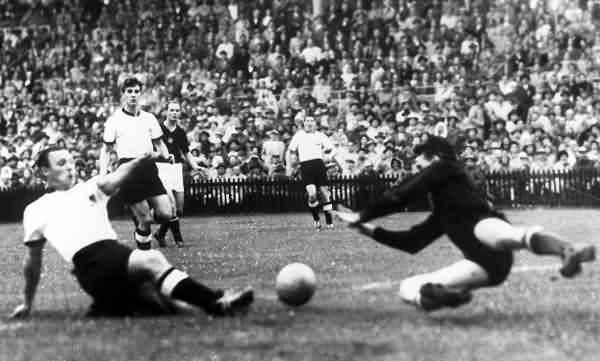
As part of the post-war normalisation, a German team travelled to the World Cup in Bern in 1954. Against all expectations, they reached the final and defeated the highly fancied Hungarians 3-2. The Miracle of Bern became one of the defining moments of the fragile new (West) German identity. Suddenly, nine years after the end of the war, it became possible to be momentarily proud to be German. In the midst of all the guilty confusion there was an instance where there was a collective feeling of national oneness, one that was allowed, legitimate. It was a signal that things could move on, that the past – while not forgotten, never to be forgotten – could perhaps be surmounted; that whatever it meant to be German need not be exclusively, definitively and eternally defined by jackboots and swastikas, by fanaticism and Auschwitz – by shame.

It was, of course, only football. But football can be a lot – a channel where national pride, competitiveness, the innate, almost crazy human impulse to prove one’s group/clan/tribe/nation to be and be recognised to be the best, the greatest, can be ritualised, played out and expressed in a way in which nobody is hurt, exploited, made homeless, enslaved or killed. In the words of Peter Gabriel, “games without frontiers, war without tears.” In 1954, balsam for the traumatised German soul.

Thirty-six years later, in a period of less than a year, the post-war European (and world) settlement, stabilised and set in a concrete balance of fear between two blocs was swept away. In a historically unprecedented peaceful revolution, the hegemony of the Soviet Empire in Eastern Europe had basically dissolved and even in the USSR the Soviet system was winding itself up. The most concrete symbol of the Iron Curtain, the Berlin Wall, had been torn down and the reunification of the divided Germany had been agreed and was in the last stages of preparation.

1990 was once more a World Cup year and in Rome West Germany, playing in their final tournament before the accession of the GDR to the federal union established by the western allies in their zones of control after the war, once more became the world champions. Those were months of euphoria in Europe, and especially in Germany, where anything seemed possible, where everything seemed positive. Germany winning the world cup appeared, as it happened, to be almost inevitable, the Football God for once in accord with all the other portents and tendencies of history. The icing on the cake, the unity of heaven and earth.

Yet 1990 also marked the end of an era. The World Cup of that year was the last major global event in which West Germany appeared as a separate entity. It was not only the GDR which disappeared; though formally the states making up the former territory of East Germany simply joined the already existing Federal Republic of Germany, in fact this accession factually also meant the end of that entity in which Germans had proved that they could be good European democrats, what German historians today are increasingly beginning to call the Bonn Republic. Seen from this aspect, the victory of the West German team in the 1990 World Cup can be regarded as a final accolade, a way of proclaiming to a brave new world, “Mission Accomplished!”

These brave new world moments tend not to last. In the euphoria of unification, the elder statesman, Willi Brandt proclaimed, “Now let what belongs together grow together!” That growing together has not always been an easy process, economically, socially, culturally, and it is by no means complete. But in 2006 an event occurred which became a moment of coalescence, when a new kind of German identity first expressed itself.

In the months before the World Cup began in Germany there was a lot of the usual public worrying about the whole affair. No nation or culture (except possibly the Jews – that itself some kind of statement about the complex, close, fateful relationship between these two cultures) is as good at public worrying as the Germans. The opening ceremony had to be completely cancelled because of a row. There were warnings about possible dangers for blacks and orientals in particular areas of the former East Germany, because of neo-Nazi gangs.

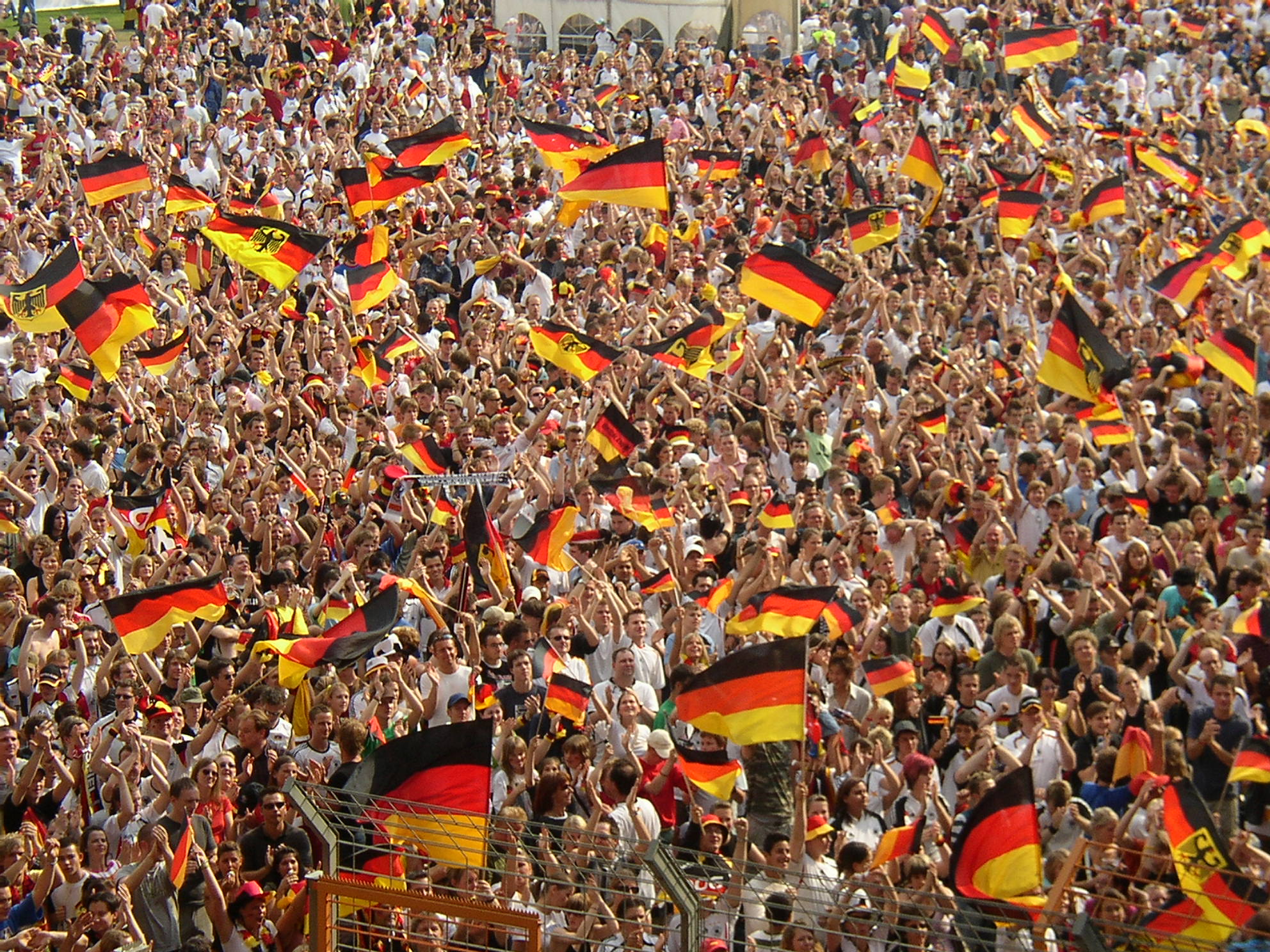
And then the competition started and a month-long spontaneous party broke out. For the first time since the war, Germans started waving their flags, decorating their cars and themselves in the national colours of black, red and gold, simply cheering the fact that they were German – just as the visitors from all over the world were cheering the fact that they were Italian, Portuguese, Brazilian, Australian. The German team reached the semi-finals, with every game being watched by literally millions in public viewings in the major squares of every German city. The event became known as the Sommermärchen, the Summer Fairy Tale.

The phenomenon has been repeated biannually ever since, whenever the European Championships or the World Cup take place. And it has become even more than just a celebration of being German; the other nationals resident in Germany also celebrate their identities and German towns become a multicoloured carpet of German, Italian, Spanish, Portuguese, Croatian and Turkish flags – with good-natured rivalry and ribbing between the various nationalities.

Sixty years after the end of the war, young Germans finally seem to have become comfortable with their own identity – and the vehicle they choose to express it is football.

They could do worse.

* * *

This is all, of course, a very particular view. It is true but it is not the whole truth, for reality is more complex. Nationalism, in all its expressions, has a dubious pedigree and is, arguably, the most destructive ideology the world has seen in the past two hundred years. And German economic nationalism is a major component in the current complex of financial and economic problems currently facing Europe.

In an ideal world, I would hope we could go beyond those bloody, sterile, exclusivist expressions of nationality which have so shaped and malformed the world in the past centuries, to a more inclusive, sharing vision of our common solidarity on this planet which so many of us share. More and more thinking Europeans are beginning to see these deeper questions as a positive possibility resulting from the current Euro debt crisis. (Angela Merkel, the current German chancellor, seems unfortunately completely ignorant of these deeper questions.) But the need to belong, to feel part of a nation, and to express that identity seems to be very deeply rooted in us – probably part of our primate hard-wiring. And, for as long as a deeper feeling of fundamental human solidarity remains in a (hopefully growing) state of development, I’m prepared to see those expressions of nationalism like the German one I’ve described here as basically positive. Better by far than pogroms, marching armies and terrorist bombs anyway.


Pictures retrieved from:


Saturday, 2 June 2012

The Debt Crisis


If there is one issue more than any other which has been exercising the public consciousness for the past four years, it has to be the question of debt.

From the bursting of the US property bubble, the collapse of Lehman Brothers, and the systemic threat of a global banking failure in 2008, through the first measures taken by many governments, individually and collectively, to try to head of that danger, to the current, deep-seated crisis in the Euro-zone, the theme of debt – public and private – has dominated world thinking, doings and commenting constantly, obsessively.

With serious consequences for millions; whether dispossessed hopeless home-owners in the USA, pensioners in Greece, or the more than half of the Spanish population between 18 and 30 who are currently unemployed. The “markets” are uneasy and, apparently, when “markets” are uneasy, the little people worldwide suffer.

I am reminded of nothing so much as the stereotypes of fearful, primitive, superstitious civilisations in bad adventure novels, where the natives, threatened with the outbreak of catastrophe, are convinced that they have become victims of the anger of the gods. Indeed, the analogy can be developed farther, for the general reaction of the natives in such pot-boilers is to offer ever more and ever more costly sacrifices to these angry gods, to try to propitiate them, before finally reaching the inevitable ghastly conclusion that nothing less than the sacrifice of their own children will serve to (possibly) appease the divine anger.

Substitute markets for gods in the previous paragraph and you get a description of the world of 2012.

In the past couple of months, I have intended many times to write something about this theme here. The reason I have not, up to now, is that I have a deep suspicion that most of the discussions being carried out on the subject are based on misrepresentations, subterfuges, and downright cynical lies. I am prepared to accept that many of those involved are sincere and genuinely believe the arguments they are making – but I am becoming more and more certain that most of those who really matter know that much of what they are saying is no more than platitudinous window-dressing and that they well recognise, at a deeper level, what it is really about … the retention, protection, and even expansion of power and wealth in the hands of those who have it, whatever the cost to those who do not have it.

Writing over 2,400 years ago, the famous Greek historian, Thucydides, records how the more powerful Athenians expressed their view of the world to the weaker Melians on demanding their surrender, “the strong do what they can and the weak suffer what they must.” Since then, despite all kinds of declarations of rights and facades of agreements and legality, very little has changed.

There is a conventional view of the current ongoing global crisis and, on the basis of this view, it’s fairly easy to describe what’s going on. For various reasons – to which nobody pays much attention now – speculative trading of finance products got out of control. The result was a bubble which burst, the crash of a few financial institutions and the threat of a crash in the whole banking sector in 2008. To avert this, most sovereign states intervened, providing billions of tax-payers’ money to prop up the banks and keep the whole system going (or at least limping). The new atmosphere of sobriety and financial rectitude focussed increased attention on the deficits and borrowing debts of those sovereign states – deficits which had had to be drastically increased to provide the money to prevent the banks from failing. The “markets” became increasingly nervous about the dependability of those sovereign debts, with the result that costs of servicing such debt rose steeply for a number of countries, thus putting ever more pressure on their “real” economies, which weakened their position even further in the eyes of the markets. A vicious circle.

This problem became particularly acute in Europe, where a large number of countries within the EU had adopted a common currency, the Euro, over a decade ago. The euro had brought considerable prosperity for its members – particularly those with strong export-based economies – by significantly simplifying trade, both between its members and with the wider world. But it also created a one-size-fits-all monetary situation for the member countries and the pressures caused by the financial crisis exacerbated hidden fault-lines enormously. Countries like Greece and Ireland could conceivably have eased their situation somewhat by currency devaluation, but such devaluation was not in the interest of other countries such as Finland, Luxemburg, Austria and, above all, Germany. Ireland, for example, could have let some of its banks fail and default, but, as these debts were practically all held in Wall Street, the City of London and Frankfurt thus potentially putting the powerful economies of the US, UK and Germany under pressure, this wasn’t allowed either. The Irish were told to unconditionally guarantee the debts of their – private – banks and the then Irish government, terrified at the prospect of being otherwise abandoned by its international “friends,” meekly complied.

For nearly three years now, the Euro-zone has been trying to deal with a situation in which the debt problems (which have different causes in each country) in Greece, Portugal, Ireland, Spain and Italy are putting the common currency under continual pressures of all kinds on the markets, thus exposing all the other member countries to major risk. All sorts of imagery is used to describe what’s going on, the most popular one being that taken from the language of illness – the threat of “contagion.” Or the other hoary old image, beloved of proponents of the Vietnam War nearly fifty years ago, the “domino theory.” A full-scale collapse in Greece, or Spain, or Italy, would serve to knock down the economies of all the other Euro-members, even the strongest, and rapidly lead to world-wide economic recession and ultimate collapse, the scale of which would make 2008 look like an insignificant blip on the line of global progress. Europe and the world are under threat of economic Armageddon and the only way to stave this off is to get the rampant sovereign debt problem somehow “under control.”

So there has been an ongoing series of frantic conferences, and bail-out measures, and stability mechanisms, and fiscal pacts, and injections of billions by the European Central Bank, etc., etc., etc. Three countries (Greece, Portugal and Ireland) have been put into a kind of international receivership and the domestic measures their partners (and the world in general, as represented by the IMF, which is one of the “receivers”) are demanding as conditions for their continual financial support, mean that their citizens – particularly their poorest citizens – are suffering badly. And the generally touted fear is that Spain or Italy could be next; in contrast to the three already hospitalised patients, economies “too large to fail.”

And still, despite all the measures taken so far, the mighty markets are still not impressed and the Euro members are divided on the question of what sacrificial offering might suffice to appease these gods and make them mild and gentle-mannered; even more austerity, measures to stimulate growth, Euro-bonds, the expulsion of Greece from the common currency …?

I am becoming increasingly convinced that all of this is just … pardon my French … bullshit.

I do not believe that it will be possible to solve the various problems besetting the global economy in any kind of enduring fashion using any of the various tools or mechanisms suggested, because the system is fundamentally broken. It has, in fact, been basically flawed all along, because it is based on axioms and assumptions which have no foundations, which have never applied, and which are nonetheless generally presented and accepted as being unquestionably true and self-evident.

Markets are natural and, in general, self-regulating.

The price of something is its value.

The basis of relations between people is one of exchange, with each party primarily pursuing his/her own (material) advantage.

Exchange usually makes everyone happy; everyone wins, nobody loses.

The fundamental principle of morality is that one should always pay one’s debts.

Our basic nature is one of lonely autonomy and our social relations and networks are secondary, conditional and ephemeral.

Everything is quantifiable.

Money “works” and can thus, somehow, increase itself.

Continuous growth is perpetually possible – even on a finite planet with, ultimately, limited resources.

These are the basic premises on which the so-called science of “economics” is based. They are all statements which can legitimately be challenged and, indeed, would be denied by most of us with respect to the way we live our everyday lives with families, loved ones, friends, neighbours, colleagues and communities.

How do you pay your debt to your parents, who gave you life and cared for you – not only materially – until you were able to stand on your own feet? How do you quantify kindness, or love, or beauty, or joy? Can you change your friends the way you change your socks? Is not a sincere “Thank You,” frequently a more than adequate payment for a favour/debt? Is monetary wealth really a measure of respect and regard? Do you always (or even usually) weigh up your own advantage before helping someone?

Yet, if economics – particularly the conventional economics upon which we seem to base our communal lives, as in my description of the current international debt crisis above – is an unquestionable science, then why does it not seem so easily applicable to our ordinary, real lives? It seems to me that there is a deep sort of schizophrenia present in the way we understand ourselves. If we really want to find solutions for the deep problems besetting our current global societies, I suspect this will only be possible if we find ways of surmounting this strange bifocal way of seeing things.

I am no utopian, no starry-eyed optimist. The current situation is the result of long, complicated processes, and concrete decisions will have very real effects on millions of people. Much as it might seem attractive, I don’t think we can just simply push some kind of “Reset” button. But I do see possibilities and potential for us, if we reflect on the way we see and understand things and are prepared to consider alternative ways of seeing and understanding them.

To admit, for example, that our various models of economic analysis may be deeply flawed and don’t provide us with an awful lot of good answers. To accept that economics, even as far as it goes, has very little basis in any of the basic moral principles which govern nearly everything we regard as important in our lives. To give this basic morality and decency the weight it deserves in our dealings, including our political and “business” dealings with each other, a weight far superior to simplistic “economic” considerations. To chose to do things, in the words of John F. Kennedy, “not because they are easy, but because they are hard.” But because they are truly worthwhile.

The questions I have been asking here crystallised, in part, for me after reading David Graeber’s Debt: The First Five Thousand Years. You don’t have to agree with all the author’s basic arguments to find this book compelling reading, but his analysis and the questions he asks will certainly open your mind to seeing things differently, above all, hopefully, to question the basic assumptions of the all-pervasive standard economics way of seeing things.

One final thought. The “Debt Crisis” can just as easily be called the “Credit Crisis.” The roots of the word credit are in the Latin word, credire, to believe. Credit is a basic fact of life, one of the fundamental things which keeps life going, on all sorts of levels. We believe each other, have faith in each other, trust each other, extend each other credit, in thousands of ways every day. Even on the level of conventional economics, trade, exchange, banking can only function at all on the basis of trust and faith. Yet, the whole world of the “markets” has abandoned this principle completely, and all those engaged in it seem to be operating on the principle that they are living in a vastly dangerous jungle, with every man’s hand raised against the other and where values like faith and trust are an immediate invitation to self-destruction. How sick is that?

It is no wonder, then, that the system is – possibly irrevocably – breaking down. Perhaps the first step forward would be to change our attitudes to all those involved in working in this area. Instead of admiring them as Masters of the Universe, or fearing them as powerful Priests in the Temple of the Gods of the Market, we should regard them with disdain and faint contempt; as sad and pitiable people, unfortunately condemned to work in an area where it is almost impossible for someone to work without losing their honour, their decency, and, ultimately, their basic humanity.


Pictures retrieved from:

[To all bloggers: Friends, you may have noticed an absence of comments from me recently on your sites. I have some kind of glitch in my Blogger account at the moment, which is making it impossible for me to leave comments. I actually can't even leave comments on my own site! Believe me, please, I'm not snubbing you. I hope to get around to doing something about it soon. Sorry!]

Saturday, 26 May 2012

1987 - A Very Good Year?


In her latest post, my fellow blogger, Lisa Golden, asks the question, “Imagine 1987 as the future and not the shrinking image in the rearview mirror. What do you see?”

At first I thought I’d do the usual thing and post a comment. But as I started thinking about it, I realised that the question was just too good for that. And then I discovered that I didn’t really want to imagine that year, a quarter of a century ago, as the future, but rather remember it as it was then. And, instead of replying on Lisa’s blog, writing something about it here.

Although, when I think about it, I suppose I can remember it as the future if I just place myself in the me that was then, seeing in the New Year for the first time in Western Germany, watching the fireworks rising into the sky above the Rhine and Cologne Cathedral illuminating a snowy city, wondering what the year would bring, still marvelling at the amazing new life I had begun, only a few months earlier, to lead.

For in the previous year, fuelled by the irresistible, all-devouring power of falling head over heels, completely, totally in love, I had trashed all the certainties and goals of my life up till then, abandoning my life and existence as a Catholic priest to start a new life in a new country. We had dared to take the words of Bowie’s Absolute Beginners (one of the big hits of 1986 and one of the songs we used as the soundtrack for the perfect microcosm of our dramatic love story) literally, “As long as we’re together / the rest can go to hell,” and set up our love-nest in Heidelberg. We were visiting the Rhineland where Eva’s family lived for the holidays, which was why we were greeting the New Year 1987 in Cologne.

At the beginning of any year, nothing is fixed. Anything can happen – and most certainly will. Billions of stories, great and small, public and private, will begin, end, continue. Out of all this we each construct our own realities, our own stories, future flowing into present before becoming immutable past before the background of everything else which is happening.

What was the background of 1987? Musically, Madonna is travelling the world with the Who’s That Girl tour, Michael Jackson releases the album Bad, Whitney Houston is warbling that she wants to dance with somebody (who loves her)[i] and the film Dirty Dancing will be released, turning Patrick Swayze into an idol for untold millions of adolescent girls even beyond his death twenty two years later. Joss Stone and Kate Nash are born. Liberace dies (of AIDS). And, for me as well as millions of others, the music which still fills the role as soundtrack for that year is that of U2’s The Joshua Tree; “With or Without You,” “I Still Haven’t Found What I’m Looking For,” “Where the Streets Have no Name.” Like me, they too came from Ireland, I had seen them live years before when they were still learning to play. They had achieved heights on the Olympus of rock previously unimaginable for an Irish band. A symbol for me that year of the attainability of all kinds of unimaginable dreams.

But a year which also taught me about how reality can bite. An immediate, fundamental change happens. The few months of just enjoying freedom from all the constraints of my previous priestly church-bound existence, a time of idle meditation on what I might best do with the rest of my life comes to a sudden end. On New Years Day Eva tells me of her suspicion that she is pregnant. I am faced with the immediate reality of having to take on responsibility – for a child, and a wife, for we also decide to marry. Life becomes challenging, in some ways even threatening. Less than a year earlier, Chernobyl has exploded, spewing radioactive waste all over Europe, and there are lingering worries about the consequences for women who are becoming pregnant. Unfounded, as it happens, for most (apart from thousands in the vicinity of the reactor in the Ukraine) but the worry is there. And I’ve got to find a job, any job. There will be mouths to feed, and bills to pay. I’m in a foreign country, my command of the language is rudimentary, and employers aren’t exactly lining up to offer interesting, fulfilling, well-paid jobs to young ex-priests. The little bit of money I had has almost run out. Eva’s family will help us, but the luxury of taking time to find and orient myself has abruptly run out for me.

Luckily, Heidelberg is a major centre for the US Forces in Europe and they’re always looking for civilian employees who can speak and write English fluently. As a native of a European Community country, I have the same employment rights as a German in Germany, so there is no trouble there. And so, in March I start work as a Voucher Examiner at the 266th Theater Finance Company of the US Army.

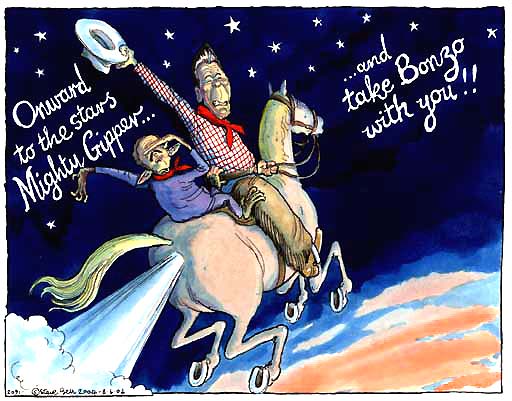
It is strange how practical circumstances can change your attitude to things. Three years earlier, back in Ireland, I’d been marching in a huge demonstration, proudly carrying a Sandinista flag, against US foreign policy and militarism generally on the occasion of Ronald Reagan’s visit to Dublin. Now I was working for the man, and glad to have the job.

The Cold War was still – officially – going on, and my job was processing a tiny amount of the tonnes of paperwork involved in paying the bills caused by the thousands of US servicemen and women who were in Europe to protect us from the Evil Soviet Empire. But the thaw was on. Gorbachev had come to power in the USSR and he was a man, as Margaret Thatcher famously said, with whom one could do business. Reagan came to Berlin in 1987 and urged Mr. Gorbachev to “tear down this wall,” but later that year the two of them amicably made history by signing the INF Treaty. In the near but as yet unimagined future the Wall would come down, the Soviet Union disappear, and in the wake of the huge realignment in world politics, most US and NATO troops would leave Germany. But in 1987 it was still business as usual in divided Germany.

The work itself was soul-destroying – taking a pile of paper which had already been worked on by someone else, doing some more work on it, and then passing it on to the next person to process it further. At some stage, a little farther down the line, the bills actually got paid. The work environment was fascinating. We were three distinct groups; soldiers, US civilian employees (mostly relatives of soldiers) and German/European employees. You got used to having two currencies in your pocket, for the Coke machine only functioned with quarters, nickels and dimes. The Americans were paid in dollars, we got our wages in deutschmarks. Our conditions and duties at work were governed by German labour law, the Americans followed army rules. They worked on German public holidays, we had to turn up on the Fourth of July. They paid less taxes, we could send our kids to college without it beggaring us.

I got to know an amazing world; that of the US forces in Germany – a little bit of America, completely sealed off (for those who wanted it so) from the host country. In places like Patrick Henry Village you could live for years, shopping at the Commissary or the PX Store, buying your (American) car from an American import dealer, going to an American movie theatre or McDonalds, sending your kids to an American school, worshipping in an American church, without any contact with the wider world around you. I worked with people who had been in Germany for ten years and had never learned a word of German.

The radio was on in our office all the time, and it was US stations we listened to. That year, the major theme was Oliver North and the Iran-Contra Affair (given increasing rumours of Reagan’s Alzheimer, one joke going around at the time took Howard Baker’s famous Watergate question and amended it to, “What did the president forget and when did he forget it?”).

But outside Thompson Barracks where I worked, my life was becoming increasingly German. My command of the language was slowly improving and I was making new friends. In the course of all this I was also making a discovery which astounded me. As an Irishman, I had grown up speaking English and I would always have claimed that, behind my particular Irish conscious identity, my default cultural conditioning was that of the English-speaking, American-dominated cultural world; literature, music, film, TV. Yet the more I worked for and with Americans, the more I found myself identifying myself as a European. On some sort of profound level I felt that I had more in common with the Germans, to whose country I had come less than a year earlier and whose language I still spoke very badly, than with the Americans, with whom I shared a language and whose popular culture I felt completely familiar with, and at home in.

In retrospect, it probably had much to do with the fact that, in that year of 1987, I was finding and developing a new identity for myself, an identity built on my exciting new role as lover and husband and – most fundamentally – father. A real one this time, as opposed to the pointless honorific conventionally offered to Catholic priests, something I had never felt comfortable with.

Many famous people died that year; Andy Warhol, Rita Hayworth, Fred Astaire, John Huston and James Baldwin, to mention just a few. And, on a wonderfully sunny August morning, the last of the top Nazi elite, the sole inhabitant of Spandau prison in East Berlin, the sad, evil old bastard, Rudolf Hess, ended his sorry life by his own hand. On that day my daughter was born and I remember thinking, in the midst of my swirling, astounded joy and wonder, that this was a sign of some kind, the end of one ghastly chapter and the beginning of a new one, full of hope and endless possibility.

On that day in August 1987 I knew that my life had changed irrevocably. The future was, as always, unknown, but now it would contain this marvellous new life, completely dependent on my wife and me. That she would be joined by a sister was something I might perhaps have suspected then. That the love which had made me toss my life on its head and give rise to her very existence would prove unequal to the everyday challenges of life and time was something I could not have imagined. Yet that happened too.

All in the future then, the past now. Time is a river and it only goes in one direction. What an adventure! Or, in one of the best phrases The Grateful Dead ever coined, “What a long, strange trip it’s been.”

1987 … it was a very good year.


[i] Coincidence is sometimes frightening. The radio is playing in the background as I write this. Thirty seconds after typing this phrase, I hear the introduction to I wanna dance with somebody (who loves me) begin. Honestly! Life is strange indeed.


Pictures retrieved from:

Friday, 18 May 2012

Holiday Fragments


Regular readers of this blog will have noticed an almost three week long hiatus. The reason for this was simple; I had holidays and had decided, as far as possible, to take a break from everything, including writing.

While it is possible to take a break and even recharge one’s personal batteries while staying at home, in common with most people I find this easier to do if I travel, go somewhere else. The tyranny of regular routine, post and telephone and things that – apparently – have to be done is strong, and the only way to really switch it off (at least in my case) is to just go somewhere else and leave it all behind. And so, for the last week of my time off work, together with my daughter and grandson, I spent a week on the Turkish Aegean coast – back to the same village we enjoyed so much last year.

It was a week I spent – by and large successfully – not thinking about things, living in and relishing the succession of pleasant moments. Switching off is not something that comes easily to me, though I know that it does me good and I would be better off if I could do it more often. Now that I am back in the normal routine of life, I find that my impressions and memories of the week solidify around fragments, particular thoughts, incidents and observations around which the rest of that week, so different from the norm, accretes.

I. Airplane behaviour; Cause and Effect
It takes nearly three hours to fly from Cologne to Izmir and we did it in the middle of the night, arriving into the balmy warmth of the Eastern Mediterranean early in the morning. As the plane came to a halt, I observed with my customary bemusement the behaviour of most of my fellow travellers. The moment the plane stopped moving, the majority of them immediately jumped out of their seats, rummaged in the overhead bins for their hand luggage and then spent five minutes standing in the aisles, impatiently waiting for the umbilical corridor to connect with the cabin door, for okays to be given from both sides so that that that door can finally be opened and the process of debarkation can begin. As always, I refused to let myself become infected by what I have always considered to be an unthinking, senseless herd instinct. With a feeling of bored, tired superiority I regarded their pointless, uncomfortable anticipation. Getting out of the plane as quickly as possible does nothing whatsoever to speed up the process of getting out of the airport; after all, we’re all going to spend at least ten minutes (if we’re lucky!), having gone through the immigration process, waiting for our bags and suitcases to be finally spit out of the entrails of the airport onto the baggage carousel.

And then, prompted perhaps those strange twists of consciousness caused by an acute lack of sleep, I had a strange idea, maybe even a mad insight. What if the course of events composing the debarkation process is in fact different to what I have always thought? Could it be that those five minutes of impatient jostling in the aisle of the aeroplane do in fact have a purpose? Maybe the standing and waiting is a necessary part of the procedure of debarkation. Without the signal given by the passengers that they are willing and eager to leave the plane perhaps the corridor would never dock with the plane, the doors remain forever closed.

The door of our plane finally opened and we were able to continue on our way to our holiday. Thanks to the passengers, whose standing up had given those responsible the signal that they could let us out of the plane?  Maybe I should be grateful to them.

II. You Can’t do That with a Kindle!
I might have consciously decided to voluntarily cut myself off from the internet for my week in Club Atlantis, but that didn’t mean I had joined the digital Luddites – far from it. Instead of packing my suitcase with kilos of books to make sure that I didn’t run out of stuff to read (the idea of being on holiday without something to read is something I don’t even want to imagine), this time I brought my Kindle. With Suzanne Collins’ Hunger Games trilogy and the last three books of Stephen King’s Dark Tower series   I was confident that I had more than enough material to see me through the week.

It’s still relatively early in the year and we were blessed with a location directly on the Aegean coast (the beach around 200 metres from our chalet) with a wonderfully refreshing sea breeze, but the weather was warm and the odd mosquito was already buzzing around. They weren’t generally a problem, as our chalet was equipped with both mosquito netting on the windows and air conditioning. But despite all this, one evening, a couple of days after our arrival, a lone mosquito found its way into our rooms. Luckily, Lara and I heard the whine of his flight and spotted him before he managed to draw any blood.

Now I’m a fairly tolerant kind of guy, but that tolerance comes to a quick end when I’m threatened by these little bloodsuckers. If they would leave me alone, I’d leave them alone too, but my particular variety of blood seems to make me an irresistible target for the winged bastards. So I’m prepared to strike first, strike hard, and f*** the damage to my karma. I had only one problem. What was I going to kill it with?

Lara and I looked at the Kindle in my hand and the old-fashioned paperback in hers. She marked her page, handed me the book and, with one well-aimed swing, I mashed the little bugger onto the wall.

Lara grinned at me, “You can’t do that with a Kindle!”

III The Obsessions of Little Boys
One of the pleasures of this holiday – though occasionally accompanied by an inevitable soupcon of chaos and stress J – was the chance to spend a week with my five-year-old grandson. It was an opportunity to observe at close quarters a world I left so long ago, that of a little boy. As I don’t have sons, the distance is one of nearly fifty years.

For over a year now, one of the most important figures in Ryan’s life is a certain Lightning McQueen. The anthropomorphic automotive hero of the Disney Cars is a frequent topic of conversation and, apart from the films on DVD, he also has a large number of model cars, T-shirts, sandals, a jacket, pyjamas, a bath towel, and heaven knows what else, all sporting motives and images from the films.

Three little boys meet at the hotel swimming pool:

“Wow! He’s got models of Lightning and Mater.”

“Cool!”

I’ve got Finn McMissile in my room. You push the boot and two machine guns pop up out of the bonnet. You want to see it?”

“Yeah!”

“Okay, I’ll bring it with me this evening when we come to dinner. Maybe we can play Cars there …”

“Cool!”

Boys! When I think about it, in fifteen years time the only thing that will have changed is that the cars are real.

I’m holding forth on the subject of perfidious Disney, the corporation’s eagerness to exploit the images which fascinate children by marketing everything imaginable and thus pull millions and millions out of the pockets of all those who have anything to do with kids, pestered and nagged into buying all these products with which those kids are confronted at every turn.

As I’m really getting into my stride, a recollection surfaces from my magpie-like memory, a recollection nearly half a century old. I’m six years old, writing a letter to Santa Claus. My biggest wish for Christmas is a model of the amazing car driven by my favourite TV character – the Batmobile.

The marketing may have become more pervasive, the range of products expanded, but otherwise, how much has really changed?

At any rate, I have seen some signs that Lightning McQueen may be facing a new rival. His new swimming-togs, proudly worn every day at the pool, featured Smiling Stan Lee’s most famous creation … Spider-man.

* * *

All too soon the holidays are over and I’m back in my normal routine. Spidey has taken off his costume and returned to his real identity of Peter Parker. And although I won’t deny that there was a slight touch of resentment in my feelings as I returned to work yesterday, at the same time I know that continuous holidays would quickly pall. It is the fact that they are an exception, a time away from the normal, the routine which them so special, so precious. Peter Parker is the norm, Spider-man the exception. Though personally, I prefer taking a few weeks in the sun to spending my “exceptional” time as a superhero rescuing the world. That would be far too strenuous and, as Spider-man frequently finds out, you don’t even get much thanks for it as a rule.


Pictures retrieved from:

LinkWithin

Related Posts Plugin for WordPress, Blogger...