Seiten

Showing posts with label Germany. Show all posts

Sunday, 30 September 2012

Michael Schumacher and the (Male) German Psyche


The news spread like a brushfire through the German media on Friday morning: Mercedes had fired their legendary Formula One driver, Michael Schumacher. Well, to be completely accurate, the reports were that they would not be renewing his contract beyond the end of this season, which amounts to more or less the same thing. Therefore the chances are good that, at the age of forty three, Schumacher will be retiring for the second time from the first division of motor racing – this time for good.

So what? Another overpaid top sportsman finally quits. Like Michael Jordan, Zinedine Zidane, Carl Lewis, David Beckham, and all the others. They entertained and were idolised by hundreds of millions, earned hundreds of millions and then rode off into the sunset, turning up occasionally as experts or “celebrities” on TV, their doings (particularly if there was even a whiff of scandal about them) being breathlessly reported in illustrated magazines and the more sensationalist of newspapers and (increasingly) web-sites. Big deal.

And the same is largely true of Schumacher. In 2010, one source estimated his net worth at around 830 million US dollars. That was the year he came back to Formula One after three years in retirement, Mercedes reportedly paying him around 30 million US$ annually to do so (not including what he earns from endorsements).

The argument often made with regards to the insane amounts earned by top sportsmen is that – in terms of returns – they are actually worth it, earning through their success much larger sums (through sponsorships, advertising value, TV-rights – especially TV-rights) for those who are actually paying them their millions. The irony about Schumacher is that success has eluded him and his Mercedes paymasters for the past three years; the best he has achieved in that period is one third place in a Grand Prix. 90 million dollars plus for that kind of performance? Nice work, if you can get it.

But maybe I shouldn’t be so small minded. Formula One is a global business where the millions are simply sloshing around, and Bernie Ecclestone, the geriatric Andy Warhol lookalike who actually owns the whole circus, is much richer than Schumacher. Economically rising and wannabe prestige-hungry countries like India, Russia, Turkey and Bahrain (to mention but a few) are all spending millions on purpose-built circuits just to attract this circus for an annual visit. They are also prepared – according to most reports – to pay Mr. Ecclestone handsomely for the privilege. And if there are human-rights or other such issues (as, most famously, in Bahrain recently), well, that kind of thing doesn’t really bother Bernie. Sport is sport and politics is politics and, hey folks, the show must go on. Bernie has been known to express some rather strange political views (about not everything being old Adolf’s fault, for instance) but then, there may be the onset of some slight senility here. His comrade in arms for much of his career, Max Mosley (boss of the FIA, the sporting body responsible for Fomula One), had the dubious distinction of being the son of the old British fascist, Sir Oswald Mosley – but then, we can’t choose our parents, can we?

Schumacher – to be fair to him – doesn’t really seem to be driven by greed; not as much as many of the others involved in his business/sport at any rate. He is quite a generous philanthropist, most famously donating $ 10 million in the wake of the Indian Ocean Tsunami/Earthquake of 2004. On the other hand, he moved his main residence from Germany to Switzerland, apparently for tax purposes. But then, a reluctance to pay taxes on their massive earnings in their native countries is a characteristic he shares with many of his racing colleagues, quite a few of whom prefer Monte Carlo as their place of residence. And from the beginning of his career up to a few years ago he was managed by the notorious, larger-than-life Willi Weber, a German impresario with a tendency to occasionally questionable business practices and a sharp eye for the best deal in every conceivable situation. Weber discovered the young Schumacher, gambling on his talent and bankrolling his entrance into Formula One in 1991 in return for a fifth of all Schumacher’s earnings for the next ten years, thus gaining him the nickname “Mr. Twenty Percent.” That deal gave Weber a powerful incentive to maximally market his client in every conceivable way, and he was diligent indeed.

No, no, no! I could easily carry on in this vein for the rest of the essay, the slightly supercilious tone of the university-educated, left-leaning, eco-conscious, culture-vulture, politically-correct intellectual I suppose I am, doing the usual condescending deconstruction of one of the favourite sports of the shallow, media-conned masses. This kind of thing practically writes itself. I could sneer about all the things that irritate me about Michael Schumacher, particularly his deification by so many ordinary German men, the kind who read the Bild newspaper, pin up Playboy centrefolds in their places of work, wash their cars every Saturday, go to Majorca with their mates from the bowling-club for a long weekend of boozing and tail-chasing every year, and dream of driving expensive cars with three-pointed stars or blue and white badges. Let me try another approach …

Benz Patent Motorwagen 1885
Germans have a particular fascination with motor cars. Although there were many people working on the concept of the “horseless carriage” in the second half of the 19th Century, it is generally agreed that the inventor of the automobile was the German Karl Benz, who took out a patent for it in 1886. Many of the other significant names working in the area were also German, Gottlieb Daimler and Rudolf Diesel, for instance. So from the very beginning there has been a deep connection between Germans and the automobile, something they themselves are well conscious of, frequently calling the car “des Deutschen liebstes Kind / the German’s favourite child.”

The argument I am developing here may be contradicted by many Americans, who can justifiably mention the central role the automobile has played in American consciousness for a hundred years, referring to Buicks and Chevrolets, Pontiacs and Chryslers and pointing out that Henry Ford was mass-producing Model Ts decades before Adolf Hitler ordered Ferdinand Porsche to design a “Peoples’ Car” / Volkswagen. And there is, of course, much truth in this.

However, I would contend that the essential difference between Americans and Germans in this regard is that the American fascination is fundamentally that with the road, while the German obsession is with the car itself. Both have to do with mobility, of course, but the meme of the road, as central to the understanding of the American psyche, goes far beyond the means of transportation to encompass all sorts of themes like freedom, frontier, adventure, leaving it all behind, a whole way of life and consciousness. The German preoccupation with the car has more to do with the object itself; its possibilities, its design, its engineering, speed and comfort. The car as a symbol of … status, power, even freedom.

For many Germans, the car itself quickly becomes an object of obsession, almost a fetish. While the dusty, battered pick-up is one of the cultural icons of a particular American rugged identity, the idea of driving a dirty, dinged car is almost physically painful to most German motorists. The following ad, highlighting one of the differences between the French and the Germans, illustrates the point I am trying to make very well:


For the typical German male, his car is one of his most treasured possessions. It is carefully looked after, regularly serviced, the smallest defect is immediately taken care of, and it is washed, waxed and polished regularly (traditionally on Saturdays, though for environmental reasons the private washing of cars is today generally prohibited). Even the smallest, most insignificant scrape between two cars will, in Germany, immediately lead to the police being called (so that questions of liability can be cleared up immediately, in case of possible dispute), where everywhere else people are quite happy to simply exchange insurance numbers. Though in many respects I have become completely “Germanised” after twenty six years in this country, in this case I am, and will remain, obstinately foreign; I regard an automobile as nothing more than a comfortable means of conveyance from A to B and still do not understand why nearly all modern cars are sold with bumpers painted the same colour as the rest of the vehicle.

While I don’t want to get into sexism or genderism here, I think it is generally accepted that an interest in the “mechanics” of things is more prevalent among the male of the species. Combine this with a fascination for speed, and a strong competitive instinct (also more typical masculine preoccupations) and you start to understand the seemingly mindless pleasure men derive from watching cars driving at speed around in circles, or – even better – driving them themselves.

Almost uniquely, the Germans – normally so uptight and controlling about things – actually allow everyone with a driving licence the possibility to live this out to an extent. On the German Autobahns there is no speed-limit, so that you can actually personally check out the top speed specifications the manufacturer claims for your car. Of course, large parts of the motorways do have speed limits for all sorts of safety reasons, but there are also enough long straight stretches where you can really let it rip. Despite a general acceptance of all sorts of “green” consciousness by Germans, none of the major political parties (with the obvious exception of the Greens) are prepared to put general Autobahn speed-limits into their programmes – it’s an absolute vote killer. And let me tell you, there is something viscerally very satisfying about driving at well over a hundred miles an hour, your concentration completely on what you are doing – and fuck the fact that you’re burning twenty per cent more fuel than you would be by driving more sedately. Need for speed, yeah!

But, of course, to do this at the really top speeds possible, in competition with others, demands a level of skills very few of us have, a willingness to risk one’s life continually in order to win, and the kind of motorised technology beyond the financial possibilities of most of us. Hence motor racing.

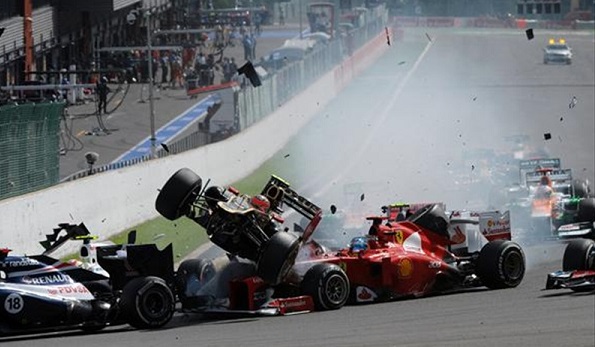
And then there’s that other thing, the thing we don’t like to admit to, that deeper truth which comes from that more savage, dark, primitive part of our nature. The thing that set our ancestors howling on the stands of the Roman gladiatorial arenas, hissing at medieval beheadings, or heretic or witch burnings, looking on with grim, self-righteous approval at 19th Century public hangings. That part of us which isn’t just appreciating the speed of the competitors, their skills in overtaking opponents, the clever strategy of a pit-stop judged just right. The cruel, bloodthirsty part of us which is just waiting for – to be honest, hoping for – the crash. Wreckage and maybe even blood and body parts flying all over the place. Burn, baby, burn!

Ok, so what about Schumacher? Get on with it!

A combination of circumstances can sometimes give rise to a situation where a figure of general public interest may become something more than this; an avatar of the hopes and aspirations of a whole group or nation. The most complete and perfect way to this kind of transformation comes through sudden, usually (though not always) violent death. Examples of this kind of apotheosis are Elvis, John Lennon and, of course, Princess Diana. But it happens to the living too, like a kind of aura which comes over them and lets them shine in an almost inhuman way for particular groups, nations or transnational groups for a while. It happened to Bob Dylan in the early sixties, and the Beatles soon after that. Muhammad Ali was one, so was Michael Jordan. Bob Marley (already before his death in his native Jamaica, after it worldwide).

During the 1990s Michael Schumacher’s popularity grew steadily in his native Germany, particularly after he won the World Championships in 1994 and 1995. In the 1996 season he moved to Ferrari and over the next few years worked with the Italian team to establish the combination of the best driver in the best car in Formula One. The result was an unprecedented period from 2000 to 2004, when Schumacher was World Champion for five years in a row.

This was the period when Schumacher became immortal for his German fans and an icon of the hopes and dreams of millions of German men. Ordinary men, what you might call “blue-collar” men.

At the end of the last century, many of the traditional self-defining characteristics of the ordinary German blue-collar male were coming under pressure. The increasing mainstream acceptance of much of the feminist agenda had much to do with this (as in the rest of the developed world), but there were also other, specifically German factors. The economic and social pressures caused by reunification were starting to make themselves felt, as were the effects of increasing globalisation. Immigrants were making up an ever more visible part of the human landscape.

The old social consensus of the Bonner Republik was in flux, the model according to which anyone prepared to work hard would find a job, be able to live a decent live with a modicum of comfort with his family and look forward to a happy old age, backed up by a secure contributory state pension. Tax money was flowing in billions into the former GDR, leaving less for the old West Germany, semi-skilled jobs were melting away, wandering into Eastern Europe or Asia where wage-costs were much lower. The old, relaxed, certain world of the work place was coming more under the turbo pressure of performance maximisation and targets, rationalisation, increased continual training and expertise requirements. Brain trumped brawn everywhere and it was the young business graduates with their suits and computers who seemed to be taking control of everything.

But against all this, there was Schumi, the kid from an ordinary working-class family, without privilege and attitude (or even much formal education), who wouldn’t even had had enough money and influence to break into the elite super-rich world of Formula One, despite his talent, if Willi Weber hadn’t financed him. But he did break into it and showed the world what an ordinary German man, possessing the characteristics of an ordinary German man, the ability to work hard, be dependable, and know motors, could do. He was the typical kid next door and allowed the fantasy that – had Lady Luck just tossed the dice a little differently – you or me could have done this as well. After all, every German man is secretly convinced that he too is an excellent driver. Not to deny, of course, that Unser Michael / our Michael is supremely talented, a consummate sportsman, and deserves every million he earns.

Unser Michael. For a particular segment of Germans, Schumacher became an embodiment of Everyman, a universal figure of identification. Even in the name the connection was there, the Deutscher Michel being a personified representation of ordinary Germanness, like John Bull or Joe Bloggs in the UK, or Joe Sixpack in the USA. All of this cannily encouraged by Weber’s comprehensive marketing and the fact that RTL, the most popular private TV channel in Germany and one whose strategy was to broadcast programmes for the “ordinary” German with a large dollop of naked tits, sensationalist reporting, Jerry Springer-like talk shows, and docu-soaps, had the franchise for Formula One. And it was this identification which turned Schumi into a figure of adulation; important enough to get millions of German men up before 6.00 a.m. on a Sunday morning to watch him race live in the Australian or Japanese Grand Prix. And win.

Such avatar phenomena are finite. Dylan gradually lost his after his controversial decision to go electric and Schumacher’s slowly faded after his (first) retirement in late 2006. The comeback was always going to be a risky business – of all such icons, Muhammad Ali was the only one who can be said to have managed it, and Ali was a special case because his retirement was forced at such a young age. And (dare I say it?) because his whole personality and character are exceptional in a way that Schumacher’s are not.

Of course, all this could just be pseudo-intellectual bullshit and Michael Schumacher may still really be the latest incarnation of Jesus Christ. Whatever, I still don’t like the lantern-jawed bastard!


Pictures retrieved from:

(Comments: I'll be away for the next few days and my internet presence may be sporadic, so don't worry if it takes some time for your comments to appear.)

Tuesday, 11 September 2012

Dada wouldn't buy me a Bauhaus


It was a post by my blogger friend Gina about the Dada movement which got me thinking about a number of different cultural/artistic movements in the first third of the last century. I have nothing like Gina’s deep understanding and expertise in the whole area of art – a comprehension which always leads me to visit her Pagan Sphinx site with a delicious combination of anticipation and admiration – so it is with some trepidation that I dare to put my toe into this particular pond. And it is because I am intensely aware of my limited understanding in this area that I will endeavour to take a more historical approach here, an attempt to consider particular “artistic” schools or movements within the broader context of general societal and cultural developments, a stage (without meaning to be presumptuous) on which I feel more comfortable.

Moreover, it is probably inevitable that I further limit this essay (in the particular consideration of two artistic movements) to a largely German, or at least Central European in a somewhat wider sense, perspective, given that I have been living in Germany for the past quarter century and feel marginally more secure on this ground than on a wider one, encompassing a wider European, or even global perspective.

After all that the 20th Century subsequently brought, it is difficult for us today to fully realise how massive the cataclysmic shock the First World War was to the consciousness of those who experienced or were affected by it. In the more than forty years since the Franco-Prussian War, which saw the humiliation of France and the formation of the German Kaiserreich, the general atmosphere had been one of continual, apparently boundless progress. Indeed, despite some discrete, largely local upheavals, such as the revolutions of 1848, many would have regarded this period of progress as going back almost a hundred years, to the post-Napoleonic settlement of 1815. At any rate, the general mood of the world was one of optimism. Things just seemed to be getting so much better all the time; from Edison’s electric light bulb to those magnificent men in their flying machines, from motor cars and modern armaments to the spread of the benefits of civilization all over the world through enlightened European Empire and the spread of US manifest destiny from sea to shining sea. And if that meant the killing of millions of savage negroes in Leopoldian Congo, or the annihilation of the cultures and lives of the Plains Indians, well, those were just the inevitable results of Darwinist survival of the fittest and the unavoidable collateral damage of the spread of superior and more powerful cultures, nations and races.

Admittedly, the situation between the five major European powers (France, Great Britain, Germany, Austria-Hungary and Russia) was continually tense. But that had been the case for over forty years now and dealing with that continual tension was what professional diplomats were for. For decades they had moderated and orchestrated the complex, dangerous game of chicken the great powers continually played with each other, dancing defiantly to the edge of confrontation and war, threatening, feinting, pulling back, brokering new compromises with new promises of future confrontations and gains. The Tangier Crisis, the Bulgarian Crisis, The Agadir Crisis, etc., etc., etc.; then all as significant as the Bay of Pigs, the Cuban Missiles or the Prague Spring were to the Cold War generations, now forgotten except to professional historians.

The world of the early 20th Century culture was already much too complex to be encapsulated by the description of any one “movement.” An additional problem arises because the general cultural flavour of the time is generally classified as Modernism, a catch-all term which tends to describe everything by defining nothing and which, as generally used, is extended to include and go beyond WWI. But – generalising and simplifying enormously – pre-war Modernism was still characterised by an optimistic view of progress, despite deeper questions of meaning and sense raised by thinkers like Schopenhauer, Nietzsche or Kierkegaard, the abandonment of conventional form by the early Cubists, or Einstein’s demolition of the classical Newtonian universe with his Special Theory of Relativity (1905). The avant-garde might be challenging progressive Realism on the cultural edges; for the mainstream such challenges were generally seen as dilettantish.

And then in Summer 1914, in the wake of the assassination of the Archduke Franz-Ferdinand in Sarajevo, the diplomats finally dropped the ball and Europe collapsed into conflagration. Although propagandist jingoism, confidently predicting victory by Christmas, was generally believed on all sides, it was the British Foreign Secretary, SirEdward Grey, whose prescience in August 1914 turned out to be truly prophetic; “The lamps are going out all over Europe. We shall not see them lit again in our time.”


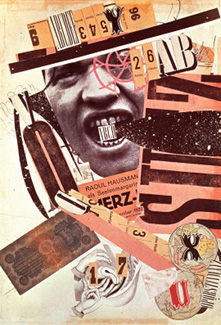
Raoul Hausmann ABCD (Self-portrait) Photomontage, 1923-24
In the German dominated cultural area of Central Europe, two artistic reactions to the incomprehensible carnage and destruction of the Great War emerged. At the Cabaret Voltaire in Zürich, a group of artists, many of them German exiles, were in 1916 the origin of a movement which came to be known as Dada. Dada was deliberately, almost despairingly provocative, one of the original group, Hans Richter, even describing it as “anti-art.” In retrospect it can be seen as an attempt to express the sensation of horror and loss of meaning and all moral foundation, all structure even, resulting from the experience of the war. Despite other possible etymologies, I personally prefer the explanation of the word “dada” as an expression of ultimate meaningless glossolalia. Dadadadadadadadadadada… But in German the word carries further connotations. Da in German means there. Dada is a kind of despairing showing, a pointing at the hopelessly shattered fragments of meaning, of decency, of sense; the rubble of everything governed and destroyed by the prevailing world order, acted out in the hopeless carnage of the trenches. There! And there! And there! And there! … Seen against this background, the frequent use of collage by Dada inspired artists takes on extra significance.


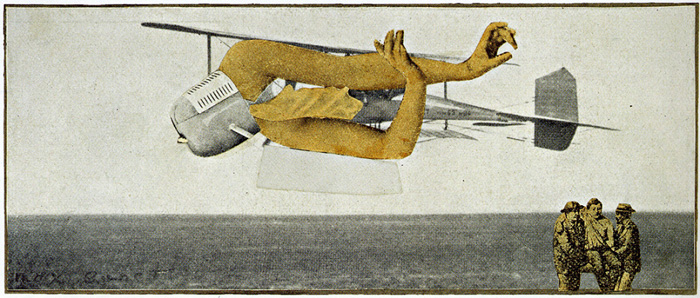
Max Ernst, Murdering Airplane, 1920
Dada was chaotic, unorganised, anarchic; it couldn’t be anything else. It was an outpouring of enraged creativity, not confined to art alone, but also finding expression in workshops and absurdist literature, like the writings of Kurt Schwitters (a good example is Anna Blume). As such it quickly surpassed itself; many of those who identified with it, such as Max Ernst, developing themselves further in Surrealism, which, at least partly, grew out of Dada.


Bauhaus building in Chemnitz
The Bauhaus movement also emerged as a reaction to the experience of the Great War, but took a very different direction – a new attempt to find meaning and order, to learn from the horrors of the war, to find an integrated approach to the individual and his/her place in society so that all the suffering would not have been in vain. The emphasis on form and structure is inevitable, given that Bauhaus was initially and primarily an architectural and design movement. Though its first leader, Walter Gropius, was non-political, many of those involved were left-leaning. Bauhaus was, by its own definition, radical: “The underlying idea of the Bauhaus, which was formulated by Walter Gropius, was to create a new unity of crafts, art and technology. The intention was to offer the right environment for the realisation of the Gesamtkunstwerk (total work of art). To this end, promising artists were to be taught in a school with an interdisciplinary and international orientation.”

Paul Klee, The Twittering Machine, 1922
Gropius and his successors, Hannes Meyer and Ludwig Mies van der Rohe, were at pains to involve various artists and craftsmen in the realisation of their concept and both Paul Klee and Wassily Kandinsky taught for years at the Bauhaus School in its successive homes at Weimar, Dessau and Berlin. Piet Mondrian, not unexpectedly, also lectured there. Identifying itself with the wider Modernist movement, the Bauhaus emphasised simplicity and functionality – an architectural and design expression of the “form follows function” aphorism, while not abandoning at any point a striving for aesthetic excellence. The interaction between art and design is well exemplified by Kandinsky, who taught both basic design for beginners as well as advanced theory at the Bauhaus during a period in which he himself was intensely exploring geometrical elements and relations in his own work.

The basic philosophy of the Bauhaus was humanist, egalitarian; it envisaged a cooperative equality of skilled workers, artists, artisans and architects, a democratisation of art, a demystification of design. This had political, revolutionary aspects, and there were many committed Marxists at the Bauhaus. But even without them, the whole direction of the movement was deeply suspicious to other, darker forces.

Ludwig Mies van der Rohe, The Brno Chair (1929-30)
On January 30 1933, Adolf Hitler became Chancellor of Germany. The Bauhaus was soon wound up, and in the following years most of its talent left the country. As did many of those who had been involved in Dada. For, although their reactions to the brutal lunacy of the First World War were in many respects antithetical, the attitude of the New Vandals who had taken control of Germany to them was essentially the same. According to the Nazis, both schools propagated entartete Kunst [degenerate art] and as such were subjected to bannings, persecution of those artists who had not left the Reich, and the destruction of some of their works.

Nonetheless, their legacies survived. The anarchic freedom, the celebration of apparent meaninglessness expressed by Dada bubbles up repeatedly ever since, exerting its spell on figures and movements as diverse as Josef Beuys, Ken Kesey and the Merry Pranksters, Malcolm McClaren and punk. The Bauhaus left a lasting influence on modern architecture ever since, as well as all sorts of areas of design. Just think about Scandinavian furniture – even that IKEA bookshelf you’ve got in your study. And, looking at the works of Andy Warhol, I like to think one can see the inspiration of both movements.

Note on the Title: Much as I would like to claim it as original, honesty forces me to admit that I first heard the phrase over twenty five years ago from my old friend, the philosopher Paul O’Grady, of Trinity College, Dublin.

The walrus was Paul
Pictures retrieved from: 
First image: Hannah Höch, Cut with the Dada Kitchen Knife through the last Weimar Beer Belly, 1919


Friday, 6 July 2012

Travelling ...


The thunderstorms which swept through during the night had wakened me briefly, but they had left the summer morning air with a wonderful cleanly-washed feeling. The sun was shining and the pleasant fresh warmth promised to become close and muggy later but that didn’t worry me. By the time that later came, I’d be gone, flying nearly a thousand kilometres westward to Ireland.

The first stage of the journey was by rail; from my home town Remscheid to Düsseldorf, with a change of train in Solingen. The highlight of this is the crossing of the Müngsten Bridge, the highest steel railway bridge in Germany. Remscheid and Solingen are both built on hills, and you can see one town from the other, but they are divided by the deep valley of the river Wupper. You look 350 feet down from the train at the river, winding its way through a densely wooded canyon. A magnificent sight on this fine morning, with wisps of water vapour lazily writhing above the water. The bridge itself has a something of a sinister reputation locally as a popular attraction for desperate people, planning to end their own lives.

I change trains in the Solingen suburb of Ohligs. Like both the other two cities in the so-called Bergisch-Metropolitan-Triangle, Wuppertal and Remscheid, it is an amalgamation of various pre-existing smaller towns. Solingen is known as the “City of Blades” and has a tradition of steel and cutlery making going back for many hundreds of years, with an historical reputation comparable only with Sheffield and Toledo. Ohligs itself is on the border between the old Duchy of Berg and the Rhineland and has, if the truth be told, more a Rheinisch than a Bergisch character. Historically, the Rhinelanders have a reputation for being relaxed, laid-back and fun-loving, while the inhabitants of Berg are more frequently described as being dour, taciturn and serious. It is, perhaps, not entirely coincidental that the Reformation made a lot of ground in Berg, while the Rhineland remained largely (if generally unfervently) Catholic.

The journey from Remscheid to Dublin is one I’ve been doing three or four times annually for the past years, ever since my parents moved to Dublin. As the train moves smoothly towards Düsseldorf, I find myself thinking about how routine it’s become for me. I was twenty one years old before I flew for the first time; now it’s just part of my life. But the world has changed in the past thirty years.

The most basic defining fact about Ireland is that it is an island. This has always made it harder to get to or leave than countries with land borders. In my youth, the most common way to and from the country was the “boat” across the Irish Sea to Liverpool or Holyhead. I’ve taken the boat too, often enough in my youth, crossing England to take yet another boat to finally reach the continent, where the way generally continued by train.

I realise that it has been quite a few years since I took a long train journey. There’s something lost there, for I find rail travel more comfortable and relaxed than flying. You have more room, you can look out the window and watch the ever-changing variety of towns and countryside, you can get up and walk around. You’re more inclined to get into conversation with your fellow travellers – or perhaps I’ve just become older and more taciturn. But that loss of relaxation is what you exchange for that most highly rated modern commodity, time. To get from Remscheid to Dublin by train and boat would take a couple of days; the way I do it now, I travel from door to door (including all the waiting at airports) in less than six hours.

Though, even in terms of relaxation, I have nothing to complain about. I do this journey so often that I have long since personally optimised every phase of it and, from the moment I arrive at the first railway station, I have moved into a personal, time out mode. I know where to get tickets, which platforms to go to, where to check in, etc., and all this stuff runs semi-automatically. So I have the inner space to just enjoy the feeling of being on the move, without pressure.

My flight is from Düsseldorf International Airport, the third biggest in Germany after Frankfurt and Munich (though it will probably be relegated to fourth after the new single Berlin airport finally gets up and running next year). Düsseldorf, with a population of just under 600,000 isn’t one of Germany’s biggest cities, but it’s one of the most successful. There are various reasons for this, one of the most important being the decision by the western allies after the Second World War to make it the capital of Germany’s largest (by population) province of North Rhine-Westphalia.

Düsseldorf has an intensively competitive relationship with Cologne, just a few miles farther up the Rhine. Cologne is bigger and over a millennium older, having been founded by Agrippa, the faithful adjutant of the Emperor Augustus, while Düsseldorf isn’t mentioned historically until the Middle Ages. Cologners tend to regard Düsseldorfers as parvenu and claim that the insecurity resulting from this is the reason why the residents of their rival city are so concerned with status, fashion, and being “in.” Certainly, the Königsallee (popularly known as the “Kö”), the premier shopping street in Düsseldorf, would claim to compete with New York’s Fifth Avenue, or the Via Condotti in Rome, and you might be forgiven for a feeling of taking the tone of the place down if you find yourself driving down the Kö in a car which isn’t a Porsche, a Mercedes, or a BMW.

Düsseldorf and Cologne both have their own varieties of beer. In Düsseldorf it’s a dark ale known as Alt, while in Cologne they brew a light, lager-type beer known as Kölsch. It’s more than your life is worth to try to order an Alt in Cologne, while the Düsseldorfers generally say that Kölsch is a liquid which passes unchanged – apart from the temperature – through the human body.

With its finely-tuned consciousness of chic, Düsseldorf is, inevitably, a major centre of culture, although here there is also a keen rivalry with Cologne. One of the city’s most successful cultural exports in the past thirty years is the cult band, Die Toten Hosen (literally “Dead Trousers,” the phrase being a slang expression meaning “nothing going on,” or “boring.”), who play a good-humoured form of punk rock, often with a healthy dollop of social criticism thrown in.

The airport is, thankfully, easily reached by rail. Thankfully, I say, because, in common with nearly all others, it costs an arm and a leg to leave your car there for anything more than an hour or two. The last stage of the journey involves a short trip on the Sky Train, a hanging monorail which takes you from the station right into the terminal building. This is large and airy, the result of a comprehensive rebuilding programme after a major fire there sixteen years ago, thus providing enough room to handle 20 million passengers a year.

Air travel, as I’ve already mentioned, has changed considerably in Europe in the past couple of decades. The key phrase is “low-cost flying.” Whereas thirty years ago flying still had a cachet of being a bit exclusive, it has now become affordable travel for the masses. Part of the philosophy behind this is the optimisation of every element of every element of the process and the reduction of the fundamental fact to its minimum, the flying from A to B. The basic flight price – on a route where the size of the planes and the frequency of flights have been carefully analysed to ensure that the vehicles are always well occupied – is kept as low as possible. Everything else costs extra; luggage, meals and drinks on the plane, choice of seats, often even personal checking-in. One of the most successful of the low-cost carriers is the Irish firm Ryanair, with its spectacular in-your-face Managing Director, Michael O’Leary (if you’re interested, you can watch him outlining the company’s philosophy here). Fortunately, I don’t have to travel with O’Leary’s firm, who are pretty ingenious at thinking up new methods to make you pay extra (they don’t fly from Düsseldorf, claiming that the landing charges there are too expensive) – as the pressure of competition with them has forced to Irish national carrier, Aer Lingus, to go low-cost too, so that I can generally get a return flight from Düsseldorf to Dublin for less than US $ 150.

“I used to think Genitalia was an airline until I discovered Aer Lingus,” some comedian once commented. Personally, I’d prefer sex to flying any time. To be truthful, I find flying both boring and frequently annoying, uselessly annoying. It starts with the security check. Even today, years after the ridiculous measure has been introduced, there still seem to be passengers who haven’t realised that you’re not allowed to carry liquids onto the plane. It doesn’t matter which queue I choose, I always seem to finish up behind the lady who wants to bring her shampoo, face-cleaning fluid and Chanel No. 5 in her hand-luggage and engages some bored, underpaid security worker, who only speaks broken German, in an interminable and increasingly bad-tempered discussion. Forget it lady, ditch your Chanel or get another flight!

But even in the world of proposed extra charges for using the aircraft toilets, Aer Lingus still retains some of its old charm. The flight attendants are always very friendly and helpful, and they still offer a warm traditional Irish breakfast, with sausages and rashers, black and white pudding, fried tomato, potato cake, brown bread and butter with orange juice, coffee or tea. It’s not free of course – though, on reflection, it never really was, after all, it was all part of the princely price you paid for your ticket – but at € 7.50 it’s still a bargain. As I usually take the morning flight, and only drink a cup (or two) of coffee before leaving home, it has become another ritual of mine whenever I take this flight.

An hour and a half after taking off, we land. And now, another aspect of low-cost flying really comes into its own for me. All the cheap carriers make you pay extra for checked-in luggage. I have become expert at travelling light, carrying everything I really need in my hand-baggage. And so, only ten minutes after the plane as stopped, I saunter past the people standing hypnotised at the baggage carousel, waiting seemingly forever for their bags to be spewed up out of the innards of the airport, down the green customs line and out of the airport. A little more than five hours after leaving home, I’ve arrived. Now there’s just the short bus and car trip to my parents’ place.

It would have taken me just as long to drive from home to Berlin or Munich – and would have cost me just as much. Funny old world, isn’t it?

This little piece from the Toten Hosen is a love song from an extremely jealous lover, who first offers to kill himself to prove his love ... and finally decides to kill both himself and his girlfriend.


Pictures retrieved from:

Wednesday, 27 June 2012

Schland: Football and National Identity


In the course of the current European football championship, the exclamation, “Schland, o Schland!” can be heard and read frequently here in Germany – most commonly as an exclamation of joy by generally younger people on Facebook – after the German team has scored or won a game.

The word Schland was invented six years ago by the German TV comedian and personality, Stefan Raab. Raab is a difficult phenomenon to explain to non-Germans. He’s like a cross between Jon Stewart (though without Stewart’s absolutely biting political side) and Conan O’Brien, and is immensely popular, particularly with people between fifteen and thirty five. From his beginnings as a clown with an MTV-clone in the early nineties, he has become involved in all kinds of media projects, including a number of attempts at the Eurovision Song Contest, which his protégée, Lena Meyer-Landrut, won with the song “Satellite” in 2010.

In the course of the World Cup in Germany in 2006, Raab coined Schland as an abbreviation for Deutschland, as spoken by a drunk. When Meyer-Landrut won the Eurovision four years later, a student group from Münster, who called themselves Uwu Lena, covered her song in a spoof version as a statement of national pride in the German team playing at that year’s World Cup in South Africa. They replaced Lena’s lyrics “Love, o Love,” with “Schland, o Schland,” and landed a surprise hit.

All right, so now I’ve presented you with a load of trivia about German pop culture and you’re starting to wonder about where I’m going with all this. Actually, I see it as exemplary for the development of a new kind of national identity in Germany – an identity of a new generation which has finally managed to liberate itself both from the abomination of megalomanic Nazi racism and the cringing, ashamed self-doubt of the post-war generations.

I’ve lived in Germany for over a quarter of a century now. In many respects I feel completely at home here, yet there is a part of me which clings to my essential Irishness, that part which refuses to apply for German citizenship (though I would be entitled to do so), that part which still chooses to see myself as an outsider, an observer of the culture in which I today probably feel more comfortable, if I am to be completely honest, than in the Ireland I left in my mid-twenties. It is a Germany which – in common with most Western European countries – is becoming ever more multi-racial and multi-cultural, even if this process is (also in common with most Western European countries) accompanied by persistent teething troubles. Certainly there are nationalities and cultures which contain significant proportions who have major problems with integration into modern western societies (particularly those with an Islamic component), but the statistics now claim that nearly a third of all those living in Germany today have a migrant background of some kind, and in many areas the majority of children being born have migrant roots. If you look at the German national football team currently competing in the European Championship, five of the eleven players at the beginning of each game up to now have had a migrant background of some kind.

I’m back to football again. And this is no accident, for – in a very strange way – football has been one of the major catalysts for the formation of this new German identity.

By football I mean, of course, soccer – in common with most of the world. Sport seems to be an area in which the USA travels a different road. America may cling to that strange ritual involving quarterbacks, line-outs, touchdowns and other incomprehensible terms surrounding what seems to be some arcane form of rugby; most of the rest of the globe regards it as a weird eccentricity. And as for baseball … well, there’s no accounting for tastes, I suppose.

For Germans, at any rate, football (soccer) is very definitely a part of the national soul, and an important one at that. It is a generally accepted fact that the Football God moves in mysterious ways which cannot be divined by his countless millions of worshippers worldwide, but, in the case of Germany, football has played a significant role in the history of a country trying to redefine its national identity in the wake of the indescribable catastrophe of Nazism.

In 1954, the German Federal Republic (then in its initial West German iteration) was in its infancy, and very much under probation. The decision to grant a generous peace, to allow a rebuilding of Germany was controversial; while the American line, championed above all by Secretary of State George Marshall, prevailed, there were many among the allies (especially in France) who would have preferred to see Germany permanently politically and economically annihilated. And most Germans themselves were deeply traumatised; after having followed the ghastly Nazi chimera for over twelve years, they were profoundly defeated, dazed with guilt, uncertain as to their capabilities regarding the future, insecure about their very identity. Millions had died, millions more been made homeless and turned into refugees, hundreds of thousands of young men had disappeared as prisoners-of-war into the Soviet gulags. Numb, they had started to tidy up the rubble and take refuge in two of their most familiar qualities, their ability to work hard and organise well. The result was the beginning of the Wirtschaftswunder, the Economic Miracle.

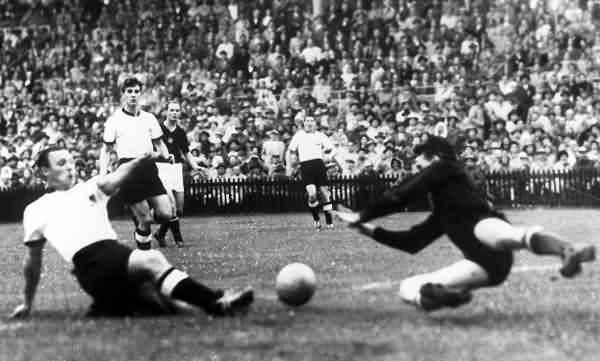
As part of the post-war normalisation, a German team travelled to the World Cup in Bern in 1954. Against all expectations, they reached the final and defeated the highly fancied Hungarians 3-2. The Miracle of Bern became one of the defining moments of the fragile new (West) German identity. Suddenly, nine years after the end of the war, it became possible to be momentarily proud to be German. In the midst of all the guilty confusion there was an instance where there was a collective feeling of national oneness, one that was allowed, legitimate. It was a signal that things could move on, that the past – while not forgotten, never to be forgotten – could perhaps be surmounted; that whatever it meant to be German need not be exclusively, definitively and eternally defined by jackboots and swastikas, by fanaticism and Auschwitz – by shame.

It was, of course, only football. But football can be a lot – a channel where national pride, competitiveness, the innate, almost crazy human impulse to prove one’s group/clan/tribe/nation to be and be recognised to be the best, the greatest, can be ritualised, played out and expressed in a way in which nobody is hurt, exploited, made homeless, enslaved or killed. In the words of Peter Gabriel, “games without frontiers, war without tears.” In 1954, balsam for the traumatised German soul.

Thirty-six years later, in a period of less than a year, the post-war European (and world) settlement, stabilised and set in a concrete balance of fear between two blocs was swept away. In a historically unprecedented peaceful revolution, the hegemony of the Soviet Empire in Eastern Europe had basically dissolved and even in the USSR the Soviet system was winding itself up. The most concrete symbol of the Iron Curtain, the Berlin Wall, had been torn down and the reunification of the divided Germany had been agreed and was in the last stages of preparation.

1990 was once more a World Cup year and in Rome West Germany, playing in their final tournament before the accession of the GDR to the federal union established by the western allies in their zones of control after the war, once more became the world champions. Those were months of euphoria in Europe, and especially in Germany, where anything seemed possible, where everything seemed positive. Germany winning the world cup appeared, as it happened, to be almost inevitable, the Football God for once in accord with all the other portents and tendencies of history. The icing on the cake, the unity of heaven and earth.

Yet 1990 also marked the end of an era. The World Cup of that year was the last major global event in which West Germany appeared as a separate entity. It was not only the GDR which disappeared; though formally the states making up the former territory of East Germany simply joined the already existing Federal Republic of Germany, in fact this accession factually also meant the end of that entity in which Germans had proved that they could be good European democrats, what German historians today are increasingly beginning to call the Bonn Republic. Seen from this aspect, the victory of the West German team in the 1990 World Cup can be regarded as a final accolade, a way of proclaiming to a brave new world, “Mission Accomplished!”

These brave new world moments tend not to last. In the euphoria of unification, the elder statesman, Willi Brandt proclaimed, “Now let what belongs together grow together!” That growing together has not always been an easy process, economically, socially, culturally, and it is by no means complete. But in 2006 an event occurred which became a moment of coalescence, when a new kind of German identity first expressed itself.

In the months before the World Cup began in Germany there was a lot of the usual public worrying about the whole affair. No nation or culture (except possibly the Jews – that itself some kind of statement about the complex, close, fateful relationship between these two cultures) is as good at public worrying as the Germans. The opening ceremony had to be completely cancelled because of a row. There were warnings about possible dangers for blacks and orientals in particular areas of the former East Germany, because of neo-Nazi gangs.

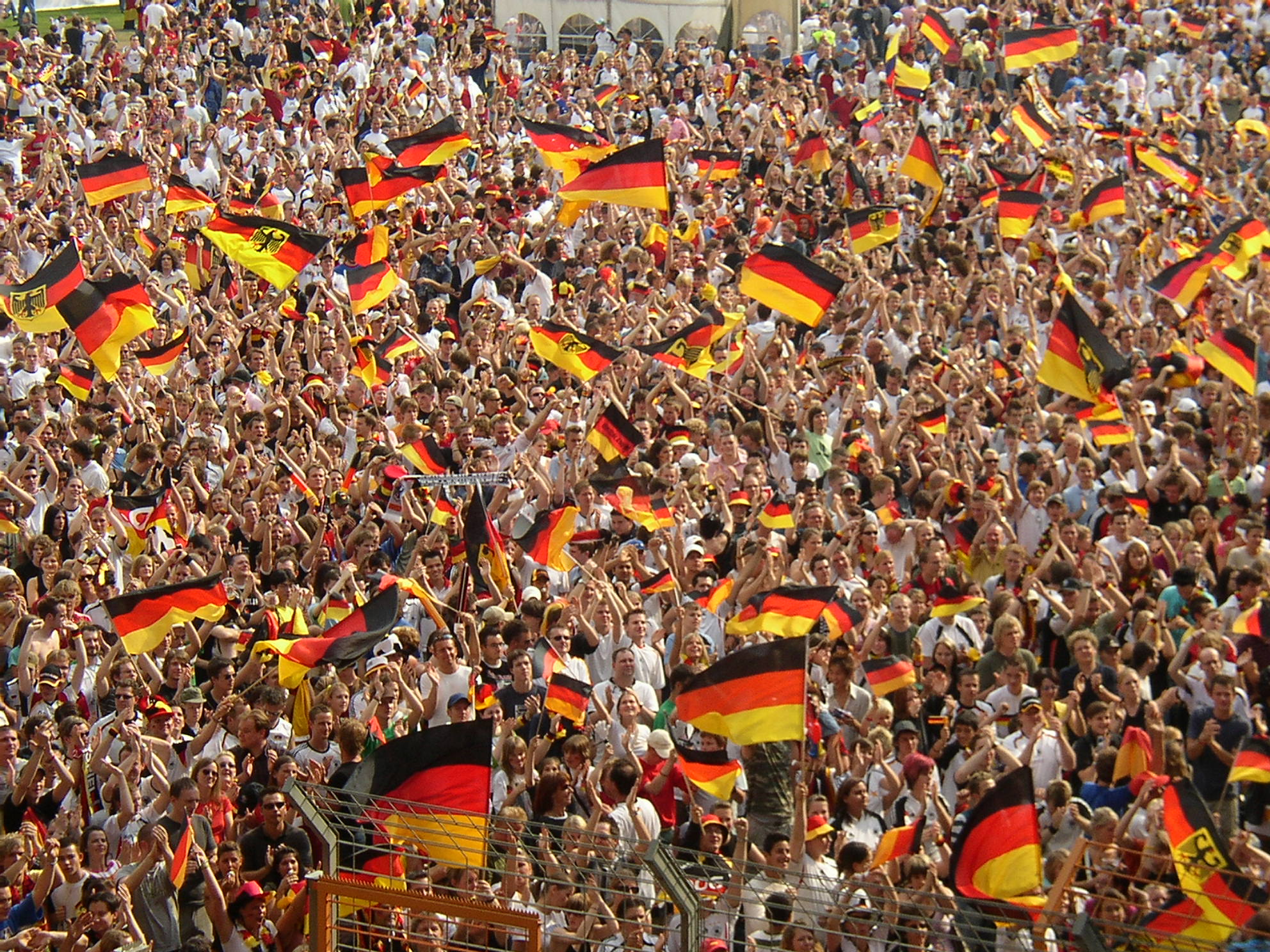
And then the competition started and a month-long spontaneous party broke out. For the first time since the war, Germans started waving their flags, decorating their cars and themselves in the national colours of black, red and gold, simply cheering the fact that they were German – just as the visitors from all over the world were cheering the fact that they were Italian, Portuguese, Brazilian, Australian. The German team reached the semi-finals, with every game being watched by literally millions in public viewings in the major squares of every German city. The event became known as the Sommermärchen, the Summer Fairy Tale.

The phenomenon has been repeated biannually ever since, whenever the European Championships or the World Cup take place. And it has become even more than just a celebration of being German; the other nationals resident in Germany also celebrate their identities and German towns become a multicoloured carpet of German, Italian, Spanish, Portuguese, Croatian and Turkish flags – with good-natured rivalry and ribbing between the various nationalities.

Sixty years after the end of the war, young Germans finally seem to have become comfortable with their own identity – and the vehicle they choose to express it is football.

They could do worse.

* * *

This is all, of course, a very particular view. It is true but it is not the whole truth, for reality is more complex. Nationalism, in all its expressions, has a dubious pedigree and is, arguably, the most destructive ideology the world has seen in the past two hundred years. And German economic nationalism is a major component in the current complex of financial and economic problems currently facing Europe.

In an ideal world, I would hope we could go beyond those bloody, sterile, exclusivist expressions of nationality which have so shaped and malformed the world in the past centuries, to a more inclusive, sharing vision of our common solidarity on this planet which so many of us share. More and more thinking Europeans are beginning to see these deeper questions as a positive possibility resulting from the current Euro debt crisis. (Angela Merkel, the current German chancellor, seems unfortunately completely ignorant of these deeper questions.) But the need to belong, to feel part of a nation, and to express that identity seems to be very deeply rooted in us – probably part of our primate hard-wiring. And, for as long as a deeper feeling of fundamental human solidarity remains in a (hopefully growing) state of development, I’m prepared to see those expressions of nationalism like the German one I’ve described here as basically positive. Better by far than pogroms, marching armies and terrorist bombs anyway.


Pictures retrieved from:


Thursday, 12 April 2012

Günter Grass and Israel


Last week, the German Nobel Literature Prize Winner, Günter Grass, published what he described as a poem, “Was gesagt werden muss [What must be said],” (you can read it here) in which he criticises the right claimed by Israel to carry out a nuclear first strike, should it feel the threat posed by Iran make this necessary, Germany for providing Israel with submarines which could be used as launching platforms for that strike, and the West, more generally, for its hypocrisy regarding the whole subject.

The result has been a storm of controversy, in which Grass has been accused by many of anti-Semitism. The Israeli Interior Minister, Eli Yishai, has responded by declaring Grass persona non grata in Israel. But Grass is not without more nuanced defenders, even in Israel.

The issue is made vastly more complex by the fact that Grass is Germany’s most prominent living writer and because of his own personal history. Grass defined himself throughout his whole public life as one of the primary voices of Germany’s conscience with respect to the Third Reich, and the country’s shameful past and its consequences have been his most central literary theme – most famously in his acknowledged masterpiece, The Tin Drum. He has described his work as “writing against forgetting.” He has also been someone who has consistently and publicly identified himself as an intellectual with left-wing sympathies – to such an extent that he publicly campaigned for Willi Brandt in the sixties. He has commented, often controversially, about many issues of German public life; from reunification to Germany’s relations with Poland. It was, therefore, a sensation when he admitted six year ago that he had, as a 17 year old, in autumn 1944, joined the Waffen SS. This was a biographical fact he had managed to conceal for over sixty years.

Declared intellectuals, as a group in any country, are not particularly noted for charitable, forgiving and understanding dealings with one another, and the German intelligentsia has quite a reputation for being particularly vicious with each other. It was no surprise then when his confession about his past led to widespread excoriation, particularly from many who had previously experienced the caustic character of comments about them by Grass. In a more detached way, the influence of his own guilt and embarrassment about his past provides a fascinating new aspect in an analysis of the roots of his literary and public personality, his writings and his utterances.

What makes any considered comment about his poem so difficult is the fact that it conflates three complex issues, winding them into a ghastly Gordian knot. They are: (i) The person of Günter Grass himself and what he actually wrote, (ii) The question of the extent to which it is acceptable for Germans to criticise Israel, and (iii) The particular question of certain current Israeli policies and actions and the wider issue of anti-Semitism.

(i) Grass and his poem
“The general silence …, which my silence has been subordinated to, … promises punishment as soon as it is broached; the common verdict: "anti-Semitism".”

In his poem, Grass himself predicts that he will be accused of anti-Semitism and this has indeed happened. It is, in my view, not justified – though one of the basic flaws in the piece is his general reference to “Israel,” rather than “particular policies pursued by the present Israeli government,” a weakness which the author himself has admitted to since publication. But, even then, the question remains as to the legitimacy of the automatic equation of any and every criticism of Israel with anti-Semitism, a point which I shall take up later.

But Grass’s piece has other major weaknesses. The form he chooses for it is, frankly, a mistake. He himself calls it a “poem” but, apart from the blank verse form he chooses for it, it has little if any poetic characteristics. The very title calls to mind, particularly in the German context where there is a tradition of such things [Stammtisch], a diatribe uttered by an ignorant man, sitting late in the evening with friends in a bar, after the consumption of too much alcohol. He states his entire argument in 382 words, a little more than half of what I have already written here. Though he is normally not a man especially known for succinct pithiness, he seems to have been suddenly afflicted with an extreme fear of the often hasty internet judgement, tl;dr; as a result he fails to do the complexity of the subject justice, something fatal in anything to do with Israel, its history, its present political situation, and its tangled relationship with all its proximate and not so proximate neighbours in the Middle East. It would have been much better for the author – and all who feel moved to comment on his views – if he had expressed them in a longer, more closely argued essay.

Beyond this, given his own biography, it can also be asked whether it was wise of Grass to publish on this subject at all. Even if his membership of the Waffen SS was short, though he was never involved in any of the activities of that sinister organisation which were related to its major role in Hitler’s Final Solution, though he was very young in that chaotic, hopeless last year of the war, it remains a part of his biography which might make him pause to think before publicly taking any position on anything to do with Israel, particularly given the fact that he only admitted it six years ago. Given the sensitive complexity which still permeates the question of how Germans should express their relationship to Israel, it would probably have been better if Grass – a German with an especially ambiguous past – had just this once kept his mouth shut.

(ii) Germany and Israel – guilt, history and responsibility
The philosophy and actions of Nazi Germany with regard to the Jews remain unparalleled in history – all the ghastly aspects of the Shoah – and were one of the factors which led to the founding of the State of Israel in 1948. The Federal Republic of Germany was founded a year later and since then has seen itself as having a historic and moral responsibility to support Israel.

Germans and Israelis are bound together in their identities by what the Germans did to the Jews between 1933 and 1945. The question of how they regard their historic responsibility for the Nazi period and particularly the Shoah, remains a central and continually developing theme in the definition of German identity. As the generation involved in the war has largely died, and even those who can even remember it as children are now over 70, new questions arise in the discussion of the nature of this historical responsibility for younger Germans. I remember reading somewhere that the legendary Nazi hunter, Simon Wiesenthal, once said that it would be a major mistake for Jews to assign Germans the same kind of personal and historical guilt for the holocaust as Christians assigned to the Jews for nearly two thousand years for the death of Jesus.

I have lived in Germany for more than a quarter of a century now and have been an observer of the difficult and fascinating process of the continuing development of German identity during this period. If there can be one lesson learnt from the current Grass controversy it is that even today, 67 years after the liberation of the concentration camps and the end of the war, it is still difficult to have a “normal” dialogue in Germany regarding the complex themes of Germany, Judaism, the Shoah and Israel. There has been little or no progress since the “Walser-Bubis Debate” (1998), the “Jenninger Speech Debate” (1988) or the “Historikerstreit” (1986-89). It seems that there are many people, in Germany, in Israel and worldwide, who see the eternal shame of German history as denying Germans any right to comment negatively about any aspects of Israeli politics or actions.

If Grass’s poem has any merit, it may be to call attention to precisely this fact. It is, I suspect, the kind of thing which will have to go on recurring, a constant re-examination of the present state of the German “soul” and the relationship between Germans and Jews. It is a process which, I would hope, can finally achieve some kind of positive development.

The past half century has seen much positive development in Germans’ own dealing with their own past, from the convenient “forgetting” of the fifties and early sixties (against which Grass so effectively worked) to serious artistic attempts at honesty and catharsis in films like Der Untergang [Downfall] (2004). I can only hope that this could be mirrored in a more general maturing in the relationship between Germany and Israel, in which honest friendship would also admit respectful and honest criticism when you genuinely feel that your friend is doing something wrong.

(iii) Anti-Semitism and criticism of Israel
There can be no doubt that the ghastly phenomenon of anti-Semitism is alive and well worldwide; one only needs to listen to the lunatic ravings of Iran’s president, Ahmadinejad, to be unpleasantly reminded of this fact. But this does not mean that any criticism of Israel can automatically be labelled as such and unfortunately there is a tendency among certain Israelis and supporters of Israel world-wide to do just this.

I’m not going to even enter the snake-pit of discussion about the origins of the State of Israel, the Palestinian problem, etc. There is enough right and wrong to be shared out all over. It is a fact that Israel exists and, as such, cannot be made not to exist – which means that Israelis have a right to live in peace, within secure borders. It is a fact that the Palestinians exist – which means that they have a right to their own state and that the over sixty-year-old scandal of the refugees must be addressed and solved. But none of this means that either side has an automatic right to do anything they choose to protect what they see as their legitimate interests.

Israel is justly proud of its position as the only genuine, mature democracy in the region. But the basis of any democracy is open discussion. Those who instinctively reject any criticism of particular Israeli policies and actions as anti-Semitic do their own cause a disservice – and this includes Prime Minister Netanyahu, who dismissed Grass’s poem on this basis. If this is the case, then there are a large number of Israelis, who vocally criticise the policies of their government, who must also be seen as anti-Semitic.

To criticise the current Israeli settlement policies, for example, is not necessarily anti-Semitic. Nor is it anti-Semitic to be very worried about and afraid of a possible nuclear conflict in the Middle East. To Israel’s credit is the fact that it has possessed a nuclear-strike capacity for decades and has never used it, being content in the knowledge that its enemies know it and know that Israel will use it – as a last resort (the so called “Samson Option”). But even should Iran actually acquire a nuclear strike capability (and most experts agree that this is not yet the case), the Samson Option would still exist for Israel (particularly given a submarine-based launch capability), though in the slightly modified Mutually Assured Destruction mode. The current (nuclear-hinting) sabre-rattling which the Netanyahu regime is engaged in is dangerous, particularly because it is playing on the fact that the USA is moving into a presidential election campaign. This is a game with too many imponderables, and one false judgement could have dire consequences, not just for the region, but for the whole world.

There is nothing anti-Semitic about that worry.

* * * * *

Even as I finish this piece, reports have appeared that Grass will respond to his critics today in the Suddeutsche Zeitung. His reaction is bellicose, and he compares his banning by Israel to actions by the junta in Burma and the Stasi in East Germany. Obviously he feels deeply hurt and misunderstood. It’s a pity that his reaction – just like his original piece – is not more considered and nuanced.

Sadly, however, it seems that nearly everyone involved in any aspect of this whole question, whether the politics, the actions, or the discussions of these, is far more interested in pouring petrol on the fire rather than putting it out.


Pictures retrieved from:

LinkWithin

Related Posts Plugin for WordPress, Blogger...