
Moreover,
it is probably inevitable that I further limit this essay (in the particular
consideration of two artistic movements) to a largely German, or at least
Central European in a somewhat wider sense, perspective, given that I have been
living in Germany for the past quarter century and feel marginally more secure
on this ground than on a wider one, encompassing a wider European, or even
global perspective.
After all
that the 20th Century subsequently brought, it is difficult for us
today to fully realise how massive the cataclysmic shock the First World War
was to the consciousness of those who experienced or were affected by it. In
the more than forty years since the Franco-Prussian War, which saw the
humiliation of France and the formation of the German Kaiserreich, the general atmosphere had been one of continual,
apparently boundless progress. Indeed, despite some discrete, largely local
upheavals, such as the revolutions of 1848, many would have regarded this
period of progress as going back almost a hundred years, to the post-Napoleonic
settlement of 1815. At any rate, the general mood of the world was one of
optimism. Things just seemed to be getting so much better all the time; from Edison’s
electric light bulb to those magnificent men in their flying machines, from
motor cars and modern armaments to the spread of the benefits of civilization
all over the world through enlightened European Empire and the spread of US
manifest destiny from sea to shining sea. And if that meant the killing of
millions of savage negroes in Leopoldian Congo, or the annihilation of the
cultures and lives of the Plains Indians, well, those were just the inevitable
results of Darwinist survival of the fittest and the unavoidable collateral
damage of the spread of superior and more powerful cultures, nations and races.
Admittedly,
the situation between the five major European powers (France, Great
Britain, Germany,
Austria-Hungary and Russia) was
continually tense. But that had been the case for over forty years now and
dealing with that continual tension was what professional diplomats were for.
For decades they had moderated and orchestrated the complex, dangerous game of
chicken the great powers continually played with each other, dancing defiantly
to the edge of confrontation and war, threatening, feinting, pulling back,
brokering new compromises with new promises of future confrontations and gains.
The Tangier Crisis, the Bulgarian Crisis, The Agadir Crisis, etc., etc., etc.;
then all as significant as the Bay of Pigs, the Cuban Missiles or the Prague
Spring were to the Cold War generations, now forgotten except to professional historians.
The world
of the early 20th Century culture was already much too complex to be
encapsulated by the description of any one “movement.” An additional problem
arises because the general cultural flavour of the time is generally classified
as Modernism, a catch-all term which tends to describe everything by defining nothing
and which, as generally used, is extended to include and go beyond WWI. But –
generalising and simplifying enormously – pre-war Modernism was still
characterised by an optimistic view of progress,
despite deeper questions of meaning and sense raised by thinkers like
Schopenhauer, Nietzsche or Kierkegaard, the abandonment of conventional form by
the early Cubists, or Einstein’s demolition of the classical Newtonian universe
with his Special Theory of Relativity (1905). The avant-garde might be challenging progressive Realism on the
cultural edges; for the mainstream such challenges were generally seen as
dilettantish.
And then in
Summer 1914, in the wake of the assassination of the Archduke Franz-Ferdinand in Sarajevo, the diplomats finally dropped the ball and Europe collapsed into conflagration. Although
propagandist jingoism, confidently predicting victory by Christmas, was
generally believed on all sides, it was the British Foreign Secretary, SirEdward Grey,
whose prescience in August 1914 turned out to be truly prophetic; “The lamps are going out all over Europe. We shall not see them lit again in our time.”
 |
|
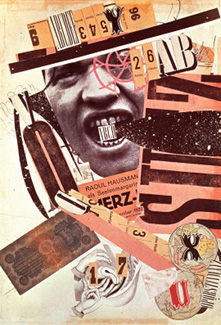
Raoul
Hausmann ABCD (Self-portrait) Photomontage, 1923-24
|
In the
German dominated cultural area of Central Europe,
two artistic reactions to the incomprehensible carnage and destruction of the
Great War emerged. At the Cabaret Voltaire in Zürich, a group of artists, many
of them German exiles, were in 1916 the origin of a movement which came to be
known as Dada. Dada was deliberately,
almost despairingly provocative, one of the original group, Hans Richter, even
describing it as “anti-art.” In retrospect it can be seen as an attempt to
express the sensation of horror and loss of meaning and all moral foundation,
all structure even, resulting from the experience of the war. Despite other
possible etymologies, I personally prefer the explanation of the word “dada” as
an expression of ultimate meaningless glossolalia. Dadadadadadadadadadada… But
in German the word carries further connotations. Da in German means there.
Dada is a kind of despairing showing, a pointing at the hopelessly shattered
fragments of meaning, of decency, of sense; the rubble of everything governed
and destroyed by the prevailing world order, acted out in the hopeless carnage
of the trenches. There! And there! And
there! And there! … Seen against this background, the frequent use of
collage by Dada inspired artists takes on extra significance.
 |
|
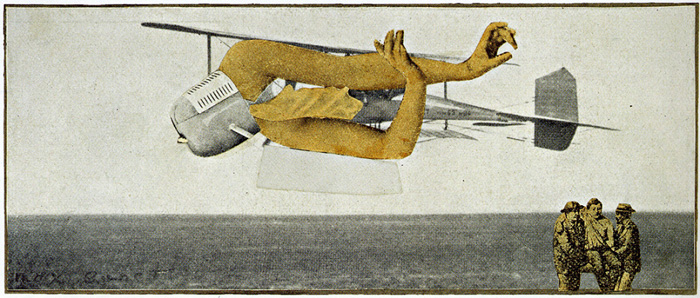
Max Ernst,
Murdering Airplane, 1920
|
Dada was
chaotic, unorganised, anarchic; it couldn’t be anything else. It was an
outpouring of enraged creativity, not confined to art alone, but also finding
expression in workshops and absurdist literature, like the writings of Kurt
Schwitters (a good example is Anna Blume). As such it quickly surpassed itself; many of those who identified with it,
such as Max Ernst, developing themselves further in Surrealism, which, at least
partly, grew out of Dada.
 |
|
Bauhaus
building in Chemnitz
|
The Bauhaus
movement also emerged as a reaction to the experience of the Great War, but
took a very different direction – a new attempt to find meaning and order, to
learn from the horrors of the war, to find an integrated approach to the
individual and his/her place in society so that all the suffering would not
have been in vain. The emphasis on form and structure is inevitable, given that
Bauhaus was initially and primarily an architectural and design movement. Though its first leader, Walter Gropius, was
non-political, many of those involved were left-leaning. Bauhaus was, by its
own definition, radical: “The underlying idea of the Bauhaus, which was formulated by Walter Gropius, was to create a new unity of crafts,
art and technology. The intention was to offer the right environment for the
realisation of the Gesamtkunstwerk (total work of art). To this end, promising
artists were to be taught in a school with an interdisciplinary and
international orientation.”
 |
| Paul Klee, The Twittering Machine, 1922 |
The basic
philosophy of the Bauhaus was humanist, egalitarian; it envisaged a cooperative
equality of skilled workers, artists, artisans and architects, a
democratisation of art, a demystification of design. This had political,
revolutionary aspects, and there were many committed Marxists at the Bauhaus.
But even without them, the whole direction of the movement was deeply
suspicious to other, darker forces.
 |
| Ludwig Mies van der Rohe, The Brno Chair (1929-30) |
On January
30 1933, Adolf Hitler became Chancellor of Germany. The Bauhaus was soon wound
up, and in the following years most of its talent left the country. As did many
of those who had been involved in Dada. For, although their reactions to the
brutal lunacy of the First World War were in many respects antithetical, the
attitude of the New Vandals who had taken control of Germany to them was essentially the
same. According to the Nazis, both schools propagated entartete Kunst [degenerate art] and as such were subjected to
bannings, persecution of those artists who had not left the Reich, and the
destruction of some of their works.
Nonetheless,
their legacies survived. The anarchic freedom, the celebration of apparent
meaninglessness expressed by Dada bubbles up repeatedly ever since, exerting
its spell on figures and movements as diverse as Josef Beuys, Ken Kesey and the
Merry Pranksters, Malcolm McClaren and punk. The Bauhaus left a lasting
influence on modern architecture ever since, as well as all sorts of areas of
design. Just think about Scandinavian furniture – even that IKEA bookshelf
you’ve got in your study. And, looking at the works of Andy Warhol, I like to
think one can see the inspiration of both movements.
Note on the Title: Much as I would like to
claim it as original, honesty forces me to admit that I first heard the phrase
over twenty five years ago from my old friend, the philosopher Paul O’Grady, of
Trinity College, Dublin.
The walrus was Paul
Pictures retrieved from:
First image: Hannah Höch, Cut with the Dada
Kitchen Knife through the last Weimar Beer Belly, 1919
|


