Ideas, philosophy, politics, current events and happenings, music, literature, art and simple incidents out of my everyday life; Reflections and observations which, I hope, might just get you thinking ...
A group of
US soldiers in Afghanistan,
charged with guarding Taliban suspects, first took away their Korans – in case
they would use them to pass secret messages to each other – and then burntthem. As if this wasn’t bad enough, they
were then careless enough to let other Afghans see them doing this and spread the happy news.
Let me just
see if I’ve got this straight. The US
armed forces – accompanied by the armed forces of many other nations – went into
Afghanistan
over ten years ago to kick out the Taliban who had given hospitality and
support to Osama bin Laden and Al Qaida. They succeeded in doing that pretty
quickly but, for reasons too complex to go into here but which had a lot to do
with the fact that Dubya was more concerned with offing Saddam (something his
daddy had wisely refrained from doing), finished up getting stuck there. Not a
good idea, as the Soviets, the Brits, or even the ancient Greeks under
Alexander the Great could have told them. Afghanistan is definitely not a country you want to get stuck in
when you’re perceived as a foreign occupying power.
The Afghans
don’t like any foreigners telling
them what to do, and a large part of their obscure, complex tribal culture has
to do with their young men learning to use guns and any other weapons available
before they would be ready to shave (if, that is, they shaved, which they
generally don’t). The longer the US and other foreign forces
remained in the country, the more they were going to be resented and resisted.
It is hard to believe that all the experts in the State Department and the
Pentagon didn’t know this. Maybe they did, but just decided to ignore it. Or
maybe it was just one of the things, as Rumsfeld put it, they didn’t know that
they didn’t know.
At any
rate, we have moved from a situation where, a decade ago, most Afghans were
delighted to see the backs of the Taliban, to a situation where they are now
back in a powerful position and gaining ever more support from many Afghans,
who see them increasingly as potential liberators from foreign oppressors. What
a wonderful example of winning the war only to lose the peace.
Ok, so Afghanistan has
turned into a complete mess. To use a US military expression, SNAFU –
situation normal all fucked up. In the wake of 9/11, the collective US leadership seems to have forgotten one of the
major lessons of Vietnam;
be careful about getting into a situation without a clear plan about how to get
out of it again. This was something Daddy Bush and Colin Powell understood
quite clearly when they sent their troops off to kick Saddam’s ass in Desert
Storm over twenty years ago. Dubya never learned this and Powell, apparently,
didn’t have the guts to make it clear to him. Anyway, the US – and all
their allies – now want nothing more than to get out of there as quickly as
possible. At least officially; the chances are that if they succeed in their
current disengagement plans there will still be thousands of “advisors” left
there, just as there are in Iraq.
But that’s all right, it’s just part of the neo-liberal wave of privatisation –
war can be privatised too; it passes off the nasty business to mercenaries, who
aren’t subject to the same degree of public control and scrutiny as national
armed forces, where influential private companies (like Academi, the Company Formerly Known as
Blackwater) can earn lots of money, and where military veterans with diverse
reasons for not wanting to return to civilian life can find well-paid work.
But even
getting out officially isn’t easy. I believe that the US and its allies don’t
really give a tinker’s curse about Afghanistan; as far as they are concerned,
if the Afghans are intent on living in a barbaric medieval theocracy, where women
are treated as chattels, those who don’t share the faith of the rulers live in
fear of death, and there’re more or less continual low-level wars between
various tribes, then they’re welcome to do so. Admittedly, there is the poppy
problem – Afghanistan is the world’s largest producer of non-pharmaceutical
grade opiates (92% in 2007) and also, incidentally, the world’s largest
producer of hashish – but, despite all the hype about the so-called War on Drugs, I have a feeling that (for
all sorts of reasons, many sordid, which I won’t go into here) the US and most
other countries can live with that. No, the real problems are the two 500 pound
gorillas next door, Iran to
the west and, especially, Pakistan
to the east.
In the
ordinary course of events, Iran
would be the easier one. In terms of sympathy, the US and the west have little to lose
there anyway. But, leaving aside the large number of people within Iran (many of
whom are devout Muslims) who might just have been persuaded that the west could
offer them moral support and an alternative model for organising their country,
the last thing anyone could want right now is more propaganda fodder for Ahmadinejad
and the Islamicist mullahs pulling his strings. Israel
and Iran
are playing a dangerous game of nuclear chicken at the moment, with vast
possibilities of dire consequences and anything which adds fuel to that
particular mix, you would think, would be something anyone sane would want to
avoid at all costs. Maybe they forgot to tell that to the US soldiers who
decided to do some book-burning, and their superior officers who were ignorant
enough to allow the situation to develop where they could even consider the
idea.
Pakistan is potentially an even bigger
problem. While it is still officially seen as the West’s major ally in the
area, it is hopelessly corrupt, increasingly unstable, and large areas of its
territories bordering on Afghanistan
seem to be factually under the control of the Taliban or groups sympathetic to
them. After all, that’s where they finally got Bin Laden, in Abottabad in the province of Waziristan. An increasingly likely
return to power of the Taliban in Afghanistan
might just push Pakistan
over the edge into chaos, civil war and an ultimate Islamicist takeover there. It
wouldn’t take much pushing. Pakistan
has nuclear weapons. It’s an open question as to how India, also a nuclear power, would (understandably)
react to such a course of events.
The blatant
ignorance which gave rise to this Koran-burning incident is simply
mind-boggling. Apart from damaging any claim to some kind of moral high ground which
the US might like to appeal to in this whole situation – a claim which actually
had some justification in the immediate aftermath of 9/11 but which has been steadily
losing credibility ever since – it is abysmally stupid from a practical
strategic point of view. If the US
wants to ensure any kind of stability in the country and the region after the
troops are officially pulled out, the struggle for the hearts and minds of as
many Afghans as possible is more vital now than ever.
It makes me
wonder about the mind-set prevalent within the US Armed Forces, when any
trained soldiers would not be aware of the consequences of such an action. No
matter what strength of suspicion about the level of involvement of the
detainees with the Taliban, the burning of Korans is a gratuitous act of insane
provocation which can only suggest that those responsible are seriously
dehumanised. They are not the actions of troops who are fighting to defend the
ideals of the American republic throughout the world, but rather of arrogant,
imperial occupiers, who could best be compared to the Roman legionaries who
played dice at the foot of the cross of Jesus of Nazareth, whom most of them
regard as their Saviour and God.
NATO has apologised,
Obama has apologised, but it’s not doing all that much good. Perhaps because
the incident is not an isolated one. Only a few days earlier, pictures were
released of US
troops apparently urinating on the bodies of dead opponents. Not to mention all
the “collateral damage,” particularly the various killings of innocent children
since the ISAF forces arrived in Afghanistan over ten years ago. And
then, of course, there was that highly publicised Koran burning by that mad
pastor in Florida
last year, though at least that one can’t be blamed on the military.
One of the
frightening aspects of all this is that it doesn’t even seem to be creating
much of a stir in the US, more occupied as it is with Whitney Houston, the Oscars
and the ghastly, unreal comedy of the Republican presidential nomination
campaign. It would offer some kind of hope if there were any real signals of
some sort of public feelings of shame at the actions of its soldiers. But why
should the Roman public be concerned about the doings of its legionaries in a
remote country, mostly populated by religious fanatics; Pharisees, Sadducees
and Zealots – or raghead Salafists, Shi’ites and Talibans? Particularly when
there are more interesting bread and circus issues at home.
-No, Frankie, it’s not on. We made a
deal. If you must use me to spew your filth, then I’ll publish your stuff over
on Obnoxious. The style over there is a little more … robust.
-Pseudo-bourgeois hypocrite! All this
is nothing more than a literary fiction; when you get right down to it, I’m
nothing more than a figment of your imagination anyway.
-Maybe, but you’re not a very pleasant figment of my imagination.
-Pleasant, schmeasant, you’re just
chicken, that’s all. What a fucking schizo wimp!
-If … and this is a hypothetical question
… if I published you this time on “Attempted
Essays,” would you leave me in peace – completely in peace – for, say, two
months at least?
-A month?
-Six weeks.
-O.k.
-Oh, and Frankie …
-Yeah?
-No explicit, graphic descriptions of
what santorum really is.
-Oh … all right!
[So, here you have it, gentle reader, Frankie
in all his nasty glory. Read on at your own risk …]
They like
to call themselves the greatest democracy in the world – the USA. Christ, if this were really
the case, then democracy in the world is in a very bad way indeed. If this is
the best democracy can do, then there can still be quite a case made for
absolute monarchy.
On the one
hand there’s the incumbent. Free at last, thank God Almighty, we are free at
last! … Yes, we can!, and all that other good (bull)shit. And what did America and the
world get? When you come right down to it, an old-style Chicago Democrat – a man
whose prime instinct is to make any deal as long as it will keep him on top. To
be fair to him – not that I have any great urge to do so, fairness is
overrated, something for that wimp in whose head I’m condemned to silently rage
most of the time – much of the past three years have been spent dealing with
the various messes that his idiot predecessor left to him. But really, Obama
has proved to be so ready to make compromises, has been so flexible that he’s
shown himself to be capable of kissing his own ass. Yes, we can, folks! We can withdraw from Iraq – though we
leave the country completely wrecked and tens of thousands of US “military
advisors” and “defence contractors” still in place. We can close Gitmo, only, er, no, we can’t, not really. We can get Bin Laden – in the middle of a
country we still call our most important regional ally, which has been
sheltering him for years. We can deal
with Wall Street and the banks – by letting them more or less carry on the way
they were going before they wrecked everything in the first place. We can deal with national and private debt …
well, we could … maybe … but Congress
won’t let us.
Ah, people,
but the crazy thing is, the way it looks right now, he’s going to be re-elected
next November. And you know what makes this craziness down-right bizarre? That
this is probably the best thing that could happen to the USA and the world
because, when you look at what the opposition is offering as alternatives, any
rational being is forced to the conclusion that a wishy-washy, infinitely
flexible Chicago Democrat boss is better than any of the various varieties of lunatic
the Republicans are likely to nominate.
Let’s be thankful for small mercies. Some of
the wackiest have already bowed out; Donald Trump, Sarah Palin, Michele Bachmann
(because Jesus told her to). Herman Cain is gone too and as I’m writing this
reports are coming in that Jon Huntsman has given up – showing, at least, that
the guy seems to actually be basically reasonable and in possession of some
intelligence. Of course, that’s probably what gave him the kiss of death; I’ve
a feeling that the Republican party just doesn’t do reasonable at the moment.
Let’s look at some of the more interesting
fruit and nut cases who are still in there and running. They’re all rich, of
course, because you have to be rich to run for the presidency in the USA; proof, should
proof be needed, that the country isn’t so much a democracy as a plutocratic
oligarchy. And they’re all as mad as hatters.
Take Rick Perry. This is the man who wants to abolish
government agencies whose names and functions he can’t remember. The guy has
been governor of Texas ever since Dubya gave
up that job to move on to wrecking the US and the world. Let’s face it,
anyone who thinks that America
is ready to elect another Texan governor just has to be a little crazy. But
then, Rick is another one of those who believe that Jesus has told him to be
president. Personally, watching this circus is making me think that Jesus must
be more than a little confused at the moment.
Then there’s the other Rick, Rick Santorum. Jesus
seems to like Ricks. Maybe that’s what’s happening; Jesus has got drunk in
heaven and started roaring out, Rick for
President, as a joke and every Tom, Dick and Harry who’s called Rick thinks
that Jesus means him. (Apart from
Michele Bachman, but her husband, Markus, has probably been taking his
inspiration from the priestly caste snob in The
Life of Brian who claims during the crucifixion, “I’m Rick and so is my
wife!”)
... considers entering the race as a
compromise candidate ...
In the special private funny-farm they’ve got
for Republican presidential candidates, Santorum has a whole suite reserved (he
thinks it’s the Presidential Suite). He’s given his name to a rather icky by-product
of anal sex (and if you don’t believe me, just google santorum). [I’ve promised the wimp not to go into any more detail
about this, much as I’d like to; let no one say I’m not a man of my word.] This
guy’s Catholicism is so conservative that he’s been endorsed by the
evangelicals, including the wonderful Mike Huckabee (just be thankful he isn’t running to, though maybe if
Santorum gets the nomination he’ll put him on the ticket as VP). Santorum is so
“pro-life,” he’s not just against abortion – he believes that sex is wrong if
it doesn’t lead to children. Believe me, people, this guy makes Pope Ratzinger
look like a dangerously radical liberation theologian. Santorum can best be
described as the American equivalent of Ahmadinejad.
What about Newt Gingrich? Newt by name, Newt by
nature, I say – the man has many similarities with a resentful lizard suffering
from halitosis. This is the guy who, as House Speaker, gridlocked American
politics back in the nineties because he didn’t like Bill Clinton (or because
he thought Bill Clinton didn’t like him). He wants to build a fence between the
USA and Mexico; should he be elected and
succeed in this, he’s going to piss off an awful lot of rich Americans who
would then have to pay decent wages for legal gardeners and household helps.
Ron Paul is a bit of a maverick. One of his
basic problems is that he’s in the wrong party. Paul’s views make him a natural
leader of the Libertarians but, since they don’t have any national clout, he
has to settle for being a Republican. The guy has the advantage of being pretty
consistent and faithful to his principles; the problem is that these principles
often tend to put him outside the real world. I think he’d feel happier in an America where
the South had won the Civil War – then he wouldn’t have to feel continually
oppressed by big Federal Government. He’s winning a lot of support from
liberal-minded people, who like his positions on (non-)intervention in world
affairs with things like foreign wars, his personal abhorrence of capital
punishment and his opposition to the War on Drugs. They’re fooling themselves –
all Paul really stands for is asserting the rights of the individual over those
of communal society and of individual states at the expense of Washington. What this
would mean in practice is that in Massachusetts,
Oregon and California
you could get legally stoned, in Texas and South Carolina you’d
probably be hanged for possessing a joint. Liberal thinking people who tend to
admire Paul should not forget that one of his heroes and major philosophical
influences is Ayn Rand.
It could also be argued that his age might mean
that America
would finish up with a president suffering from dementia. I don’t see any
problem in this; Ronald (it’s morning in America) Reagan proved that this can
be done without seriously disrupting daily business and the press could once
more ask the interesting questions, What did the president forget and when did
he forget it?
In the end, it doesn’t really matter – the way
things look at the moment, Mitt Romney is going to get the GOP nomination. What
a prospect! This is a man who believes that some of the lost tribes of Israel
settled in America, were visited there by Jesus after his resurrection and left
divinely inspired records, written on golden plates in a language called “Reformed
Egyptian,” to be discovered by Joseph Smith (guided by angels) nearly eighteen
hundred years later. He also believes that God doesn’t want you to drink
coffee.
The man became a multi-millionaire, running
companies which specialised in asset stripping and hedge funds. His business
background is firmly among the people who caused the financial crisis of 2008,
the consequences of which are still reverberating around the globe.
He has the advantage of being more flexible
than Obama. Having introduced a package for universal health care as Governor
of Massachusetts in that state, he now claims to be against “Obamacare,” though
the basic differences between the two measures are minimal. Watching him
throughout the campaign for the Republican nomination, he seems to be a
chameleon, one capable of taking on whatever opinions necessary to attract the
majority of Republican voters in order to achieve the nomination. His basic
claim for suitability for the job is his long experience in business – if elected
he would then, logically, run the USA as a successful CEO runs a
company. One wonders how he will deal with employees – oops, sorry, citizens –
who don’t live up to agreed targets and reach agreed goals.
In the end, it probably won’t make all that
much difference whether Obama or Romney rule the USA for the next four years. The
best you can say for them both is that most of the alternatives are a lot
worse. Isn’t modern US
democracy wonderful?
The wimp usually
finishes up his posts with some music. I’d like to dedicate this little number
to Rick Santorum.
Like most of the world, I presume, I find myself this weekend remembering that Tuesday in September ten years ago when we watched with horror as the hijacked planes crashed into the TwinTowers and the world was changed. If nothing else, the media won’t let us forget it; for the last week or longer we’ve been bombarded with specials, pictures, analyses, talking heads, etc., a phenomenon which will reach its peak on Sunday.
This alone makes me reluctant to write this – there’s more than enough being published on the subject. Yet, despite this, I feel a need to not let the day go by without reflecting on it myself. The first thing that occurs to me is how successful Osama bin Laden was with the diabolical action he and his followers planned and followed through. Terrorism has as its primary aim the spread of terror – fear – and confusion, the provocation of reaction in response to the initial act of terror; a reaction which serves to bring the agenda of the terrorists to the fore, to win attention for their cause, to help them recruit followers so that their agenda can be followed through on, to force those they see as their foes to act on their terms. In all of these goals Al Qaida was successful.
More of the long term goals of the Islamicist terror organisation have also been advanced. Ten years after 9/11, after a decade of war which has caused the deaths of thousands of western troops, the deaths of hundreds of thousands of Afghans and Pakistanis, and the spending/waste of hundreds of billions of dollars, Afghanistan is still not pacified and it looks like the Taliban (even if only as part of a very slightly more moderate coalition) are poised to return to some kind of power in a chaotic Afghanistan still dominated by warlords, corruption and fundamentalist Islam. Iraq has been wrecked; a brutal secularist-inclined dictator has been removed but fundamentalist Islam is several orders stronger in the country than it was ten years ago. And more hundreds of thousands have died. Fundamentalist Islam still rules in Iran. Nuclear-armed Pakistan – most frighteningly – is on the edge of falling under Islamicist control. Only Saudi Arabia, bin Laden’s primary goal, still remains fragilely under the control of the House of Saud but even here rich fundamentalist Wahabists, who do not belong to the clique around the king, continue to finance Islamicist radicalism globally.
While Al Qaida seems to have lost some impetus in the past few years, it remains as dangerous as it was ten years ago – if not more so. The group has fissioned, spawning dozens of autonomous cells worldwide, many of them composed of second or third generation immigrants who are completely at home in the countries of the west in which they are located.
The other major question is the effect the 9/11 attacks (and those following them in Indonesia, London, Madrid, Mumbai, etc.) and the “War on Terror” instituted under the leadership of the USA have had on those societies which see themselves as based on ideals of freedom and democracy. Here too the balance after ten years is sombre. It is understandable that security became an aspect which increased in importance for those societies under attack after the fall of the TwinTowers. What is questionable is the extent to which other values have been subordinated to the perceived demands of security and how high the price of this subordination has been.
There are values which belong to the fundamental building blocks of open, free societies, values which have developed and been achieved over the course of hundreds of years, often as a result of long struggles and suffering on the part of many brave people. Values like habeas corpus, due process, the right to a free trial and legal representation, the inadmissibility of purported evidence obtained under duress or torture, the rights of innocent, uninvolved civilians to integrity of life, limb and property, the presumption of innocence until proof of guilt, rights of privacy.
An Afghan child injured in a US bombing raid
All of these rights and values have been seriously compromised in the past decade, both in those democratic societies considered under attack as well as in those countries where various military actions have been carried out, countries like Iraq, Afghanistan and Pakistan. The Homeland Security Act, Guantanamo, Abu Ghraib, extraordinary rendition of suspects and their torture in countries like Iraq, Afghanistan, Mubarrak’s Egypt and Ghadaffi’s Libya, the treatment of many of those who have attempted to make abuses of the law public (whistleblowers like Bradley Manning), lies told to the world (Saddam Hussein’s possession of Weapons of Mass Destruction), the bombing and killing of innocent civilians in Iraq, Afghanistan and Pakistan (“collateral damage”) all represent betrayals of the values which Al Qaida was attacking on 9/11 and which the western authorities in various governments, particularly in the USA and the UK, have ostensibly been defending.
Those who wish to justify such things will claim necessity as their reason; the ongoing situation demands them, they are the lesser evil and, in such a war context, the end justifies the means. Yet all these arguments are questionable. Ten years after its inception, the so-called War on Terror shows no sign of being brought to a successful conclusion, even if Osama bin Laden was finally run to ground this year (on the territory of a putative ally of the US). Many of the actions justified according to this rationale have been counter-productive; one need only look at the negative results the pictures of the abuse and humiliation of the suspects held in Abu Ghraib had on Muslim public opinion worldwide.
The War on Terror is a dangerous and misleading misnomer. You cannot fight a war against an idea or a concept – and the Islamicist terror which found its expression in 9/11 is the expression of a (ghastly and horrible) ideology – wars are fought against people. Ideas and concepts can only be combated by other ideas. And the ideas at the basis of the open and (generally) free societies of the west, the values which the USA understands as the foundation of its democracy, are worth defending and proclaiming. Moreover, if we are convinced of their worth, then we must surely be confident of their power to prevail over the half-baked idiocy of those ideologies which are presented by simplistic fundamentalists (of whatever persuasion). But this cannot take place as long as our leaders and decision makers betray these very values in their proclaimed measures to defend them. The cynical saying regarding the destroyed town of Bến Tre in Vietnam in 1968, attributed to an unnamed US major by Peter Arnett, comes to mind; “It became necessary to destroy the town to save it.”
An open, free society will always be vulnerable, to an extent, to the attacks of those who reject its values. That is the price we pay for freedom. But we can only defend and spread that freedom by ourselves adhering to those values which are its foundation.
In a series of events best described as curious serendipity, I bought Empire of Illusionby Chris Hedges this week. Curious because my cousin Maureen had told my mother that I had recommended it. Which I hadn’t, but that’s something I want to correct now and, in doing so, thank Maureen for the roundabout recommendation. I bought it … and have read it in less than a day.
Hedges’ book, published in 2009 is an extended essay, written (it seems to me) in a white heat of passion and indignation at everything that is sick in our society. Its basic premise is that our contemporary culture and society are in a state of terminal decay. We have replaced literacy with instant tasteless spectacle, individual moral responsibility with feel-good illusion, and constructive critical thinking with conformist conditioning. Our possibilities for real democratic involvement and reflective engagement have been hollowed out and left meaningless by a continuous subversion by a small elite of the rich and powerful, driving a global grasp for total control by supremely irresponsible corporations.
Hedges is writing about America in particular, but most of his criticism can be applied one-to-one to Western Europe as well. In the first four chapters he examines the moral and intellectual vacuity in the TV-driven media, the porn industry, the academic establishment and what can best be described as the psychology industry. From a German perspective, things don’t look all that different here. Europe is perhaps more fortunate in that public state involvement in the education area has not been pared back as drastically as in the USA; on the other hand, this does not mean that education is particularly healthy in Europe, Britain being a prime example. Hedges’ fundamental concern over what he calls “the assault on the humanities” is one that I have shared for a long time. The interesting thing here is that this has not been to the benefit of the hard science and engineering and technology; in fact many of the countries in the developed world are having trouble finding enough college applicants with the sufficient secondary school qualifications for studies in this area – in marked contrast to the emerging industrial and economic giants of India and China.
Today the most desired places and consequently those most difficult to get into (right up there with medicine and law) are those in the whole area known as “business studies.” This is not surprising in a culture in which getting rich has been elevated to the highest attainable value but it has drastic long-term consequences. Instead of exposing the cleverest and most talented young intellects we produce to an academic environment which would encourage the widening of their intellectual boundaries, the growth of their moral and cultural sensibilities, the fostering of their creativity, they are being encouraged to devote themselves to an arcane world of amoral pseudo-science, the new quasi-religious orthodoxy whose deeply-rooted fallibility has been amply demonstrated in the past few years. While I am not so naïve and idealistic as to argue that the securing of basic material security is a not a prime issue – indeed right – for everybody, at the same time I would argue that other values, above all basic moral sense but also cultural creativity, are also essential to society and are areas worth engaging our most talented young people in.
And we are not. Hedges’ opening chapter on the desolate, all-encompassing world of the modern mass-media is particularly powerful. The cult of celebrities, the worship of image, the 24/7 obsession with cruel triviality, as exemplified by Jerry Springer, Big Brother and all the other “reality soaps” is pilloried in all its shallowness. Real engagement in the depth, the complexity of issues has become non-existent. It is exploitative “bread and circuses” at its most sensationalist banal, appealing frequently to the worst in us and finding a ready echo. The disrespect and cruelty towards others often involved is a theme he expands in the following chapter on pornography. Indeed, the comparison between present-day America – I would expand this to cover much of what globally goes under the name of mass culture – and the degenerate late days of various previous empires comes frequently to mind. Late in the book, Hedges himself draws the comparison explicitly:
“Cultures that cannot distinguish between illusion and reality die. The dying gasps of all empires, from the Aztecs to the ancient Romans to the French monarchy and the Austro-Hungarian Empire, have been characterized by a disconnect between the elites and reality.” (p. 143)
In a world where Paris Hilton is an icon and people make pilgrimages to the tomb of Elvis, where Michael Jackson can generate a billion dollars in revenue after his death and the second-long exposure of his sister’s nipple causes a US-wide controversy, it’s hard to deny him.
And yet … At times, reading the book I found myself feeling slightly irritated. While I wholeheartedly recommend it, this doesn’t mean that I completely agree with it all. Empire of Illusion is the work of a moralist, someone so indignant at and disgusted with what he sees in the world that he feels himself to make an impassioned statement in the sense of Zola’s J’accuse. Everything he says is true, yet there is perhaps more truth to which he does not give sufficient weight. While mass media culture is increasingly illusionary, mindless, trivial and sensationalist, there are other realities too. The internet can be seen as a platform for the extension of this pabulum, with Twitter and Facebook as its current apotheoses, but much more also happens on these platforms. The whole WikiLeaks phenomenon and the millions of supporters who galvanised in its support, movements like Avaaz and Direct Action which have specialised in organising support on-line are, perhaps, signals of new counter-(mass)cultural possibilities. Text-messages, twitter and internet seem to have played an important role in the almost successful revolution in Iran in 2009 and in the recent events in Tunisia. And, perhaps beyond the main-stream, there is a an awful lot of serious analysis, dialogue and creativity going on all over the web – in discussion groups and blogs and all sorts of other forums.
The problem is that the more serious, the deeper, the more nuanced and critical disappears in the cacophony of the vastness of triviality. It used to be the case that other, critical opinions had to be censored or forbidden; this is no longer necessary. The small controlling elites and the corporations in parasitic relationship with each other control nearly all the means of mass access – their critics, like Hedges (and Nader and Chomsky and all the others), must no longer be silenced, they can simply be ignored because their voices are no longer heard above the orchestrated symphony of mass-marketed illusion.
Yet even in the particular US context which is Hedges’ focus, there is more. In the heat of the mid-term elections last autumn, over 200,000 Americans attended the Rally to Restore Sanity and/or Fear in Washington. It was basically, for nearly all who attended it, an appeal for reason and decency in public discourse. It is, perhaps, indicative in another way of the deep dysfunction in society Hedges is addressing, that the rally had to be called and organised by Jon Stewart, someone who is basically a comedian. But it can also be seen as some sort of sign of hope.
Hedges’ deepest criticism is that the professed, public values to which we give lip-service have long been hollowed out and made meaningless by corporate capitalism. Democracy has become a ritualistic farce and public morality has been emasculated in favour of the profit motive. Lulled by illusions, brutalised by sensationalism, controlled by manipulative shallow psycho-techniques, we collaborate in our own exploitation and the rape of our world. And we do. But we also resist and – at least to an extent – seek to empower ourselves by other means.
At the end of the book Hedges too recognises this and professes his belief in the ultimate supremacy of hope and love. “Love will endure, even if it appears that darkness has swallowed us all, to triumph over the wreckage that remains.” (p. 193) Perhaps I am just more optimistic by nature, but I would like to hope that this can happen before nothing but wreckage remains. It is true that the stakes are becoming horrifyingly high and that the (inevitable) fall of empires is usually accompanied by vast suffering and misery. But we have to try, if only for our children and grandchildren. Hedges’ conclusion is too apocalyptic for me. Maybe the best we can hope for is that we somehow continue to muddle on, still balancing on the knife-edge. After all, who would have taken bets in October 1962, at the height of the Cuba Missile Crisis that we would still be here today, over forty eight years later?
With these lines the great Irish poet W.B. Yeats wondered about his portion of moral responsibility for the suffering and death caused during the Irish War of Independence. Many years before the 1916 Rising, during a period of intense personal nationalistic fervour, he had written a play called Cathleen Ní Houlihan, the message of which could be interpreted as a call to armed resistance against British control of Ireland, and which was performed in the Abbey Theatre in Dublin.
Those familiar with the course of Irish history at the end of the 19th and the beginning of the 20th Century would probably counter that Yeats had a somewhat inflated sense of his own importance and significance – at least with respect to nationalist circles in Ireland at the time – but his lines came to my mind when I heard of the shootings in Tucson, Arizona last Saturday.
The blogosphere, the internet and the media (both in the USA and worldwide) are today full of discussions about the role the present culture of political debate in the attack on Congresswoman Giffords and the killing of six other people, including a nine year old girl. In particular, the language and rhetoric of the political right, personified above all by Sarah Palin, has come in for criticism. Attention has been drawn to her “Crosshairs” advertisement and her tweet referring to it specifically in last year’s election campaign: ‘Commonsense Conservatives & lovers of America: "Don't Retreat, Instead - RELOAD!" Pls see my Facebook page.’ This is presented as the most prominent example of many instances of extreme rhetoric targeted against President Obama and the Democrats, since the elections of 2008, some of which have described Obama’s Health Care project (and other administration projects) as Second Amendment questions. Given that the right to bear firearms is seen in America as guaranteed by the Second Amendment to the Constitution, such phrases can be understood as incitement to armed resistance, even if those making them formally deny that such is their intent.
Those who know me or who read this blog regularly will know that I am no great fan of Ms. Palin and the political right in the USA (or anywhere else, for that matter). From all the evidence which has been presented up to now, the killings on Saturday were the work of one isolated, extremely disturbed individual – a car crash looking for somewhere to happen. Every society has its share, unfortunately, of such nuts. It can, of course, be argued that they are more prevalent and have it easier to express themselves in a deadly fashion given the whole gun culture in the USA, something which is hard for most of the rest of the world to understand, but I don’t want to go there; in my experience, the firearms issue is one about which it is very difficult to discuss rationally with the majority of Americans anyway. So the indignant replies of right-wing supporters of Ms. Palin, defending her from charges of co-responsibility for the attack would seem to be justified. Loughner was deranged, a typical amok killer, exceptional only in the fact that he could be apprehended before he managed to kill himself or get himself killed. This kind of thing happens, the silicon chip inside his head got switched to overload, no-one else is responsible.
And yet … The fact remains that he chose to attack Congresswoman Giffords, who had been one of those “targeted” by Ms. Palin (and who had specifically protested about just that targeting) and whose office had already been attacked, and that six others had to die because she was selected by the twisted reasoning of the attacker as his goal. And, perhaps even more significantly, this attack by (probably) a madman on a politician happens before a backdrop in which metaphors of violence and war have become increasingly popular and common in public political discourse, particularly from the right in the wake of the Democratic victory of 2008.
Don, a friend of mine from Texas who describes himself as a conservative, has assured me in the past that such rhetoric is simply part of a rambunctious political culture traditional in America and that (most) people are intelligent enough not to take it seriously. And it is indeed true that politicians the world over have a strong tendency to the inflation of language. So we have the phenomenon my fellow blogger Susan referred to recently as “the war on nouns.” There’s the war against terror, of course, and the war on drugs, but we’ve also had (this one more generally from the left) the war on poverty. Of course, it’s not so easy to win a war on a noun, but that’s another matter. Still, it is my impression – and it’s a view I’ve also heard expressed by many others, American and non-American – that there is a different quality to the language which many on the right have been using towards Obama since he began to campaign for the presidency and the Democrats in general, and that quality is best described with the word “hatred.” Hatred is a very dangerous emotion in public discourse. It is infectious. It sets aside a basic attitude of respect for others, for the possible sincerity of their positions, for the presumption of their integrity, for their right to their opinions. And the distance from hatred to violence is small.
And if it is not hatred, then it is the language of hatred and this is, in some ways, even worse because it is cynical and manipulative. Perhaps it is a reflection of our age that hyperbole has become commonplace and that it is no longer possible to win attention with measured speech. We are confronted with sensation at every turn and have become jaded as a result. So it no longer means anything to say, “I think my opponent is mistaken in some of his positions,” no, instead one has to say, “My opponent is a liar whose positions are anathema to everything decent people stand for.” And then when some misguided crazy actually takes what I say literally and goes off and kills my opponent, I defend myself by saying, “I really only meant that I disagreed with him, I didn’t want anyone to kill him!”
And this is the position in which Sarah Palin, Glenn Beck and others find themselves and where the question Yeats asked himself comes into play. The kind of access they have to the public media gives them immense power over the formation of individual and collective opinion and power always has the corollary of responsibility. Think of the well-known story of Henry II and Thomas à Beckett, and imagine the king giving a present-day press conference after the murder in Canterbury Cathedral:
“Even if we didn’t always see eye to eye, I had the greatest respect for Archbishop Beckett and condemn his murder completely. When I said, ‘Will no one rid me of this troublesome priest?’ I was simply expressing a feeling of personal vexation and giving voice to the hope that he would give up his political opposition to me. I never meant for him to be killed and I certainly never ordered anyone to do so.”
Demagoguery is reprehensible because it appeals to the baser instincts of those who are addressed by it, but it seems to me that demagoguery and cheap sensationalist media tricks have become all too common in contemporary political discourse. Palin’s “Crosshair” poster is a typical example of this. I don’t believe for a second that Sarah Palin wanted anyone to shoot Congresswoman Giffords but the imagery the poster used was cheap, offensive and irresponsible and the argument some of her supporters are currently using to claim that the symbols are geological rather than those of gunsights is grotesque and in appalling taste. So although she never meant to incite a lunatic like Loughner, nevertheless Ms. Palin could well take a little time to think about issues of power and moral responsibility and will hopefully moderate her language and imagery in the future.
And perhaps in this context we could also think a little about the whole way we organise our political structures. We base them around competition, around parties, on principles like winning and losing. We set up a basic dialectic but, instead of solving problems in a dialectical fashion by achieving a synthesis which incorporates the best of both positions and transcends their opposition to each other by going beyond it, we simply say that one side wins and the other loses. There’s something seriously questionable about a system which makes something wrong simply because the other guy says it’s right – but that’s the basis of the form of democracy most countries have given themselves.
Parliaments evolved as an alternative to having people literally fight over things, so there’s a large element of formalised, unbloody war as a method of conflict resolution to them. We can go beyond this – and have done in many other areas. Imagine a business run by a board of directors who had to face a shadow board of directors who spent four years criticising everything the board did as a matter of principle, until the shareholders met again to elect a new board! Personally, I’d like to see more constructive consensus between politicians, governments trying to access all the human resources and creativity available to them in order to govern well, elected representatives looking at the issues involved and discussing ways to reach optimal solutions in the interests of all those they are representing rather than beating up on each other. So that government of the people, by the people, for the people shall not vanish from the earth. But yes, I’m a bit of an idealist. And even at that, I’m not holding my breath.
So, the mid-term elections in the USA are over and there has been a major swing to the Republicans, leaving President Obama with a House of Representatives in which the Democrats are in the minority. The world has looked on as Americans have gone through their biannual exercise of their federal democratic right and wonders what the result will mean for the US and the world.
Which is what I take as justification to write this post, although I am not an American and thus open to the criticism that what US Americans do in the privacy of their own country is really none of my business. But (to adapt a saying originally applied to Britain and Ireland) when the USA sneezes, the rest of the world catches a cold and so we have justifiably followed the arguments and the passion, the debates and mudslinging, the patriotism and ballyhoo. What happens in America has deep consequences for the whole world, for a number of reasons. For the past sixty-five years (arguably, for the past hundred) the USA has been the most powerful country in the world; for the past twenty, the only superpower (although this is changing as large emerging economies like Brazil, India and – most of all – China discover and start to flex their ever more powerful muscles). At the end of the 1920s, a crash on Wall Street could trigger a worldwide Great Depression and eighty years later the worldwide consequences of the collapse of Lehman Brothers showed how little has changed. Decisions made in Washington, in thousands of US boardrooms or by millions of American consumers have worldwide consequences. Culturally, from Hollywood to the music business to virtual reality the US remains the international powerhouse. Moreover, the world has become so networked, so interdependent and wired together that we have all been able to follow the long election campaign blow by blow online and even involve ourselves in countless discussions on the issues facing the electorate last Tuesday.
Well, the US electorate (or rather the 42% of them who actually turned out to vote) has decided that the Republicans will control the House for the next two years, the Democrats will have a narrow majority in the Senate and they’ll all have to work together (or not) with the Obama administration. The stringent US separation of legislature and executive has (not for the first time) led to a situation where Congress and the Presidency are controlled by different parties and can thus, more or less, checkmate each other. This is perhaps the most worrying consequence of the election outcome; gridlock, two years of which the country can very badly use at the moment.
But behind this election result can be seen much deeper streams and trends. At the heart of the campaign fought for the minds and hearts of the American people in the run-up to November 2 are questions concerning the nature of American society, the relationship between the individual and society and the role of government in society. These are fundamental questions about how to parse and interpret the basic revolutionary values as expressed in the other great 18th Century revolution, that of France; liberty, equality and fraternity. And all of this before an historical background which itself is not clear to many Americans, let alone outsiders.
Americans generally understand the Republicans as being more “right”, the Democrats as more “left” wing. What precisely is meant by right and left here is not easy to define, and is not always the same as what would be defined under these terms in other parts of the world. Simplifying enormously, the difference is more one of tendency, with the Democrats more inclined to stress the principle of equality while the Republicans tend more to liberty. At the same time, the Republicans would more quickly describe themselves as “conservative” while the epithet “liberal” can more conveniently be applied to the Democrats.
Seen from a European perspective, of course, what designates right and left in the USA is very much a question of gentle nuance, particularly when it comes to definitions of “left-wing” and the majority of US Democrats including President Obama, were they in Europe, would generally feel most at home in parties designated here as “centre-right.” But then, in Europe, “liberal” is usually not used as a pejorative either (the term “neo-liberal” is a different matter); most parties calling themselves “Liberal” are generally regarded as being in the middle of the political spectrum.
But many Americans, particularly those who regard themselves as more conservative, are deeply suspicious of Europeans anyway. The appeal of and to tradition, the history of the Revolution (nearly two and a half centuries ago now) and the colossal respect for the constitution makes them still tend to see us either as oppressed slaves of the unelected privileged classes or (sometimes simultaneously!) as dangerous statist socialists/communists. Europe is the old world from which the USA have liberated themselves and from which nothing can be learned. Those who would protest this view should remember Donald Rumsfeld’s scornful designation of those countries which showed themselves reluctant to get involved in the Iraq adventure in 2003 as “old Europe.” Yet, at the beginning with massive American help, Europe has generally been a wonderful success story since the end of World War II, expanding to include most of the Soviet Block following the collapse of the Iron Curtain twenty years ago. To give but one (central) example, most Western European countries have had comprehensive public health systems for half a century now and we are still both free and healthy.
But the tropes and memes of the Revolution are strong indeed, and all that seems necessary to harness the worries and fears of many ordinary Americans is the clarion call to rally against despotic big government and an overweening state which is acutely threatening the basic values of liberty and cannot solve any problems anyway. Throw in images of mad King George and heroes in frock-coats armed only with muskets and principles, add a president with a foreign father, an Arabic middle name and therefore possessing a whiff of un-American ideas such as socialism, and you’ve got yourself a movement. What seems to have been forgotten in all this is the other broad consensus which united the USA in the last historical situation in which it was faced with a financial and economic crisis comparable to the present one; Roosevelt’s New Deal.
Obama and the Democrats made mistakes in the past two years, no doubt about it. One ironic one is summed up in the three word phrase the Clinton campaign used to keep themselves on course in 1992, “The economy, stupid!” In retrospect it can be argued that the administration devoted too much time and effort to things like getting the Health Care measures through, rather than concentrating enough on the growing economic problems facing the country as a result of the financial meltdown (though in fairness it can also be argued that this was a campaign promise the president felt he had to keep). In doing so, Obama left himself open to two avenues of attack; that on health care itself and on his handling of the economy in general.
This is where the whole thing becomes confusing, even bizarre to us external observers. The issue of general social medicine – an issue which most Europeans take for granted – seems to be an issue on which many Americans regard their country as being fundamentally attacked in its constitutional foundations. The discussion, in many senses, left the practical area and became a powerful symbolic expression of a battle over the soul and identity of the American people and their national understanding. As such, it also served as a catalyst to focus worry over the future, suspicion of government in general and unease about the best way to handle the financial and economic crises. The result was the Tea Party and a major swing away from the Democrats.
I won’t go into that whole area further, the electorate has spoken and the lines have been drawn – at least for the next two years. Depressing as it may seem that the USA seems to be dominated by uncertainty, suspicion, anger and fear, this is not the only impression the past few weeks have left with me. The other, more hopeful image which remains are the very strange counter-protests last weekend, the rallies called out and inspired by Jon Stewart and Stephen Colbert, a chance for ordinary Americans to express their deep-seated wish for moderation, manners and dialogue with regard to the ongoing discussion of the nature of the civil society they live in and the political and economic problems it faces. It’s never easy to know when Stewart is being serious, but speaking before over 200,000 in Washington he seems to have epitomised what millions of Americans really feel:
“... [Gestures across the Malland toward the Capitol.] Americans don’t livehere or on cable TV. Where we live, our values and principles form the foundation that sustains us while we get things done – not the barriers that prevent us from getting things done. Most Americans don’t live their lives solely asDemocrats, Republicans, liberals or conservatives. Americans live their lives more as people that are just a little bit late for something they have to do. Often something they do not want to do. But they do it. Impossible things, every day, that are only made possible through the little, reasonable compromises we all make …”
Now that’s a picture of America that I like. If only the politicians on all sides will listen. That French expression of the ideals behind the great revolutions of the late 18th Century comes to mind once more; Liberty, Equality … and Fraternity. It’s the last of these which contains and overcomes the tension between the first two.
US Americans are fond of thinking that their country is special. In one sense, of course, they’re right, but only that in which every country is special, every country is different. No, with Americans it’s a bit different. The very fact that they appropriate the general term of description for all residents of North, Central and South America, “American”, to describe themselves is perhaps a little indicative of this; I know that if I were a Canadian, an Argentinean or a Mexican it would annoy me. But it goes farther than this; they have a real sense that their country is more than just one nation among others on the earth. To quote the journalist, publicist and educator, Max Lerner (1902-1992), “America is a passionate idea or it is nothing” (Actions and Passions). And indeed, historically, there is a lot of truth in this. The Revolution of twelve British colonies in 1776 was something special, something new in world history, a revolution based on ideas of the Enlightenment such as equality, like the Rights of Man to life, liberty and the pursuit of happiness (although, come to think of it, there might be one or another citizen of the Helvetic Confederation who would also stake certain claims in this area). Moreover, certainly for most of the 19th Century, the USA served as a dream, an ideal for millions of the huddled massesin the “old world” yearning to breathe free, a dream capable of inspiring its own citizens to grow beyond themselves, in dealing with their own problems to go beyond themselves, to form out of their country an ever more perfect union.
Yes, it’s a great story, an inspiring story, a continuing story, apparently a never-ending story. Something its citizens can justly feel proud of. But what makes it unique is its particularity and it is only this which makes it different from the particularity of the stories of other countries; the French particularity of challenging with their Revolution the anciennes regimes in the rest of Europe, the Indian particularity of Gandhi’s way of non-violent resistance, the particularity of the South African way of truth and reconciliation, to mention just a few.
And now a group of US Americans once again appeal to their uniqueness, the holy precepts of their ancient constitutional expression of liberty to protest against … against what? Against big government which they see as threatening their freedom. Against federal government which they see as imposing too much taxation, supporting unnecessary social programmes. Against – above all – a political elite which has lost touch with their needs and their realities, which claims to represent them without listening to them, without caring for them, interested only in preserving their cosy world of power, privilege and prosperity, obtained and sustained at the expense of ordinary little people. Appealing to one of the early symbolic gestures at the genesis of their Revolution in Boston, they call themselves the Tea Party.
What, I believe, would surprise most of those who identify with the Tea Party is that they are really not that original at all and can instead be considered as the US American expression of a movement which has been gaining strength throughout what we may call the western democracies in the past decade or so. Perhaps movement is too strong a word; what I am referring to is a general feeling of alienation from the political process as represented and controlled by the established political parties which has given rise to divergent groups and parties in different countries, all feeding off the same inchoate feelings of resentment and practical powerlessness. Despite different national characteristics, they all offer quite similar platforms; the National Front in France, the UK Independence Party, Geert Wilders’ Freedom Party in the Netherlands and the Sweden Democrats being some European examples.
A look at the – for want of a better word – policies formulated by these parties and movements serves to give a clearer view of what the issues are which concern their supporters, what the needs, desires and longings are of those who throng to their rallies, what fuels the anger which leads them to elect these parties and movements or candidates endorsed by them. They can be conveniently be clarified under a few basic headings.
1) We are being ripped off. We are ordinary people who have to make ends meet. We work hard to earn our livings and have to cut our cloth to suit. We are the ones whose taxes are paying for everything and we are not getting value for our hard-earned dollars, euros, pounds. Instead, those in power pay themselves handsomely with our money to preserve their power and privilege, at the same time using much more of this money to support those too lazy and indigent to go out and work themselves. At the same time, the provision of those services we have a right to is becoming ever worse, things like roads, protection (policing), emergency services, etc.
2) Professional politicians are not representing us. Those “up there” don’t care about us anyway. They present themselves ritually every couple of years for election or re-election but when the elections are over they don’t give a damn about us. They pay themselves so well that they have no idea what it feels like to have to worry about how to pay next month’s bills, that the car needs expensive repair or, worse, replacement, they know nothing about bad schooling and the struggle to stay healthy and cope with illness. They live in fancy neighbourhoods, can pay for private schooling and universities for their kids, have adequate private health insurance. They have no experience of the fears that their children will stray from the straight and narrow, will be pregnant or addicted by the age of sixteen, won’t get decent training, won’t find jobs. Inside a cocoon of privilege and wealth, their children will make the right friends, get the best education and then inherit the political positions held by their parents. And it doesn’t matter what party you vote for, because – in terms of those in power and influence – there’s very little difference between them. They all sit in Washington, in London, in Brussels, jetting around and our costs and passing off all the real work to faceless bureaucrats who live in their own artificial worlds and are, practically seen, responsible to nobody.
3) We are being forced to pay for mistakes our leaders have made in the past and our children will have to pay even more. Already billions of the taxes we pay are being spent to service debts accrued in the past and the politicians are still borrowing more, paying more and more of our good money to the banks every year. We know from bitter experience where that leads, what happens when you can’t pay the mortgage on your house, the loan for your car. That’s why the city can’t afford to repair the roads, police the playground, etc., because it’s in hock up to the eyeballs. Debts made by politicians on our behalf, which we have the privilege of paying back. And if we can’t, hell, they’ll just borrow more to pay the interest and our children can pay for it.
4) The money we worked so hard to earn, which we pay in taxes, is given to people too lazy to work. Now we know that anyone can hit a bad-luck patch and that’s what social services and unemployment benefits are for. But there are thousands and thousands who have no interest in doing anything for themselves and, worse, there’re more and more of them coming every year. Because in poor countries all over the world, the word has spread that if you can get in here you get money for nothing and, if you set about it right, you can even bring your whole family too – and your in-laws and their families as well. And, if they do work, then they’ll work for less than we can live on and take away jobs, of which there aren’t enough anyway, from our children. And they don’t make any effort to fit in, to learn our language, to dress the way we do. Often, they seem to even look down on us and have the cheek to demand all sorts of extra rights for themselves and accuse us of discrimination if they don’t get them. And the politicians do nothing to stop this. Why should they, they don’t have nests of them living in their neighbourhoods, they are more inclined to find their presence useful, as household-helps or gardeners.
5) Things are not as good as they used to be and we’re afraid they are going to get worse. We can remember times when things were simpler and more understandable. Our countries have proud histories of struggles to establish the values we hold dear and those values used to be taken seriously and respected by everyone. Today everything seems so complex and no-one seems to take these values – like hard work, honesty, fairness – seriously any more. The future seems ever more uncertain and threatening and we don’t know which of the experts to believe or whether they’re all just following vested agendas anyway. We yearn for straight, simple answers, for strategies which we can understand and which make sense to us. We need clear and credible leadership, leaders who name things by name and tell it like it is. We’re not getting it.
The impressions that I have sketched here are real for millions of people in our societies, they are the result of their concrete experiences. The problem is that these experiences are the result of complex processes in complex societies, societies which are interconnected and networked in ever more complex ways. Furthermore, we process everything we experience through our individual and common perceptions and it is mostly the fact that what we perceive has happened is far more important for us than any so-called objective explanation of what has actually been going on.
And here is where my problems with the Tea Party movement and all the other parties and movements like them begin. They are an expression of a longing for simple answers to complicated questions, a desire for certainty in an uncertain world. They quickly reduce difficult issues to appeals based on simple slogans, slogans which every individual can then interpret for him or herself.
Let us take one concrete example. A popular theme in the Tea Party movement is the call for less Government. The question begs itself as to what people mean by this. When you start to reduce it to the thousands of individual questions involved then you start to hear all sorts of different opinions. What does less government mean in the realm of education? Should we reduce communal funding for schools, reduce the length of free, compulsory schooling? That would save money. What about policing, law-enforcement, crime and punishment? What about consumer protection, the setting, implementation and control of standards for food and drugs? The basis of an awful lot of what we call government is the establishment of standards in all sorts of areas of life, standards which are necessary to secure our basic wish for equality, justice and fairness in all sorts of situations. Most of the laws we have (and laws and their implementation are the basis of government) are the result of concretely perceived needs and desires for regulation in communal life, the necessity of regulating conflicting interests. And it goes without saying that we all tend to regard our own interests as legitimate and necessary.
The dangerous thing about the Tea Party, and UKIP and the Sweden Democrats and all the others is that they offer a platform for various individuals to exploit the real fears and discontentment of ordinary people who have finally become fed up enough to start to articulate themselves or, more often, look for figures to articulate their worries and concerns. I don’t want to go into the individual motivations of those who emerge as leaders in such groups; many of them may well be sincere in their involvement and really believe in the simplistic slogans they offer as panaceas. But many of them are also following their own agendas, even if these be nothing more sinister than their desire for the personal rush supplied by the cheers and applause of the crowd, that craving for approval some seem to need on a larger scale than normal and whose rhetorical and communicative talents allow them to obtain this in such an arena. And I won’t even go into the possibilities such movements offer to all sorts of vested interests and groups with specific agendas to steer, influence and manipulate.
Of course, all this could not happen if a vacuum had not developed in the first place; a vacuum of trust, a fundamental disconnection between the “professional” political castes which exist in most of our societies and the people they purportedly represent. The perception most ordinary people have that politicians are not to be trusted, that they are lacking in understanding and empathy for our everyday problems and lives must be taken seriously by those involved in politics and those considering getting involved in politics. The very emergence of such groups is already an indictment of the political establishments. Unfortunately, the instinctive reaction of professional politicians in the established parties is one of hostility, ridicule and rejection. They should rather ask themselves where they have failed and what they could have done to prevent people being so disaffected as to feel they have to channel their needs and frustration in such directions. These are questions Democrat politicians at all levels in particular could profitably and honestly ask themselves in the USA at the moment. A look at Sweden or the Netherlands at the moment, where populist “right-wing” parties hold the balance of power following recent national elections should be warning enough.
The sad thing, in my view, is that such movements don’t really solve anything in the long term. Simplistic slogans and easy remedies may make people feel good but they don’t deal with complex problems just by being stated or chanted. Looking back in nostalgia to the good old days when everything was simpler and better is a universal human tendency but it is usually highly selective and involves strongly rose-coloured spectacles. We live in a complex, interconnected, networked global society and the future is not going to get simpler, particularly a future in which the world population will continue to grow, resources will become scarcer and a larger proportion of the global population will be demanding a fairer share of them.
And, perhaps, we need to demand more of our politicians. Not more work, for, in general, they work hard enough. The questions are at what, and for whom? No, what we must demand of them is more principle, more honesty, more moral courage. The courage to tell us the truth, even when the truth isn’t comfortable. The courage to say no more often. The courage, occasionally, to resign rather than compromise on basic principles. All of which is also, in the end, a challenge to us all to look at ourselves first. The conservative Savoyard diplomat, Joseph de Maistre (1753-1821), a hero of the Counter-Enlightenment, has left little useful to our modern society, with one important exception; his comment, “every nation gets the government it deserves.” If there is any truth in this, then our politicians are, in some sense, a mirror-image of ourselves. And that, truly, can be a very worrying thought …
 Let me just
see if I’ve got this straight. The
Let me just
see if I’ve got this straight. The 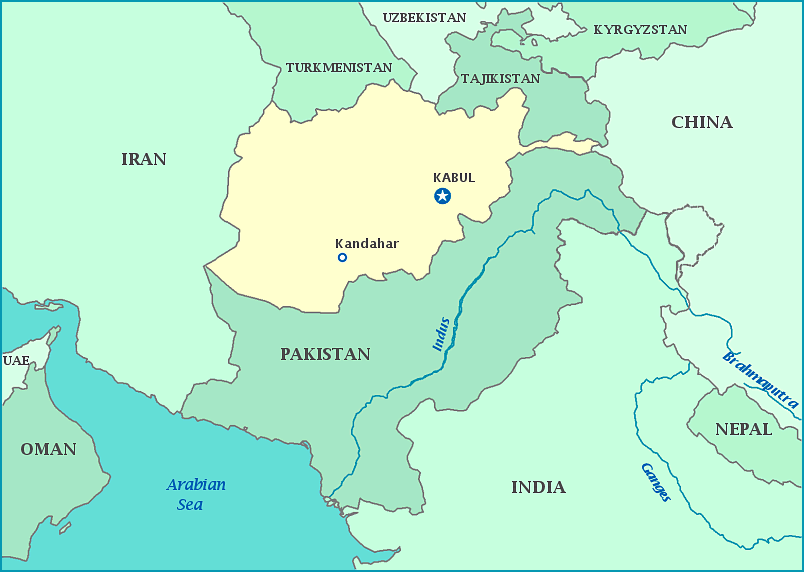



.jpg)

