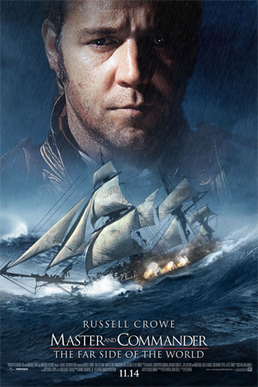
Over the
past few months I’ve been working my way – very pleasurably I may add – through
the novels of the Master and Commander or
Aubrey-Maturin series by Patrick O’Brien.
For those who do not know them – and I cannot recommend them highly enough –
the books tell of the adventures of Captain Jack Aubrey of the Royal Navy and
his friend, the doctor Stephen Maturin, during the Napoleonic Wars.
Over the
past few months I’ve been working my way – very pleasurably I may add – through
the novels of the Master and Commander or
Aubrey-Maturin series by Patrick O’Brien.
For those who do not know them – and I cannot recommend them highly enough –
the books tell of the adventures of Captain Jack Aubrey of the Royal Navy and
his friend, the doctor Stephen Maturin, during the Napoleonic Wars.
In twenty
books, published over thirty years up to 1999, O’Brien immerses us completely
in the world of 200 years ago, a literary and historical tour de force, which critics have favourably compared with the
works of C.S. Forester, Anthony Trollope and, above all, Jane Austin, all the
more remarkable for the fact that he was writing at the end of the 20th
Century. While there are all sorts of themes in the novels about which I could
comment here, I was struck today by an aspect which, while mostly incidental to
the development of plots and characters, provides a major contrast to our
contemporary world.
Stephen
Maturin, a well educated and highly intelligent man, is typical of a particular
kind of character of that era in which the ideas of the Enlightenment and the
Scientific Revolution were spreading throughout the world; the polyglot who is
interested in almost everything. His major hobby is one which he describes as
that of a “naturalist” or, occasionally, a “natural philosopher,” someone who
occupies himself with the scientific discovery, observation and cataloguing of
all sorts of living things (his primary area of interest is birds, but he by no
means limits himself to the area of ornithology, naming a new species of turtle
which he discovers after his friend, Aubrey, and regularly collecting
interesting specimens of beetle for his friend and espionage boss, Sir Joseph
Blaine). In the course of the books, Maturin regularly takes advantages of his
world-spanning voyages with Aubrey to observe all kinds of birds and animals,
going into raptures, for example, at his first sight of an albatross and
frequently having to bargain with the captain – whose primary concern is the
pursuit of his various naval orders – to obtain the opportunity to observe
the local fauna in the many parts of the world they visit.
The
impression one gets from O’Brien’s descriptions of Maturin’s naturalist activities is one, above
all, of burgeoning abundance. So much of the world is still undiscovered, uncatalogued
and, even in many of the regions where people are present, most of the birds
and animals are largely unimpinged upon by humans. Even in those areas where
men are making a living from the hunting of animals – the activities of whalers,
particularly those from New England, play a
role in a number of the books – the profligate abundance of nature is so great
that it seems unimaginable that the activities of humans could ever make a real
dent in it.
Well, not
quite unimaginable. The Dodo of Mauritius had been rendered extinct by the end
of the 17th Century, a fact of which Stephen Maturin is aware. He is
also aware of the encroachment of human beings on the habitats of various other
creatures, thus making it at first difficult for him to catch a glimpse of the
platypus in New South Wales.
But around 1812, the planet still seems to be so huge – even if the seafaring
adventures of Aubrey and Maturin send them extensively travelling around it,
including a circumnavigation – and so teeming with life, that the possibility
of humanity significantly damaging it would hardly have occurred to anyone.
 A month
ago, Lonesome George, the last remaining representative of one of the
subspecies of the Galapagos Tortoise, died. Aubrey and Maturin visited the
Galapagos on one of their voyages – the visit forms part of the 2003 film of
some of their adventures, Master and
Commander, starring Russell Crowe and Paul Bettany. Given the longevity of
the animals, it is possible that some of thousands of tortoises which they saw
there were parents of the far fewer representatives alive today.
A month
ago, Lonesome George, the last remaining representative of one of the
subspecies of the Galapagos Tortoise, died. Aubrey and Maturin visited the
Galapagos on one of their voyages – the visit forms part of the 2003 film of
some of their adventures, Master and
Commander, starring Russell Crowe and Paul Bettany. Given the longevity of
the animals, it is possible that some of thousands of tortoises which they saw
there were parents of the far fewer representatives alive today.
Although
the world described in O’Brien’s novels is so different to our own, it is not
really all that long ago. I’ve described a thought experiment here
and it’s worth repeating at this point. Imagine that when you were a baby, a
very old person (maybe a neighbour or a relative), over ninety years old, came
to visit you and caressed you on the head. Now imagine that that person also
had the same experience as a baby, being personally “blessed” by the oldest
person in their neighbourhood. If you
are over twenty years old today, then that
old man or woman was already alive by the time Napoleon was finally defeated at
Waterloo.
In that
short period, less than the span of three human lives, the world population has
grown from around one billion to seven billion people. And those seven million
are claiming more and more of the room and resources of the planet for their
own exclusive use.
There’s
nothing special about this – it’s a basic characteristic of all life forms to
exploit their environment to best suit themselves, usually regardless of the
consequences, even the consequences for themselves. Any biosphere is in a state
of continuously changing dynamic stability, a stability which is always
fragile. Balance is always an interplay of a myriad of complex factors and
relationships and is always subject to change. In a way, it’s like riding a
bike; balance is only possible when there is movement, change.
But
generally (and there are always exceptions of sudden, usually catastrophic
change) alteration takes place slowly, over hundreds, thousands, millions of
years. Against this background evolution unfolds.
Enter human
beings. Like no other animal, we are always in a hurry. And we are endlessly, frequently
for other species fatally, adaptable. We think, we learn, we plan, and change
our behaviour within single generations.
Let’s be
clear about this; this is not a modern phenomenon. By the time Europeans were
starting to settle Australia
(the era of Jack Aubrey and Stephen Maturin) their aboriginal predecessors,
arriving on the continent around 50,000 years earlier, had quickly wiped out
all the large herbivore animals, and consequently the large carnivores which
had preyed on them (megafauna). The same thing happened in North America,
leaving only some wolves, bears and the bison around 15,000 years ago, and –
most recently – in New
Zealand only 700 years ago. That such major
extinction events were less common in Eurasia and, above all, Africa,
is most probably due to the fact that these were the parts of the world where
humans first evolved and developed and thus other large animals had the necessary
time to achieve a kind of modus vivendi with
the strange non-conforming naked ape.
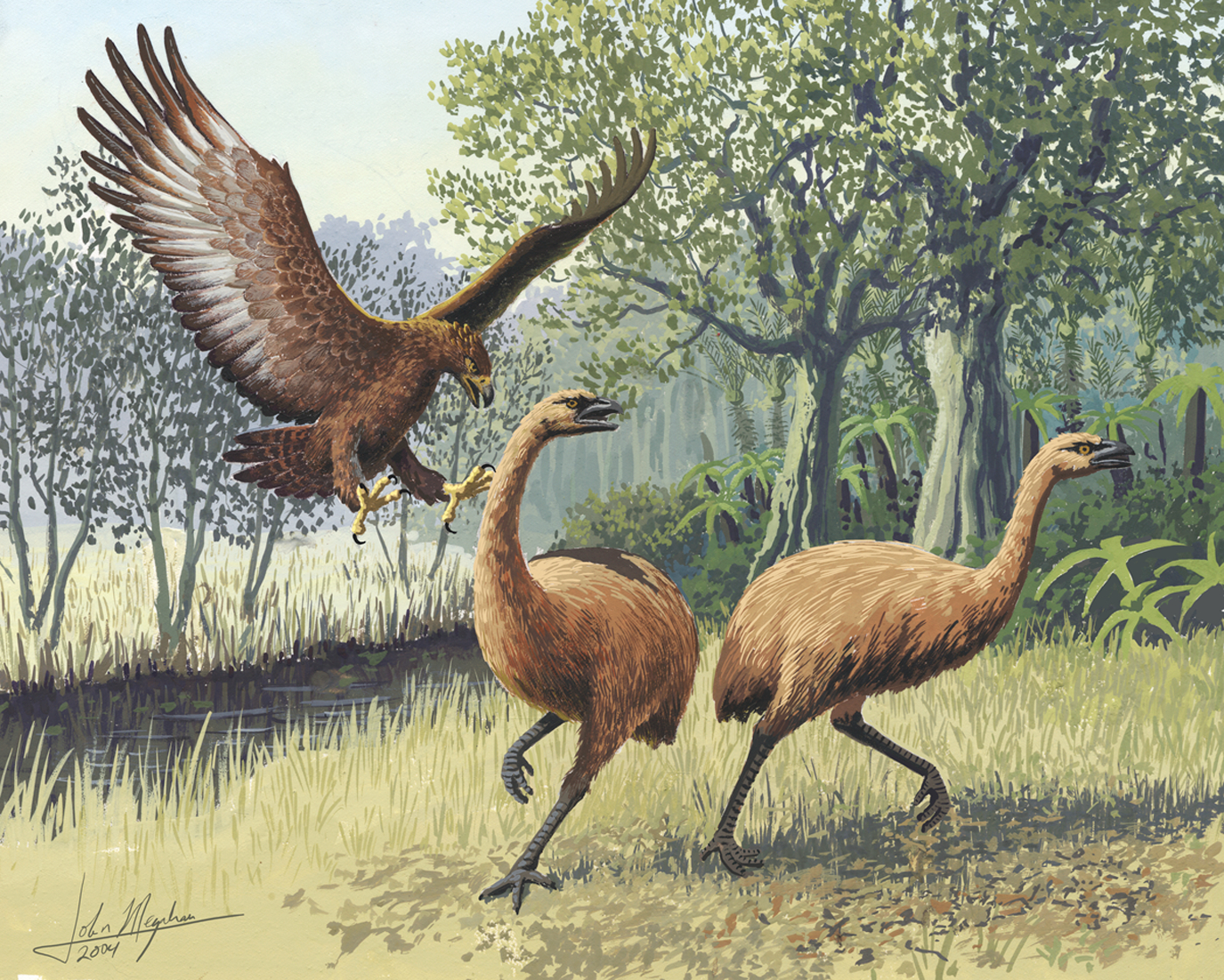
 |
| Haast's Eagle attacking Moas |
Nonetheless,
as catastrophic as these human settlements were for megafauna species like the
giant wombat (diprotodon), the American lion, the sabre-toothed tiger
(smilodon), the moa or Haast’s eagle, humans managed to settle into their
biospheres in Australia and the Americas – having basically taken over the
position at the top of the food-chain. But even within such systems, small new
impetuses could lead to massive change. Thus, the reintroduction of the horse
(one of those megafauna species wiped out by the first human waves of
settlement around 12,000 years ago) into North America
by the Spaniards gave rise to the great Plains Indian societies (Apache,
Navaho, Comanche, Sioux, etc.) from the end of the 16th Century
onwards.
But it was
the spread of Europeans in the past five hundred years, driven by a new nexus
of ideas and their results, like an aggressively missionary religion,
Enlightenment ideas and the mind-set of the ongoing Scientific Revolution,
which moved change and the rate of change onto a whole new level. By the
beginning of the 19th Century this was really beginning to gather
momentum and since then it has simply exploded.
“Increase
and multiply, fill the earth and subdue it …” (Genesis 1:28) Well, we’ve
certainly done that. The question is
whether we haven’t overdone it a bit. The whalers Aubrey and Maturin encountered in their voyagers have largely
disappeared – because nearly all the whales have been killed off. The oceans
from which the crew of the frigate Surprise
regularly fished myriads of anchovies, mackerel or tuna, and which even in
my childhood (less than half a century ago) were deemed to be endlessly
bountiful are now in danger – in large areas – of being fished out. Just ask
the (former) cod fishers of the Newfoundland Grand Banks. And there are many
other more complex chain reactions which can also be observed; anyone has gone
swimming in or walking on the beaches of the Western Mediterranean in recent
years will have noticed the explosive increase in the number of jellyfish …
because we have killed off too many of the larger fish which prey on them. Remove
one component of a food chain and you can cause all sorts or cascades of
change, many of them unforeseeable, and the ecological effects can be colossal.
It was rats, who travelled with the first Maoris to New Zealand and who preyed on the eggs
of the flightless moas, which were as much responsible for their extinction as
their hunting by humans. Rabbits in Australia. More aggressive American
grey squirrels driving out the more timid native red varieties in the British Isles. There are countless examples of such
unintended consequences and many of them lead to the extinction of species. Some
experts predict that the number of existing species on the planet may have been
halved by the end of this century.
So what? We
need the room and what does it really matter if the final lesser spotted humpbacked
toad croaks his last? The law of evolution is the law of the jungle, the
survival of the fittest and if humans are the meanest, baddest sons of bitches
in the valley of death, well, then, that’s just too tough for the others.
Except that
the rules of evolution say nothing about the survival of the winners. Any
species is faced with the continual danger that it will become too successful,
that it will wipe out all its competitors, neutralise all who would prey on it
and thus reproduce until it finishes up destroying the biosphere on which it is
dependant. It’s always a danger in any closed system.
 We humans
have spread all over the planet and, large and complex though it may be, Planet
Earth itself is a closed system. The signs are increasing that we are causing
rising stress for the planetary eco-system itself. Like an organism with a
bacterial infection, we are – in a real sense – giving our planet fever. Seven
billion humans produce a lot of heat, particularly as our demand for energy is
much higher than any other animal and, ever since we discovered fire, our basic
way of producing energy is by burning stuff, and most of the energy produced
this way is lost as waste heat. Moreover, from our own biological cellular energy
production, to the metabolising of the billions of domestic animals we keep to
feed us, to the cars that transport us and the oil-fired power stations which
produce our electricity, the basic chemical reaction used to produce
energy/heat is always the same. Take any variety of carbon bonded with
hydrogen (carbohydrates or hydrocarbons - sugar, wood, oil, etc.), add oxygen and a spark of some kind and you
get a more or less energetic reorganisation of elemental molecules to form
water and carbon dioxide. It’s simple high-school chemistry and the only
process working in the other direction on this planet is photosynthesis. That
we are producing lots of heat and carbon-dioxide cannot be disputed, the only
question that can be debated is how much of this we have to do before it
reaches significant, dangerous levels.
We humans
have spread all over the planet and, large and complex though it may be, Planet
Earth itself is a closed system. The signs are increasing that we are causing
rising stress for the planetary eco-system itself. Like an organism with a
bacterial infection, we are – in a real sense – giving our planet fever. Seven
billion humans produce a lot of heat, particularly as our demand for energy is
much higher than any other animal and, ever since we discovered fire, our basic
way of producing energy is by burning stuff, and most of the energy produced
this way is lost as waste heat. Moreover, from our own biological cellular energy
production, to the metabolising of the billions of domestic animals we keep to
feed us, to the cars that transport us and the oil-fired power stations which
produce our electricity, the basic chemical reaction used to produce
energy/heat is always the same. Take any variety of carbon bonded with
hydrogen (carbohydrates or hydrocarbons - sugar, wood, oil, etc.), add oxygen and a spark of some kind and you
get a more or less energetic reorganisation of elemental molecules to form
water and carbon dioxide. It’s simple high-school chemistry and the only
process working in the other direction on this planet is photosynthesis. That
we are producing lots of heat and carbon-dioxide cannot be disputed, the only
question that can be debated is how much of this we have to do before it
reaches significant, dangerous levels.
So, as
Lenin once asked, what is to be done? Wiping out 85% of the present population
of the planet to return to the levels of two centuries ago isn’t really an
alternative – although one of the last stages for a species which has become
too successful in a closed system is the phenomenon of die-back, where, within
a very short period of time, most representatives of the species simply succumb
to the consequences of overcrowding and too few resources, The result is
either, in the best case, the achievement of a new equilibrium with only a tiny
fraction of the species or, at worst, a situation in which this fraction is so
small that it is no longer viable and becomes extinct.
But, unlike
lemmings, we humans have the value of our intelligence, our ability to plan and
anticipate our future. We cannot bring back all the species we have managed to
inadvertently kill off, but we can modify our behaviour so as to develop new
ways of living on our planet in the future. However, this means changing some
of our most basic attitudes. Above all, I believe, we need to look very critically
at the whole idea of growth, which is at the basis of the
economic and societal models we follow. In the world of Aubrey and Maturin, when the world
seemed so huge and so bountiful, there was no need to question it, but today,
when the reality of the finite capacities of our planet, large though they may
be, is becoming more evident, it will soon become unavoidable. To believe that
we can go on growing indefinitely within a finite system is fundamentally
illogical.
This does
not mean that we must condemn ourselves or our children to restrictive,
soul-destroying poverty. A good start, in my view, would be to apply our
intelligence, ingenuity and imagination to examining the possibilities involved
in the idea of sufficiency.
We don’t
really have any other alternatives.
O let them be left, wildness and wet;
Long live the weeds and the wilderness yet.
Inversnaid, Gerald
Manley Hopkins
Pictures retrieved from