Seiten

Showing posts with label history. Show all posts

Tuesday, 22 December 2015

The Sum of All Fears

“ … the only thing we have to fear is fear itself …”
Franklin D. Roosevelt, Inaugural Address (1933)
 "There is always an easy solution to every human problem--neat, plausible, and wrong."
H. L. Menken, The Divine Afflatus (1917)

Let me begin here with an admission: When I look at our world today, at the end of 2015, I am afraid.

I am not afraid of terrorists, Islamic or otherwise. They want me to be afraid – that’s what terrorists do, attempt to incite terror. I know that there is an infinitesimal chance that I, or someone close to me, may become their victim; we may be in the busy centre of a large European city, or on an aeroplane – just a question of being in the wrong place at the wrong time. I could also be driving along the motorway/highway/autobahn when some confused or crazy fool comes shooting onto it through the exit ramp. Or I could just be struck by lightning. But I repeat, I am not afraid of terrorists; I refuse to grant them this power over me. They are attacking the values of the open society in which I live. The vulnerability we have towards their attacks – despite all the reasonable security measures in place – is the inevitable price we pay for the values of openness and tolerance which are at the foundation of any society which truly claims to be civilized.

I am not afraid of migrants, be they refugees fleeing from war or persecution, or so-called “economic” migrants, those prepared to uproot themselves, abandon their homes, families and friends, give up everything they know in order to seek a better future for themselves and their children. I realise that their arrival will challenge the country, culture and society in which I live. But I believe that this challenge can be fruitful, creative and positive if we face up to it with courage, honesty, openness, and generosity. I accept that the arrival of larger groups of migrants will change the culture in which I live; that there will be an inevitable interaction and mingling between my (Western European) culture and the different life-experiences and traditions that these migrants bring with them. But cultures are and have always been dynamic and fluid realities, constantly shifting, and frothing, and mixing, and growing. My grandfather wouldn’t have known what to do with a pizza, or a vanilla latté, my grandmother would have been scandalised by Madonna and Lady Gaga, or the use of the word “fuck” on prime-time TV.

I am not afraid of Islam. I don’t much like it, but then a general attitude of scepticism and suspicion regarding all religions has been growing continuously in me in the past decades. There are aspects of Islam, particularly the ambivalence regarding violence towards non-believers in many places in the Quran, which I find disturbing. (On the other hand, there are passages of the Old Testament which aren’t particularly edifying in this sense either.) I find the cultural misogyny of most Islamic determined traditions deeply distasteful. But I am also aware that the Christian and other religious traditions have anything but a pristine history when it comes to their treatment of women – and that not all of these historic attitudes have been left behind. I believe that secularism and the freedom to believe and practice religion (in so far as this practice does not restrict the freedom of others) are some more of those basic values I mentioned earlier, those foundational values of civilized society. As long as its practitioners accept these basic values, any religion, no matter how idiotic it may seem, can be practiced in a free society. Ultimately, I believe, the basic values of the secular, open, and free society will prevail over backward-looking, exclusivist, chauvinist and fundamentalist versions of every religion, though it may take generations. And that includes Islam.

 As long, of course, as we hold fast to those values, born in the Enlightenment and matured – with much struggle and suffering – primarily in Europe and North America – in the 19th and 20th Centuries; openness, tolerance, secularism, participation, democracy, civil rights, the rule of law and an independent judiciary, freedom of thought and expression, a critical press, the social securing of the basics necessary for life.

But as I look around the world at the end of 2015, these are the values which I see increasingly under threat. And not only that, they are being challenged and scraped away bit by bit in their original heartlands; Europe and North America.

It is this of which I am afraid. I take Roosevelt’s observation seriously. For what I perceive increasingly in the past year is a growth of uncertainty and fear in our society. I am becoming more afraid of fear itself; more specifically of the exploitation of that fear and the consequences of that exploitation.

Living in the centre of Europe I don’t have to look far to see it. There’s Putin in Russia and Erdogan in Turkey. Closer to home, to the east there are Viktor Orban in Hungary and Jarosław Kaczyński and his PiS party in Poland. Looking west, Gert Wilders in the Netherlands, Marine Le Pen in France and UKIP in Great Britain. And all the other populist right-wing demagogues in many other European countries. In this context – despite the perennial tendency of US Americans to perceive their culture as exceptional – Donald Trump is also just another confirmation of a widespread trend in the developed democracies. Here in Germany, where Angela Merkel has taken a courageous stand on the question of migrants (and if you’d told me a year ago that I would find myself praising the German chancellor I’d have replied with an expletive!) and where the country has provided a safe haven for a million people this year, Pegida and the Alternative für Deutschland have been gaining in popularity.

Despite all their particularist agendas, all of these various obnoxious figures are pretty much carbon copies of each other. All feed off and exploit the same fear that is widely present in our societies. This fear has many sources, but basically it is rooted in the apprehension many (particularly those who are less educated) feel when faced with a world in which change is all prevailing, in which the shape of the future appears to be less certain and more threatening. The demagogues all put forward the same kind of analyses and strategies; retrenchment, stigmatization and persecution of those who are obviously other, building walls and fences, narrow nationalist pride, appeals to cultural (and often religious) chauvinism.

They are all offering (to paraphrase Menken) simple and easy solutions for complex problems. These solutions are not only wrong, they are dangerous. For, playing to and exploiting the inchoate fears widely present in our societies, they deny the enlightenment values which are the fundament of our societies, appealing instead to emotional irrationalities. To anyone with any sense of the sorry history of the 20th Century it should be obvious where this leads. Make no mistake, my friends, even if these people are democratically elected, even if they keep the forms of democracy in the countries they control, regularly having themselves re-elected, they are proponents of an evil the world has already seen too much of. Putin, Trump, Le Pen, Orban, Kaczyński, Farage, Erdogan and all the others are proponents of what might best be described as fascism lite. And they are quite prepared to use many of the techniques perfected by their predecessors. To give but one example, all of them are prepared to publicly trumpet untruths and continue to do so, even when these statements have been repeatedly rationally proved to be untrue. Both Hitler and Goebbels described this strategy as “the big lie.”

So, faced with this resurgence of irrational, dangerous, fascist demagoguery, what can we do? How should we, in our ordinary little lives, react to this exploitation of fear which will, if it continues to grow, destroy the fundamental values of the societies in which we live?
 "All that is necessary for evil to triumph is for good men to do nothing," is a quotation usually attributed to Edmund Burke, though in this form it goes back to Tolstoy. No matter, it gives us a strategy for responding to these attempts (far more dangerous than anything ISIS can do) to destroy the character of our societies. We must respond immediately to the facile, dangerous lies put about by these fear mongers wherever we encounter them; from friends, family members, work colleagues, acquaintances; at home, at work, in the bus, in the pub, on Facebook. Many of us are just too polite, or too apprehensive of conflict, or just too lazy (I know that all these reasons frequently apply to me) to engage here, to get involved. But, I am becoming increasingly convinced, the failure to contradict the nasty simplistic views, grown in fear and cultivated in ignorance by neo-fascist ideologues, only leads to their growth and spread. If they are not countered, they will lead us into a new Dark Age.


Images retrieved from: 
http://www.wakingtimes.com/2014/06/26/fear-used-turn-spirituality/ 
http://ntrsctn.com/irl/2015/09/throw-things-at-donald-trum-in-new-game-trumpealo 


Sunday, 24 February 2013

Family Histories 1: The Cowboy


It was a fine Sunday morning in early summer 1865. James Hunt opened the door of his new home and looked south over the road and the downward sloping land towards the lake. He gave a sigh of contentment and muttered a brief prayer of thanks in Irish to the mother of God.

It had been a long, hard journey to this point of his life, but he could now allow himself a feeling of achievement that he had finally managed to be standing here this morning, on his own land in the townland of Smutternagh, on the shores of Lough Key, in the county Roscommon. Though the term “his own land” was a relative one; the land belonged to the King-Harmon family as did all the land in Smutternagh and thousands of acres more all around Boyle. Indeed, as far as his own family memories extended back, through the hard years scratching a living from a barely usable Curlew mountain allotment, back to the fabled days of comfort on good land in the townland of Eastersnow on the Plains of Boyle up to their catastrophic eviction in the 1830s, the landlords had always been the King family – whose place in the Anglo-Irish stratosphere had been achieved with the noble title of Lorton.

As his gaze moved across the green wooded islands on the lake, over to Rockingham House, the residence of the King-Harmons, he reflected that beyond lay the Plains of Boyle – and Eastersnow. He had been born there, but was only a little boy when Lord Lorton had decided that the holdings there were too small for modern progressive farming. He had evicted the smallholders, including James’ father and his family, to restructure his lands there into bigger tenancies, suitable for large-scale cattle farming. The growing cities of industrial England had an insatiable appetite for beef, and prosperous cattle-tending tenants could pay better and more certain rents.

His father, Thomas, had never really got over it. On his deathbed, he urged his sons to do everything possible to regain the family holding there. It was their birthright, he always claimed, taken from them by the heartlessness of English landlords. The tribulations of the Hunt family mirrored the tribulations of all the Gael, dispossessed and persecuted in their own country by a foreign invader.

Lord Lorton doubtlessly would have seen it differently. Had he not accepted responsibility for the evicted tenants and given them an alternative, land reclaimed from the mountain in the townland of Cornameelta? Thomas Hunt could only laugh bitterly – an exchange of land valued at 18 shillings an acre for land valued at 3 shillings an acre! Land where you could barely grow a few potatoes, good for nothing else except a few scrawny sheep and cattle, who could hardly find enough grazing there to put meat on their bones.

A blessing in disguise perhaps; scratching a living from the side of the mountain in Cornameelta, relying on scrawny sheep and cattle, may have helped the Hunts avoid the fate of millions of Irish who had been living on tiny tenancies and relying completely on potatoes for their sustenance. When the blight came, three years running in the 1840s, the whole family survived where a million others died.

James looked over the fields which were now his and considered the strange connection his family had with them. For, though his tenancy was new, he had memories of this farm from his childhood; after they had been evicted from their holding in Eastersnow, the family had spent a brief period here, sharing the land with a family called Brady. But the Bradys had sucked up to the land agent and had been awarded tenure while the Hunts had to move on.

You couldn’t trust the Bradys, his father had always said. During the Famine years, a Brady had led a group of desperate hungry thieves from Smutternagh to steal a bullock from the Hunts, drive it back here and slaughter it for food. It couldn’t be proved, of course, but the Bradys knew that the Hunts had a way with cattle and that it would be relatively easy to rob a Hunt animal from the sprawling common mountainside at Cornameelta.

Well, the Bradys were gone now, along with the Monaghans who had lived in the other half of the house at the door of which he was standing. One of the Monaghans, who had given up their tenancy earlier in favour of shopkeeping in Sligo, had told him that Brady had lost his taste for farming and wanted to emigrate. James had visited him, here in this house, and had agreed to pay the passage for the Brady family from Sligo to Scotland thus vacating the farm.

Just one expense among many involved in securing this new future for himself and the family he would found. Between the passage for the Bradys, the backhander paid to Lord Lorton’s land agent, the first year’s rent, the cost of the stock which would be the basic business of the farm, and even furniture (for the Bradys had left nothing in the house but one fire-iron), he reckoned the whole venture would finish up costing him ₤100, everything he had managed to scratch together over the previous fifteen years.

For, as a young man, in the years immediately after the Great Hunger, James had decided to try to earn his living by putting the one skill he had to practical use, his knowledge of cattle. Not that he had much choice. His brother Thomas would take over the paltry tenancy on the Cornameelta mountain; James was left with the option of either emigrating or trying to survive somehow in the collective trauma which was post-famine Ireland. He’d started to trade in cattle, travelling all over the north Connacht counties, Roscommon and Sligo, Leitrim and Mayo, buying store cattle from individual farmers or at small fairs and driving them to the port of Sligo, or Derry, or even occasionally all the way to Dublin, to sell them at a profit for export to the industrial cities of Britain.

Drovers they were called in Ireland, those men who earned a living buying and selling cattle. They were the original cowboys, though the Irish version didn’t ride horses. They walked, painstakingly gathering their herds and driving them along the narrow winding roads towards the larger fairs, sleeping in barns, or under hedges, walking behind the cattle, whacking them occasionally on the withers with sally rods to keep them under control and moving in the right direction.

In following this profession, James was living and acting in a way which went back thousands of years in Irish history. At the end of the 12th Century, Giraldus Cambrensis distainfully described the native Gaels’ reliance on cattle in his Topographica Hibernica, and the Táin Bó Cúailnge, the great Irish epic, comparable with the Ramayana or the Illiad, is, in essence, the story of a cattle raid. The story of the attack by the men of Connacht on Ulster to steal Cooley’s bull, the single-handed defence of Ulster by the young hero, Cuchullain, and all the other tales and destinies decribed in the saga, begins with Queen Maeve’s jealousy of the fine bull owned by her husband and her determination to obtain a finer one for herself. The Táin is traditionally dated as taking place in the first century A.D. Maeve’s capital was at Cruachan (today’s Rathcroghan) and is less than 20 km as the crow flies from Eastersnow. If there is an historical core event at the basis of the Táin, then it is not beyond the bounds of possibility that a distant ancestor of James Hunt was a member of the raiding party which set out at the behest of their warrior queen to salvage her pride and honour by stealing a bull owned by a prosperous farmer in Ulster. Eighteen hundred years later, my great-grandfather spent around fifteen years of his life doing much the same thing, though unlike his ancestor (and the Bradys), he paid for the cattle which came into his possession.

His father’s dream had been a return to Eastersnow. Given the fact that the small tenancies there had been consolidated into much larger farms, James realised that he could not achieve this; but Smutternagh was an acceptable compromise and he was content.

As he stood there, surveying his new domain, a man came up the road and greeted him. In the way of the customary easy hospitality then common, James invited him into his new home to share his breakfast of boiled potatoes and a salted herring. The stranger accepted and the two ate together. When the meal was over the visitor remarked, “I must be a very humble man to sit down to breakfast with a new tenant and I married to Lord Lorton’s daughter.”

While most tenants had little or no contact with the Anglo-Irish ascendancy living in the big houses, there was of course one major exception; those who took positions in service. Lord Lorton had something of a reputation for an appetite for pretty young servant girls, so the visitor’s comment may well have been more than just an empty boast. If I had not decided to limit this account, as far as possible, to facts which were diligently researched by James’ grandson, my late Uncle Séamus, I might be moved to speculate as to the identity of the visitor, since he was certainly one of the neighbours. I might begin to wonder about the fact that the son of Odie McLoughlin (whose farm was a couple of hundred yards up the road from the Hunt place), Pat, who was born around 1860, was shown special favour by the landlord and was assisted by him to build the first two-story house in the townland. But as Pat McLoughlin was my other paternal great-grandfather, I am not going to continue my thoughts in this direction, which is, after all, nothing more than pure speculation …

Returning to verifiable facts, James Hunt ultimately had ten children, of whom six were girls. The five oldest girls all emigrated to the USA while in their late teens. None of them ever took a position in service to the King-Harmon family at Rockingham House on the other side of the lake.

Nearly a hundred and fifty years later, James’ small tenancy of twenty one statute acres now forms the nucleus of a much larger unit, farmed by my cousin, who has built himself a fine new house beside the one James Hunt moved into. That small Irish cottage still stands, though it is no longer inhabited. And while the population of Smutternagh has been decreasing for nearly a hundred years now, there are still descendants of James Hunt there. And will be, hopefully, for a long time to come.


Pictures retrieved from:

Tuesday, 11 September 2012

Dada wouldn't buy me a Bauhaus


It was a post by my blogger friend Gina about the Dada movement which got me thinking about a number of different cultural/artistic movements in the first third of the last century. I have nothing like Gina’s deep understanding and expertise in the whole area of art – a comprehension which always leads me to visit her Pagan Sphinx site with a delicious combination of anticipation and admiration – so it is with some trepidation that I dare to put my toe into this particular pond. And it is because I am intensely aware of my limited understanding in this area that I will endeavour to take a more historical approach here, an attempt to consider particular “artistic” schools or movements within the broader context of general societal and cultural developments, a stage (without meaning to be presumptuous) on which I feel more comfortable.

Moreover, it is probably inevitable that I further limit this essay (in the particular consideration of two artistic movements) to a largely German, or at least Central European in a somewhat wider sense, perspective, given that I have been living in Germany for the past quarter century and feel marginally more secure on this ground than on a wider one, encompassing a wider European, or even global perspective.

After all that the 20th Century subsequently brought, it is difficult for us today to fully realise how massive the cataclysmic shock the First World War was to the consciousness of those who experienced or were affected by it. In the more than forty years since the Franco-Prussian War, which saw the humiliation of France and the formation of the German Kaiserreich, the general atmosphere had been one of continual, apparently boundless progress. Indeed, despite some discrete, largely local upheavals, such as the revolutions of 1848, many would have regarded this period of progress as going back almost a hundred years, to the post-Napoleonic settlement of 1815. At any rate, the general mood of the world was one of optimism. Things just seemed to be getting so much better all the time; from Edison’s electric light bulb to those magnificent men in their flying machines, from motor cars and modern armaments to the spread of the benefits of civilization all over the world through enlightened European Empire and the spread of US manifest destiny from sea to shining sea. And if that meant the killing of millions of savage negroes in Leopoldian Congo, or the annihilation of the cultures and lives of the Plains Indians, well, those were just the inevitable results of Darwinist survival of the fittest and the unavoidable collateral damage of the spread of superior and more powerful cultures, nations and races.

Admittedly, the situation between the five major European powers (France, Great Britain, Germany, Austria-Hungary and Russia) was continually tense. But that had been the case for over forty years now and dealing with that continual tension was what professional diplomats were for. For decades they had moderated and orchestrated the complex, dangerous game of chicken the great powers continually played with each other, dancing defiantly to the edge of confrontation and war, threatening, feinting, pulling back, brokering new compromises with new promises of future confrontations and gains. The Tangier Crisis, the Bulgarian Crisis, The Agadir Crisis, etc., etc., etc.; then all as significant as the Bay of Pigs, the Cuban Missiles or the Prague Spring were to the Cold War generations, now forgotten except to professional historians.

The world of the early 20th Century culture was already much too complex to be encapsulated by the description of any one “movement.” An additional problem arises because the general cultural flavour of the time is generally classified as Modernism, a catch-all term which tends to describe everything by defining nothing and which, as generally used, is extended to include and go beyond WWI. But – generalising and simplifying enormously – pre-war Modernism was still characterised by an optimistic view of progress, despite deeper questions of meaning and sense raised by thinkers like Schopenhauer, Nietzsche or Kierkegaard, the abandonment of conventional form by the early Cubists, or Einstein’s demolition of the classical Newtonian universe with his Special Theory of Relativity (1905). The avant-garde might be challenging progressive Realism on the cultural edges; for the mainstream such challenges were generally seen as dilettantish.

And then in Summer 1914, in the wake of the assassination of the Archduke Franz-Ferdinand in Sarajevo, the diplomats finally dropped the ball and Europe collapsed into conflagration. Although propagandist jingoism, confidently predicting victory by Christmas, was generally believed on all sides, it was the British Foreign Secretary, SirEdward Grey, whose prescience in August 1914 turned out to be truly prophetic; “The lamps are going out all over Europe. We shall not see them lit again in our time.”


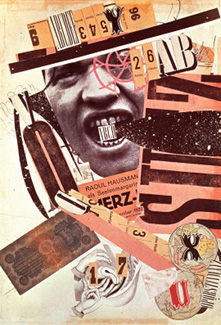
Raoul Hausmann ABCD (Self-portrait) Photomontage, 1923-24
In the German dominated cultural area of Central Europe, two artistic reactions to the incomprehensible carnage and destruction of the Great War emerged. At the Cabaret Voltaire in Zürich, a group of artists, many of them German exiles, were in 1916 the origin of a movement which came to be known as Dada. Dada was deliberately, almost despairingly provocative, one of the original group, Hans Richter, even describing it as “anti-art.” In retrospect it can be seen as an attempt to express the sensation of horror and loss of meaning and all moral foundation, all structure even, resulting from the experience of the war. Despite other possible etymologies, I personally prefer the explanation of the word “dada” as an expression of ultimate meaningless glossolalia. Dadadadadadadadadadada… But in German the word carries further connotations. Da in German means there. Dada is a kind of despairing showing, a pointing at the hopelessly shattered fragments of meaning, of decency, of sense; the rubble of everything governed and destroyed by the prevailing world order, acted out in the hopeless carnage of the trenches. There! And there! And there! And there! … Seen against this background, the frequent use of collage by Dada inspired artists takes on extra significance.


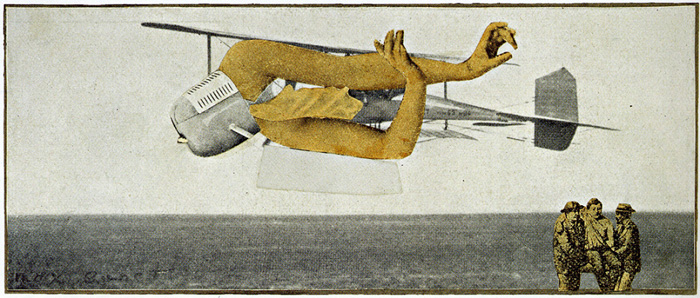
Max Ernst, Murdering Airplane, 1920
Dada was chaotic, unorganised, anarchic; it couldn’t be anything else. It was an outpouring of enraged creativity, not confined to art alone, but also finding expression in workshops and absurdist literature, like the writings of Kurt Schwitters (a good example is Anna Blume). As such it quickly surpassed itself; many of those who identified with it, such as Max Ernst, developing themselves further in Surrealism, which, at least partly, grew out of Dada.


Bauhaus building in Chemnitz
The Bauhaus movement also emerged as a reaction to the experience of the Great War, but took a very different direction – a new attempt to find meaning and order, to learn from the horrors of the war, to find an integrated approach to the individual and his/her place in society so that all the suffering would not have been in vain. The emphasis on form and structure is inevitable, given that Bauhaus was initially and primarily an architectural and design movement. Though its first leader, Walter Gropius, was non-political, many of those involved were left-leaning. Bauhaus was, by its own definition, radical: “The underlying idea of the Bauhaus, which was formulated by Walter Gropius, was to create a new unity of crafts, art and technology. The intention was to offer the right environment for the realisation of the Gesamtkunstwerk (total work of art). To this end, promising artists were to be taught in a school with an interdisciplinary and international orientation.”

Paul Klee, The Twittering Machine, 1922
Gropius and his successors, Hannes Meyer and Ludwig Mies van der Rohe, were at pains to involve various artists and craftsmen in the realisation of their concept and both Paul Klee and Wassily Kandinsky taught for years at the Bauhaus School in its successive homes at Weimar, Dessau and Berlin. Piet Mondrian, not unexpectedly, also lectured there. Identifying itself with the wider Modernist movement, the Bauhaus emphasised simplicity and functionality – an architectural and design expression of the “form follows function” aphorism, while not abandoning at any point a striving for aesthetic excellence. The interaction between art and design is well exemplified by Kandinsky, who taught both basic design for beginners as well as advanced theory at the Bauhaus during a period in which he himself was intensely exploring geometrical elements and relations in his own work.

The basic philosophy of the Bauhaus was humanist, egalitarian; it envisaged a cooperative equality of skilled workers, artists, artisans and architects, a democratisation of art, a demystification of design. This had political, revolutionary aspects, and there were many committed Marxists at the Bauhaus. But even without them, the whole direction of the movement was deeply suspicious to other, darker forces.

Ludwig Mies van der Rohe, The Brno Chair (1929-30)
On January 30 1933, Adolf Hitler became Chancellor of Germany. The Bauhaus was soon wound up, and in the following years most of its talent left the country. As did many of those who had been involved in Dada. For, although their reactions to the brutal lunacy of the First World War were in many respects antithetical, the attitude of the New Vandals who had taken control of Germany to them was essentially the same. According to the Nazis, both schools propagated entartete Kunst [degenerate art] and as such were subjected to bannings, persecution of those artists who had not left the Reich, and the destruction of some of their works.

Nonetheless, their legacies survived. The anarchic freedom, the celebration of apparent meaninglessness expressed by Dada bubbles up repeatedly ever since, exerting its spell on figures and movements as diverse as Josef Beuys, Ken Kesey and the Merry Pranksters, Malcolm McClaren and punk. The Bauhaus left a lasting influence on modern architecture ever since, as well as all sorts of areas of design. Just think about Scandinavian furniture – even that IKEA bookshelf you’ve got in your study. And, looking at the works of Andy Warhol, I like to think one can see the inspiration of both movements.

Note on the Title: Much as I would like to claim it as original, honesty forces me to admit that I first heard the phrase over twenty five years ago from my old friend, the philosopher Paul O’Grady, of Trinity College, Dublin.

The walrus was Paul
Pictures retrieved from: 
First image: Hannah Höch, Cut with the Dada Kitchen Knife through the last Weimar Beer Belly, 1919


Saturday, 26 May 2012

1987 - A Very Good Year?


In her latest post, my fellow blogger, Lisa Golden, asks the question, “Imagine 1987 as the future and not the shrinking image in the rearview mirror. What do you see?”

At first I thought I’d do the usual thing and post a comment. But as I started thinking about it, I realised that the question was just too good for that. And then I discovered that I didn’t really want to imagine that year, a quarter of a century ago, as the future, but rather remember it as it was then. And, instead of replying on Lisa’s blog, writing something about it here.

Although, when I think about it, I suppose I can remember it as the future if I just place myself in the me that was then, seeing in the New Year for the first time in Western Germany, watching the fireworks rising into the sky above the Rhine and Cologne Cathedral illuminating a snowy city, wondering what the year would bring, still marvelling at the amazing new life I had begun, only a few months earlier, to lead.

For in the previous year, fuelled by the irresistible, all-devouring power of falling head over heels, completely, totally in love, I had trashed all the certainties and goals of my life up till then, abandoning my life and existence as a Catholic priest to start a new life in a new country. We had dared to take the words of Bowie’s Absolute Beginners (one of the big hits of 1986 and one of the songs we used as the soundtrack for the perfect microcosm of our dramatic love story) literally, “As long as we’re together / the rest can go to hell,” and set up our love-nest in Heidelberg. We were visiting the Rhineland where Eva’s family lived for the holidays, which was why we were greeting the New Year 1987 in Cologne.

At the beginning of any year, nothing is fixed. Anything can happen – and most certainly will. Billions of stories, great and small, public and private, will begin, end, continue. Out of all this we each construct our own realities, our own stories, future flowing into present before becoming immutable past before the background of everything else which is happening.

What was the background of 1987? Musically, Madonna is travelling the world with the Who’s That Girl tour, Michael Jackson releases the album Bad, Whitney Houston is warbling that she wants to dance with somebody (who loves her)[i] and the film Dirty Dancing will be released, turning Patrick Swayze into an idol for untold millions of adolescent girls even beyond his death twenty two years later. Joss Stone and Kate Nash are born. Liberace dies (of AIDS). And, for me as well as millions of others, the music which still fills the role as soundtrack for that year is that of U2’s The Joshua Tree; “With or Without You,” “I Still Haven’t Found What I’m Looking For,” “Where the Streets Have no Name.” Like me, they too came from Ireland, I had seen them live years before when they were still learning to play. They had achieved heights on the Olympus of rock previously unimaginable for an Irish band. A symbol for me that year of the attainability of all kinds of unimaginable dreams.

But a year which also taught me about how reality can bite. An immediate, fundamental change happens. The few months of just enjoying freedom from all the constraints of my previous priestly church-bound existence, a time of idle meditation on what I might best do with the rest of my life comes to a sudden end. On New Years Day Eva tells me of her suspicion that she is pregnant. I am faced with the immediate reality of having to take on responsibility – for a child, and a wife, for we also decide to marry. Life becomes challenging, in some ways even threatening. Less than a year earlier, Chernobyl has exploded, spewing radioactive waste all over Europe, and there are lingering worries about the consequences for women who are becoming pregnant. Unfounded, as it happens, for most (apart from thousands in the vicinity of the reactor in the Ukraine) but the worry is there. And I’ve got to find a job, any job. There will be mouths to feed, and bills to pay. I’m in a foreign country, my command of the language is rudimentary, and employers aren’t exactly lining up to offer interesting, fulfilling, well-paid jobs to young ex-priests. The little bit of money I had has almost run out. Eva’s family will help us, but the luxury of taking time to find and orient myself has abruptly run out for me.

Luckily, Heidelberg is a major centre for the US Forces in Europe and they’re always looking for civilian employees who can speak and write English fluently. As a native of a European Community country, I have the same employment rights as a German in Germany, so there is no trouble there. And so, in March I start work as a Voucher Examiner at the 266th Theater Finance Company of the US Army.

It is strange how practical circumstances can change your attitude to things. Three years earlier, back in Ireland, I’d been marching in a huge demonstration, proudly carrying a Sandinista flag, against US foreign policy and militarism generally on the occasion of Ronald Reagan’s visit to Dublin. Now I was working for the man, and glad to have the job.

The Cold War was still – officially – going on, and my job was processing a tiny amount of the tonnes of paperwork involved in paying the bills caused by the thousands of US servicemen and women who were in Europe to protect us from the Evil Soviet Empire. But the thaw was on. Gorbachev had come to power in the USSR and he was a man, as Margaret Thatcher famously said, with whom one could do business. Reagan came to Berlin in 1987 and urged Mr. Gorbachev to “tear down this wall,” but later that year the two of them amicably made history by signing the INF Treaty. In the near but as yet unimagined future the Wall would come down, the Soviet Union disappear, and in the wake of the huge realignment in world politics, most US and NATO troops would leave Germany. But in 1987 it was still business as usual in divided Germany.

The work itself was soul-destroying – taking a pile of paper which had already been worked on by someone else, doing some more work on it, and then passing it on to the next person to process it further. At some stage, a little farther down the line, the bills actually got paid. The work environment was fascinating. We were three distinct groups; soldiers, US civilian employees (mostly relatives of soldiers) and German/European employees. You got used to having two currencies in your pocket, for the Coke machine only functioned with quarters, nickels and dimes. The Americans were paid in dollars, we got our wages in deutschmarks. Our conditions and duties at work were governed by German labour law, the Americans followed army rules. They worked on German public holidays, we had to turn up on the Fourth of July. They paid less taxes, we could send our kids to college without it beggaring us.

I got to know an amazing world; that of the US forces in Germany – a little bit of America, completely sealed off (for those who wanted it so) from the host country. In places like Patrick Henry Village you could live for years, shopping at the Commissary or the PX Store, buying your (American) car from an American import dealer, going to an American movie theatre or McDonalds, sending your kids to an American school, worshipping in an American church, without any contact with the wider world around you. I worked with people who had been in Germany for ten years and had never learned a word of German.

The radio was on in our office all the time, and it was US stations we listened to. That year, the major theme was Oliver North and the Iran-Contra Affair (given increasing rumours of Reagan’s Alzheimer, one joke going around at the time took Howard Baker’s famous Watergate question and amended it to, “What did the president forget and when did he forget it?”).

But outside Thompson Barracks where I worked, my life was becoming increasingly German. My command of the language was slowly improving and I was making new friends. In the course of all this I was also making a discovery which astounded me. As an Irishman, I had grown up speaking English and I would always have claimed that, behind my particular Irish conscious identity, my default cultural conditioning was that of the English-speaking, American-dominated cultural world; literature, music, film, TV. Yet the more I worked for and with Americans, the more I found myself identifying myself as a European. On some sort of profound level I felt that I had more in common with the Germans, to whose country I had come less than a year earlier and whose language I still spoke very badly, than with the Americans, with whom I shared a language and whose popular culture I felt completely familiar with, and at home in.

In retrospect, it probably had much to do with the fact that, in that year of 1987, I was finding and developing a new identity for myself, an identity built on my exciting new role as lover and husband and – most fundamentally – father. A real one this time, as opposed to the pointless honorific conventionally offered to Catholic priests, something I had never felt comfortable with.

Many famous people died that year; Andy Warhol, Rita Hayworth, Fred Astaire, John Huston and James Baldwin, to mention just a few. And, on a wonderfully sunny August morning, the last of the top Nazi elite, the sole inhabitant of Spandau prison in East Berlin, the sad, evil old bastard, Rudolf Hess, ended his sorry life by his own hand. On that day my daughter was born and I remember thinking, in the midst of my swirling, astounded joy and wonder, that this was a sign of some kind, the end of one ghastly chapter and the beginning of a new one, full of hope and endless possibility.

On that day in August 1987 I knew that my life had changed irrevocably. The future was, as always, unknown, but now it would contain this marvellous new life, completely dependent on my wife and me. That she would be joined by a sister was something I might perhaps have suspected then. That the love which had made me toss my life on its head and give rise to her very existence would prove unequal to the everyday challenges of life and time was something I could not have imagined. Yet that happened too.

All in the future then, the past now. Time is a river and it only goes in one direction. What an adventure! Or, in one of the best phrases The Grateful Dead ever coined, “What a long, strange trip it’s been.”

1987 … it was a very good year.


[i] Coincidence is sometimes frightening. The radio is playing in the background as I write this. Thirty seconds after typing this phrase, I hear the introduction to I wanna dance with somebody (who loves me) begin. Honestly! Life is strange indeed.


Pictures retrieved from:

Thursday, 22 March 2012

Around the World in 1762


Madame de Pompadour - Francois Boucher

It’s been quite a while since I warmed up the old time machine in the garden shed for a quick trip around the world. High time, therefore, to power up the motors, check the dials, make sure that all the screws and bolts are secure and take a look at the way things were. After all, any machine will rust up if it’s not used every now and again. We’ve already looked at 1810 and 1911. I thought this time we’d go a little further back, turning the main dial back a quarter of a millennium, to 1762.

The machine is programmed to follow the rising sun, so we begin over the Pacific. Though some European explorers have made contact with the various groups of Pacific islands, their influence has been small; indigenous Polynesian peoples still live their various diverse forms of life, largely undisturbed. The same can be said for Australia and New Zealand. This isolation will not, however, last much longer. Interest in the Pacific area is growing in Europe, and in six years time the Royal Society will send an expedition, under the command of James Cook – who in 1762 is charting the coasts of eastern Canada and Newfoundland – to observe the transit of Venus on Tahiti and explore large amounts of the New Zealand and Australian coastlines.

Japan is still a largely closed country, the Tokugawa Shogunate strictly controlling very limited trade with the gaijin western foreigners following the sakoku (“locked country”) policy. In China, the Manchus are at the height of their power, the Qianlong Emperor of the Qing Dynasty, who reigned for almost sixty years, almost until the end of the century, exercising control over an area more or less contiguous with the modern Peoples Republic. There is increasing trade with Europeans, particularly in tea, which is becoming ever more popular in Europe, especially in Britain and its colonies. The British and Dutch East India Companies are competitors in the tea business. The Portuguese maintain their trade colony in Macao, but it is in decline. Hong Kong is an unimportant island, inhabited by a few thousand fishermen and charcoal burners.

Farther south, however, Europeans are more present, the Spaniards controlling the Philippines and the Dutch firmly ensconced in what is now Indonesia. There is no love lost between the Protestant Dutch, on the one hand, and the Catholic Spaniards and Portuguese on the other, they have been rivals for lucrative trade and influence in Eastern Asia for a hundred and fifty years now.

Clive with Family - Joshua Reynolds
To the west, the Seven Year War, which is still raging in Central Europe, has taken on a global aspect with a world-wide struggle for power and influence between France and Britain having far-reaching consequences for India. By 1762, the British – in the form of the East India Company and its brilliant, ruthless military and administrative genius, Robert Clive – has managed to basically wipe out French influence in the subcontinent and to majorly expand its power (and profits) in the increasingly moribund Mughal (Mogul) Empire. It is no exaggeration to claim that the British Empire in India was basically founded in the 1750s and 60s.

Africa at this time is haemorrhaging people, both from the east and west coasts, in the ghastly form of slavery. A majority of the slaves have originally been captured by other Africans as a result of raids or wars – in East Africa they are sold to Arab traders who sell them on throughout the Middle East and the Orient; in West Africa it is the Europeans who have an insatiable thirst for labourers to use in their American colonies, above all in the Caribbean, where the vastly lucrative cultivation of sugar demands huge amounts of human workers for its brutally hard cultivation, harvesting and processing. By the middle of the 18th Century, the entire economies of islands like French Saint-Domingue (Haiti), Martinique and Guadaloupe and British Barbados and Jamaica are almost totally based on sugar, making vast profits for a small group of unbelievably rich sugar barons. But slaves from West Africa are also being shipped in their hundreds of thousands to Portuguese Brazil and the more southerly British colonies in North America, to work on the growing tobacco and cotton plantations.

Europe is at war, though the Seven Year War is winding down and will end next year. On the continent, the major struggle is between Prussia, supported by Britain and some other German allies, on the one side, and France, Austria and Russia on the other. After initial serious setbacks, Frederick the Great of Prussia has basically fought the Austrians and Russians to a standstill – the borders following the end of the war will show few differences to those at the beginning. The struggle between France and Britain rages globally, with the French suffering major losses in India and, above all, Canada. As such, the Seven Year War can reasonably be called the first real World War. Though the short-term costs for Britain are high, the war definitively establishes Britain as one of the foremost world powers. But the administration of global empires frequently involve difficult policy decisions and some of those made by Britain with relation to her American colonies (particularly taxation policies and the prohibition of settlement west of the Appalachians) will have fateful consequences.

Europe and its colonial offspring in the Americas have already begun to cast a longer shadow, one which will grow to dominate the entire globe, for better or worse, in the next two hundred and fifty years, and as such demand our particular attention. It is the century of absolutism, where kings and emperors believe in their divine right to rule and rule accordingly (with the exception of the eccentric Britons, who had severely restricted the power of their monarch to the advantage of Parliament at the end of the 17th Century). But it is also the Century of the Enlightenment, where great minds in Europe and America are thinking about humanity and society in new and radical ways and reaching radical conclusions. In 1762 Jean-Jacques Rousseau publishes two of his most influential works, Emile and The Social Contract. David Hume, in his dry, somewhat cynical art, has managed to call almost everything into question. Voltaire is one of the most admired figures in Europe and has even spent a number of years in Berlin, at the invitation of the Prussian monarch, Frederick the Great – though they soon fell out. For, though the monarchs believed in their absolute right to rule, many of them were open for the ideas of the new thinkers of the Enlightenment – ideas like tolerance and rationality. The Empress Elizabeth of Russia, who dies at the beginning of the year, takes pride in the fact that not a single Russian has been executed during her twenty year reign.

Though it is a time where women are regarded, almost universally, as inferior to men, in 1762 women are in charge of some of the most powerful empires in the world. Elizabeth will be succeeded this year, after a few months of rule by her son, Peter III, by her daughter-in-law, the German born Catherine the Great. The Austrian Empire is ruled by the firm hand of Maria Theresa. And even in France, where the king is Louis XV, it is no secret that the real power behind the throne is his mistress, Madame de Pompadour.

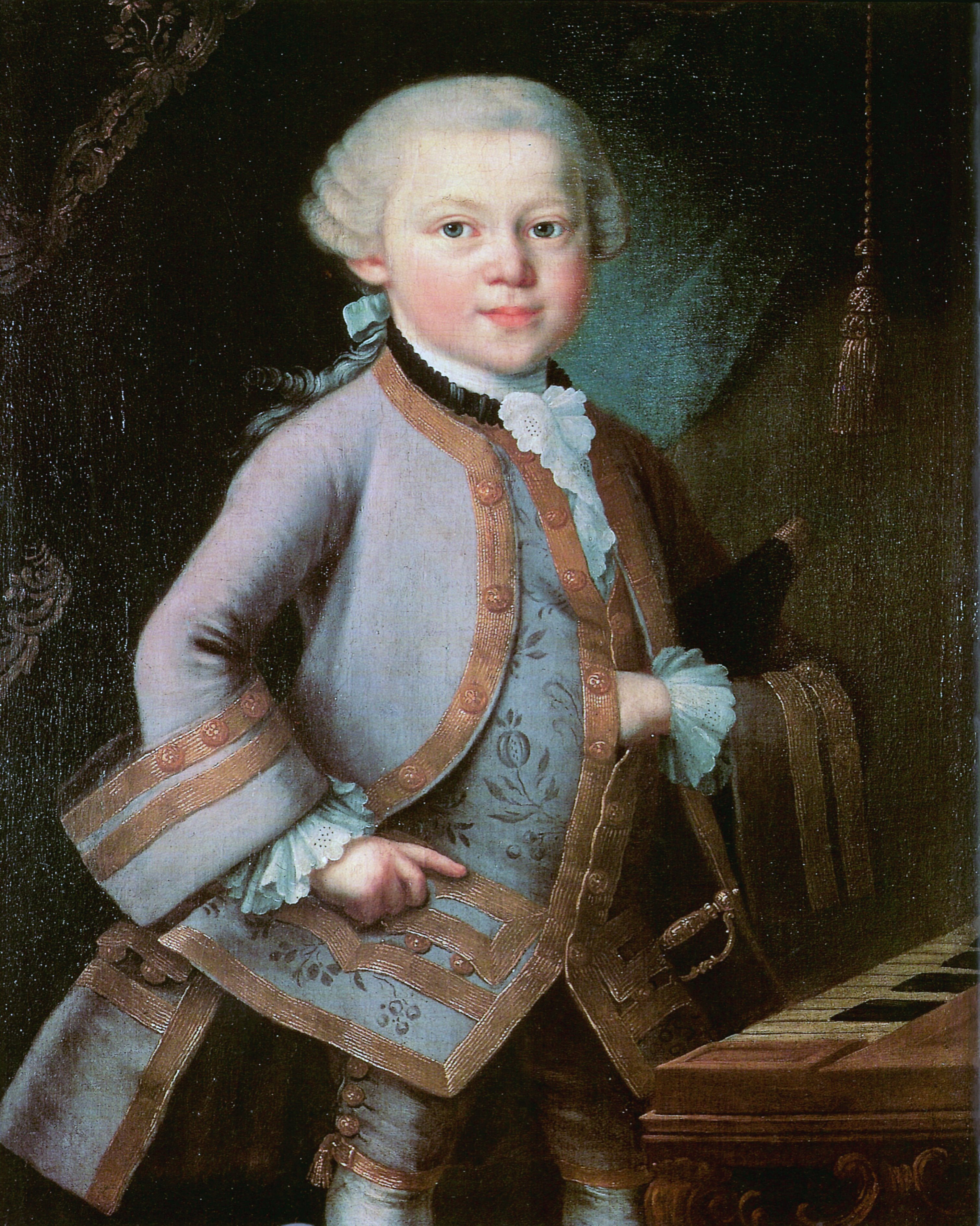
The young Mozart
In art, it is a period where, it seemed, everyone who was anyone wanted to have their portrait painted – if you had enough money, you could visit London and have your image preserved for eternity by Joshua Reynolds or Thomas Gainsborough. In music, a golden age is dawning. Joseph Hayden, who has just become Kapellmeister to the immensely wealthy Esterházy family, will write his 9th Symphony. In Salzburg Leopold Mozart, having discovered that his daughter, Nannerl, and especially his six-year-old son, Wolfgang, are musically gifted, has resolved to use their talents to secure his family fortunes and will embark with them this year on a musical tour of Europe. The Jackson Five of classical music.

While South and Central America remain under Spanish or (in the case of Brazil) Portuguese control, Britain, with the enthusiastic help of its colonists, has succeeded in throwing France out of most of North America. Wolfe’s defeat of Montcalm at the siege of Quebec in 1759 paved the way for British sovereignty over Canada. But the high costs of the war would lead Britain to increase taxation in its American colonies. In so far as the British felt obliged to justify this at all, they argued that the colonists were the ones who had benefited most from the victory, saved as they were from the undoubted horrors of French rule. But the one great advantage the colonists had hoped for, the right to expand westwards beyond the Appalachians, was denied to them by their British overlords, who had given the native tribes (many of whom had allied themselves with the French in the war) assurances that there would be no white settlement in Trans-Appalachia. The seeds of the American Revolution were sown, seeds which would be watered by the ideas of the Enlightenment. And practical experience in the French and Indian War (as the Seven Year War was known in America) was also significant for the future – one of the major American military talents to cut his teeth in the conflict was the young Virginian, George Washington.

But for all the sprouting ideas of the Enlightenment, all the signs of the changes still to come, life, for most of the world population in 1762 (around 850 million), goes on as it had always done. Most people still wrestle an uncertain, insecure life from the land, are illiterate (or poorly educated at best), living often short lives of brutally hard work, sickness, hunger, exploitation at the hands of the rich and powerful, and often violent death. In Britain, the transformation which will become known as the Industrial Revolution has already begun; in two years time James Hargreaves will build his first Spinning Jenny and the new “Factory System,” where relatively lowly skilled workers are gathered in larger numbers to use increasingly complex technology to produce large quantities of manufactured products, is starting to make a mark in various areas of production. One of the most successful early entrepreneurs to make his name and fortune in this manner, is the pottery manufacturer, Josiah Wedgewood (the grandfather of Charles Darwin), who set up the first true pottery factory near Manchester in the 1750s. But the widespread growth of new, immensely more productive methods of production– as well as political and many other changes – which will transform the world, are still a few decades in the future.


Pictures retrieved from:

Tuesday, 21 February 2012

The Nineties - A Golden Age?


The course of human affairs is constant, chaotic and – initially at least – without structure. Only as events recede into the past do we start to identify patterns, to see stories with beginnings, middles and endings, to impose structure and meaning on the raw mass of events which are continually occurring. And even these structures are continually changing; both as stories continue to develop and be told, and as our particular concerns and preoccupations colour the way we create and recreate the structures of meaning we call history.

There is a general historical convention that around thirty years should have elapsed before historians apply themselves to material to “write” history. As far as I can ascertain, this convention (which I encountered when I was studying history) has much to do with the so-called Thirty Year Rule, which legally stipulates in Great Britain, Ireland and Australia, that cabinet records are generally kept confidential for thirty years before being made available to scholars and the general public. But we live in a world where the rate of change has become ever faster, and the amount of information available ever greater, and so – in many cases – there seems to be an increasing willingness to compress this period.

Recently, I have increasingly come across articles on-line which deal with The 90s. It has long been a convention to try to characterise history according to the completely arbitrary framework of the decimal divisions of our conventional recording of time; and decades which seemed to be particularly noteworthy (as decades) have even picked up special sobriquets, be they the Roaring 20s or the Swinging 60s. Still, I will admit to a certain feeling of unease when I see people dealing with the last decade of the past century as a rounded-off period of history. This feeling is a purely subjective one and has, I think, largely to do with the realisation that I am getting older and that periods which I lived through as an adult and which (to me) still seem very recent are, for those a couple of years (or decades) younger than me, as remote as the 60s of my childhood are for me. No sooner have I been forced to accept that, for the young people of today, the 80s are so incredibly long ago – I remember a comment my daughter (disparagingly) made a few years ago watching some film or other, “My God, that’s so eighties!” – now I am expected to do the same with the 90s.

Yet, as a specific period in history, “the 90s” can actually be pretty accurately defined as a particular historical period with a clear beginning and an even clearer ending, even if these are placed a little outside the chronological decade. They began on November 9, 1989, with the Fall of the Berlin Wall and ended on September 11, 2001, with the Fall of the Twin Towers. It was a decade of optimism, of feel-good, of the peace dividend, and the end of the bi-polar conflict which had had the world quaking under the fear of Mutually Assured Destruction since of the end of WWII.

It was, for my generation, a decade with loads of “the future is now” experiences. I remember Bob Dylan commenting on Bill Clinton’s election with some bemusement that he was now older than the president and, indeed, he went along to play “Chimes of Freedom” at Clinton’s inauguration – along with Fleetwood Mac belting out “Don’t Stop Thinking about Tomorrow at the inaugural ball. Come to think of it, Michael Jackson was there too and, hell, Clinton played saxophone for Chrissakes. A few years later, Tony Blair was elected UK prime minister – and he admitted to having played electric guitar in a garage band.

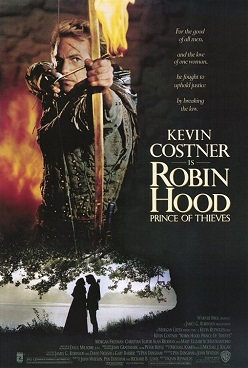
All of these 90s feelings came back to me forcibly  recently when I heard of the death of Whitney Houston. Though her career began in the eighties, it was the film, The Bodyguard, which made her fame undying worldwide, particularly with the song “I Will Always Love You.” And thinking of that film brought me to Kevin Costner, another man who made it big in the nineties. And thinking of Kevin Costner brought me to his version of Robin Hood: Prince of Thieves (1991). The film is overacted and relies in many places on a strong dose of melodramatics but it also has a lightness, almost naïve whimsicalness about it, a deep optimism that everything will work out in the end (which it does, with Sean Connery turning up as Richard Lionheart to bless Robin’s marriage to Marion), which is quintessentially nineties. The film also features a show-stealing performance by Alan Rickman as the wonderfully evil Sheriff of Nottingham, who gets the best lines of the movie

“Just a minute. Robin Hood steals money from my pocket, forcing me to hurt the public, and they love him for it? That's it, then! Cancel the kitchen scraps for lepers and orphans, no more merciful beheadings, and call off Christmas!”

The essential optimism of the 90s, I believe, was a consequence of the collapse of Soviet dominated communism at the end of the 80s. Today, nearly a quarter of a century later, it is easy to forget just how unbelievable this was – and how sudden. In October 1986, the agreement in principle between Reagan and Gorbachev in Reykjavik over the reduction of intermediate nuclear weapons in Europe was regarded with amazement by the world; three years later the Berlin Wall fell, a year after that Germany was reunited, and a year later the Soviet Union ceased to exist. The shadow of the bomb – a continuous reminder of the complete precariousness of human existence on the planet for forty years – disappeared. Truly, the horse had learned to sing, and the song was American. Operation Desert Storm continued the theme and showed that the US could be the global policeman, impressively kicking Iraqi ass and taking names. Moves towards greater European union took place, with the European Community renaming itself Union, welcoming Austria, Sweden and Finland as new members, and making the final preparations for the introduction of a common currency.

Windows 3.0
The digital revolution was gathering speed. While PCs (and Macs) had already been spreading throughout the 80s, in the 90s they finally became a fixture in the majority of the households in the developed world. The internet exploded and by the end of the decade, most of us had mobile phones. The DVD arrived and began to kill VHS. Whereas at the beginning of the decade using a PC was a complicated nerdish business, involving knowing your way around the frustrating vagaries of DOS or cursing a frequently crashing Windows 3.0, by the time Bin Laden’s maniacs were crashing the hijacked planes into the World Trade Center Windows XP had just come on the market.

Of course, whether you experienced the 90s as a Golden Age or not is very much determined by who you were and where you lived. While, for much of the world, things seemed much better in 1995 than they had in 1985, there were gruesome exceptions – Yugoslavia, for example, or Rwanda. And there were those who famously didn’t survive the decade, from Kurt Cobain to Princess Diana.

The Golden Age was, at any rate, doomed. Although the transition to the new millennium went smoothly and the Y2K panic proved unwarranted, the party was coming to an end. In 2000 the Dot-Com Bubble burst and with 9/11 everything changed. Openness, optimism and feel-good were suddenly, catastrophically replaced with defensiveness, paranoia and the War on Terror. We are still living with the consequences.


Pictures retrieved from:

LinkWithin

Related Posts Plugin for WordPress, Blogger...