Ideas, philosophy, politics, current events and happenings, music, literature, art and simple incidents out of my everyday life; Reflections and observations which, I hope, might just get you thinking ...
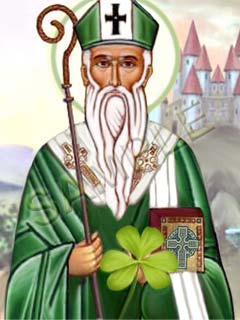
The top o’
the mornin’ to ye! Begorrah, bedad, an’ bejaysus, sure isn’t it a grand day and
all for us to be celebratin’ the feast of our own glorious Saint Patrick, it
bein’ fifteen hundred and eighty years since he arrived on the misty green shamrock
shores of the dear auld emerald isle, wavin’ his bishop’s crozier to banish the
snakes and bring the benighted pagan Oirish into the bosom of God’s holy church?
Is that
enough stage-Irishness for you? Enough Paddywhackerry? Will you wear the green
today, go off to watch or even march in the parade and get all tipsy and
lachrymose on green beer, Guinness or whiskey (always to be spelled with an “e”)?
In Germany, where I live, St. Patrick’s Day barely
causes a blip on the radar screen, apart from parties organised in the Irish
Pubs, one of Ireland’s
most successful modern cultural exports, which can be found in nearly every
middle-sized town. There’s a street in the Altstadt
of Düsseldorf which has three of them, one being a gay pub. And speaking of
gays, as far as I know, the Ancient Order of Hibernians, organisers of the New York parade, still don’t allow openly LGBT
organisations to take part. They would do better to recall the great Irish
bisexual, Oscar Wilde, and honour his memory.
Contradictions.
Insofar as national stereotypes are valid at all, the Irish are nearly as full
of them as the stereotype neurotic New York Jew. There is a kind of deep
insecurity at the heart of the Irish character, born of an unholy conjunction
of colonial oppression and Catholic guilt. And even these further stereotypes
are themselves contradictory. For while there is no doubt that the “native
Irish” were exploited, oppressed, discriminated against, killed and starved in
their millions by the more powerful English between the 17th and the 19th Centuries,
at the same time there was much of what was Irish which contributed to the
growing identity of Britishness during
that period, and – particularly in the 19th Century – there were many Irish
people who were as comfortable with the dual identity of Irish and British as most
Scots and Welsh are today (and, indeed, in the 20th Century, hundreds of
thousands of Irish immigrants in Britain who have adopted a British identity,
while retaining, to various degrees, a sense of their original Irishness).
Then there’s
Catholicism. Similar to the Poles, religious separateness developed in Ireland as a
defining national characteristic in reaction to English acceptance of the
Reformation. Because the English
became Protestant, it became a part of Irish self-definition to be Catholic
and, the more being Catholic became a criterion for discrimination and
persecution, the more stubbornly the Irish clung to it. Yet parallel to all
this, most serious Irish nationalist thinkers retained a strong sense that
being Catholic was not synonymous
with being Irish and a large number of those who developed and espoused ideas
of Irish separatism were Protestant, from Jonathan Swift to Wolfe Tone, Charles
Stewart Parnell to Oscar Wilde, W.B. Yeats to Douglas Hyde (independent Ireland’s
first president).
But
Catholicism remained a major part of the Irish identity, for many the defining
component. The decades of national trauma following the disaster of the great
potato famine in the middle of the 19th Century coincided with a restructuring
of the Catholic Church worldwide along strict, all-encompassing,
highly-structured lines, defining itself sharply in contrast to the ever more
pervasive ideas of the Enlightenment, politically expressed in the American and
French Revolutions. The result, in Ireland, was a particularist
Nationalist culture, whose religious component offered an extra reason to
reject everything British as being a product of obdurate heretic Protestantism,
whose adherents were, basically, damned by God to eternal hellfire. And it was
a variety of often joyless Catholicism which defined much of modern life and
what it had to offer as “occasions of sin” (most particularly in relation to
anything to do with sexuality) and stoked the subconscious Freudian fires of
guilt with rigorous efficiency, while at the same time allowing for frequent,
ghastly violence, abuse and hypocrisy. To anyone who would dispute this
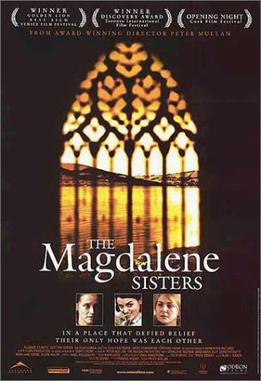
interpretation, I simply recommend watching Peter Mullen’s 2002 film, The Magdalen Sisters, the basic accuracy of which, as far
as I know, nobody has been able to call into question.
According to my researches, the words of this
most popular of hymns to St. Patrick – and one which I learned in my earliest
schooldays – were penned by a Sister Agnes in 1920. The “heretic throng” she
refers to was, for the Irish Catholics of the time, clearly Protestant. Historically,
of course, the Patrick who spread the Christian message in Ireland in the fifth Century
(whichever one of them you take, most historians believe there were at least
two of them!) had nothing to do with heretics,
as those against whom his words were strong were pagans, but that wasn’t
important. As a child I was certain – for so I was taught – that Patrick was a
Catholic. The fact that the Protestant Church of Ireland also reveres St. Patrick
as its founder and that one of its two major cathedrals in Dublin is named after him didn’t matter. As
far as we were concerned, those cathedrals were rightfully Catholic anyway, and
had been robbed from us by the Protestants during the Reformation. The fact
that Patrick was most probably an Englishman, bringing a foreign religion whose
basic goal was to extirpate the cultural uniqueness of the native Irish druidal
religion, was never presented in these terms and much was made of the remote
possibility that the young Romanised Patrick, who had been captured as a slave
by Irish pirates and brought to Ireland to herd pigs, in fact came from a
settlement on the northern coast of Gaul.
When the Irish Free State became independent in
1922, the predominant ethos became that narrow Catholic definition of Irish
identity – a development accelerated by the fact that the great majority of the
Protestants on the island lived in the province
of Ulster, most of which remained
British as Northern Ireland.
The new state was over 90% Catholic and for the rest of the 20th Century,
the small Protestant minority declined ever further. And that narrow
exclusivist understanding of national identity contributed to a withdrawal on
many levels from the wider world, contributing even to a declaration of
neutrality during World War II. In that atmosphere of righteous isolation, it
was possible to cultivate further the national neurotic mythology of persecuted
specialness, doomed to suffering, mediocrity and failure by centuries of
foreign political, economic and religious oppression.
Even during my childhood it was showing cracks,
under assault from (far too slowly) growing prosperity, rock and roll,
television and the insistent spiritual “pollution” from a more open, exciting
wider world. The Church itself was undergoing its own revolution as a result of
Vatican II. From the beginning of the nineties up to a couple of years ago, the
roaring of the Celtic Tiger seemed to have been systematically banishing the
last vestiges of the old, limited, outdated, claustrophobic national identity
to the scrapheap of history.
The Celtic Tiger was so enthusiastically,
exaggeratedly embraced by the Irish, perhaps, because it offered a new
possibility for self-definition. It certainly ultimately led to a kind of
collective unreal hubris, and the throwing out of a number of babies with large
amounts of undoubtedly filthy bathwater. All this made the crash, when it
inevitably came a few years ago, all the more bitter.
But for all the flaws in the current rescue
strategies, and all the suffering the Irish people are currently going through –
much of it unnecessarily demanded by a corrupt, twisted, global finance mafia –
there is no going back to the old, narrow, neurotic nationalism. That mould, at least, has been broken
forever. The Irish who celebrate their national holiday today are undoubtedly
more sombre, thoughtful, self-questioning than those of a decade ago. But they
are also more mature.
The (Protestant) Irish rebel leader, Robert Emmet, executed in 1803, made a famous last
speech, which became part of the sacred scriptures of Irish nationalist
republicanism. He finished by saying
“Let no man write my epitaph; for as no man who
knows my motives dare now vindicate them, let not prejudice or ignorance,
asperse them. Let them and me rest in obscurity and peace, and my tomb remain
uninscribed, and my memory in oblivion, until other times and other men can do
justice to my character. When my country takes her place among the nations of
the earth, then and not till then, let my epitaph be written. I have done.”
Today, I
would argue, his country has indeed taken her place among the nations of the
earth – no better, but certainly no worse, than most of the others. His epitaph
can be written, has, indeed, been written in the course of Irish history since
his death, and particularly in the past fifty years, long after notional
political independence was achieved.
Happy Saint
Patrick’s Day! Be proud to be Irish, because today is the day we allow everyone
worldwide to share our identity – with all its flaws and glories J.
Growing up as I did in Sligo, in the north west of Ireland, it was impossible not to come into contact with W.B. Yeats. Although Yeats was not born in Sligo, he always regarded it as his real, spiritual home, his “country of the heart” as he called it. Sligo has proudly described itself since the poet’s death as “the Yeats country” and as boy I was constantly reminded of him. I know where Wandering Aengus’s Hazel Wood is and have played in the SallyGardens, I have visited Dooney Rock, where the fiddler played, and looked out at the wooded islands in Lough Gill and wondered which one he decided to call Inishfree. I know Glencar Waterfall, that place of “the waters and the wild” where you can find a refuge from a world “more full of weeping than you can understand.” And towering above everything, as spectacular in its own way as TableMountain over Cape Town, “bare Benbulben’s head,” on whose slopes in Drumcliffe Churchyard the poet’s remains now peacefully “cast a cold eye on life, on death,” dominates the skyline.
Benbulben
Give the starting phrase, “I will arise and go now …” to anyone from Sligo and they will go on to recite “The Lake Isle of Innishfree,” although some, depending perhaps on the amount of alcohol they have consumed, may give you versions you have never heard before – the most common continuing, “… and go to feed the ducks…,” the rhyming couplet ending with a common, if somewhat coarse expression of indifference. Despite the genuine deep love and pride (after all, his Nobel medal can be seen in the local museum) that Sligonians have for Yeats, he was never truly one of them, being a member of the “quality,” that strange tribe of protestant Anglo-Irish Ascendancy who dominated Ireland up to the middle of the 19th Century and who have almost disappeared today, finally fading away in ostentatiously Catholic (parochial) independent Ireland. An inevitable extinction in the Ireland’s post-colonial aftermath perhaps, given all the enmity that had gone before but, in another sense, a loss of a group which gave Ireland culturally so much, from Swift, Goldsmith and Wilde to Shaw and Beckett (the last two also Nobel laureates). Yet Yeats always regarded himself as Irish and served two terms in the Senate of the new independent Irish Free State in the 1920s.
Because of (perhaps even despite) my Sligo background, I have always had a deep respect and wonder for Yeats’ poetry; a sublime distillation of aesthetic beauty, contemporary comment and intellectual depth. He is a writer whose work, always good, continually improved and developed as he grew older. He has the ability to continually grab you with a phrase or a couplet, leaving the image resonating deeply in your mind. Here are some of the greatest:
“…But I, being poor, have only my dreams; I have spread my dreams under your feet; Tread softly because you tread on my dreams.”
(He wishes for the Cloths of Heaven, 1899)
“…Those that I fight I do not hate Those that I guard I do not love;…”
(An Irish Airman Foresees his Death, 1917)
“…All changed, changed utterly: A terrible beauty is born.”
(Easter 1916, 1921)
Sailing to Byzantium (1928) can lay claim, in my view, along with Eliot’s Prufrock and Ginsberg’s Howl!, to be one of the greatest poems in the English language in the 20th Century. It is a deep meditation on ageing and maturing, written when Yeats was 63, on the progress from action and doing in youth to introspection and spiritual searching as one grows older; a reflection on the possibility and meaning of mortality and immortality. Its centre is the appeal for liberation from an ageing body:
“…Consume my heart away; sick with desire And fastened to a dying animal It knows not what it is; and gather me Into the artifice of eternity.”
Although one can perhaps note that ten years later, his last poem, The Circus Animals’ Desertion, (1938) expresses a more pessimistic, less hopeful view,
“…Now that my ladder's gone, I must lie down where all the ladders start In the foul rag and bone shop of the heart.”
Sailing to Byzantium is a poem which culturally resonates today as deeply as ever. Its opening phrase, “That is no country for old men …” was taken by Cormac McCarthy as a title for his 2005 novel, filmed by the Coen brothers in 2007.
But Byzantiumis not the only poem which still speaks powerfully nearly a hundred years later now. One other above all serves as a seer’s vision of the horrors which the 20th Century would bring. The Second Coming (1919) is a masterpiece of brooding, prophetic apprehension:
“…Things fall apart; the centre cannot hold; Mere anarchy is loosed upon the world, The blood-dimmed tide is loosed, and everywhere The ceremony of innocence is drowned; The best lack all conviction, while the worst Are full of passionate intensity.”
No wonder that this poem, with its final couplet, a packed image which could serve to inspire a Stephen King novel (and King, in fact, quotes the poem in his apocalyptic The Stand, 1978), was frequently quoted in the aftermath to 9/11.
“…And what rough beast, its hour come round at last, Slouches towards Bethlehem to be born?”